

Beans, baked, canned, plain or vegetarian
Whole food · Legumes and Legume Products
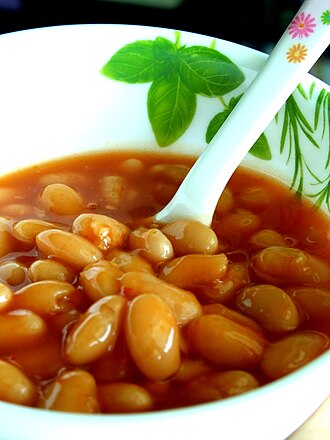
Photo: Wikipedia
Canned baked beans are tender navy beans slow-cooked in a sweet, savory tomato sauce, offering a soft, creamy texture with a comforting, slightly smoky flavor. They are a convenient, shelf-stable staple packed with plant-based protein and fiber, making them a hearty and nutritious quick meal or side.
Calorie split: 18% protein · 79% carbs · 3% fat
↓ Full nutrition💚 Why it's loved
People adore baked beans for their perfect balance of sweet and savory flavors and their incredible versatility—they're equally at home on a breakfast plate, as a barbecue side, or mixed into a casserole. In many cultures, they are a nostalgic comfort food, evoking memories of family meals and cookouts.
⚠️ Watch-outs & how to enjoy it better
Canned varieties can be high in added sugars and sodium, which may concern those monitoring blood sugar or blood pressure. To mitigate this, rinse the beans thoroughly under water to reduce sodium by up to 40%, and pair them with a source of protein (like eggs or cheese) or healthy fat (like avocado) to slow sugar absorption.
Key benefits
- Excellent source of plant-based protein and dietary fiber
- Supports digestive health and promotes satiety
- Rich in essential minerals like iron and folate
- Low in fat and cholesterol-free
- Provides a quick, balanced energy source
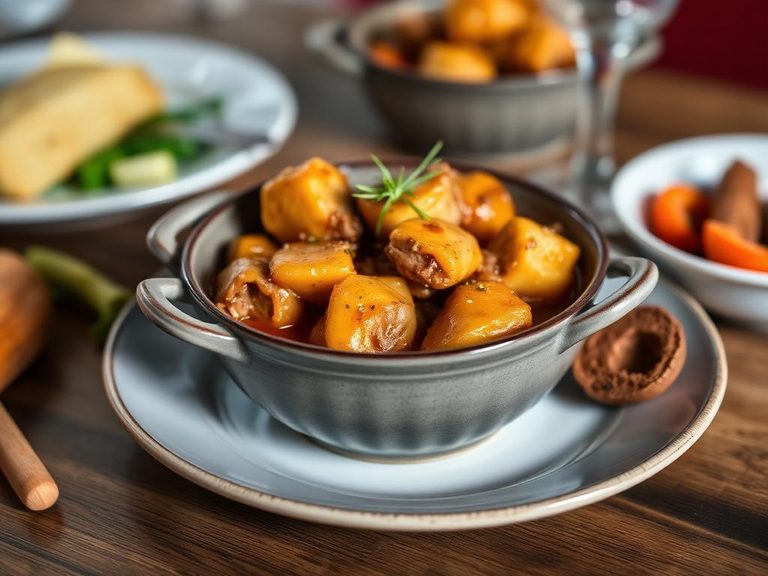
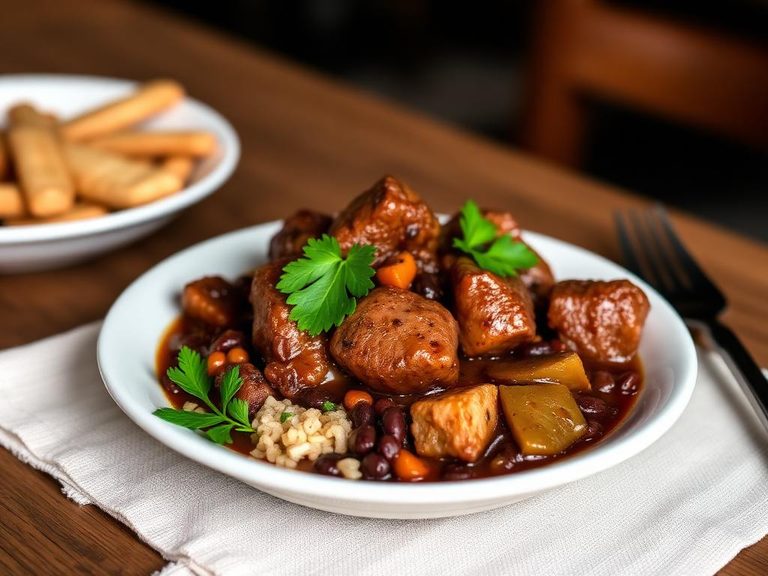
🍽️ Popular dishes

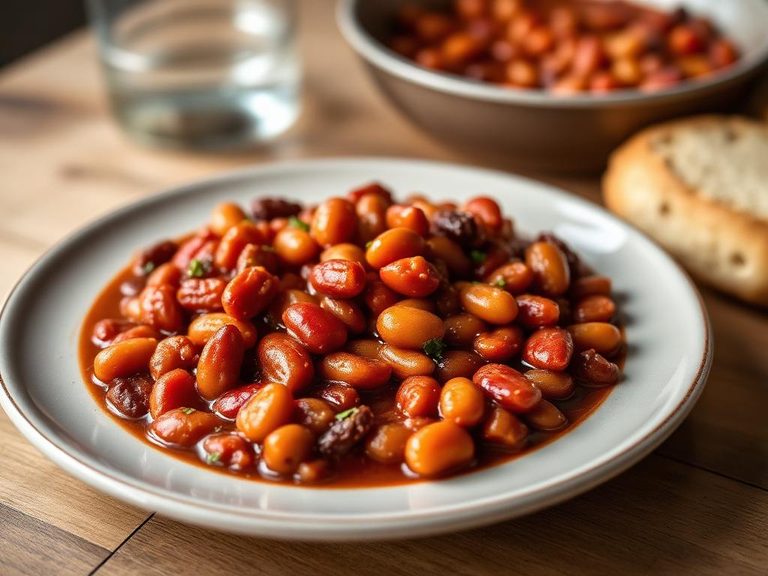
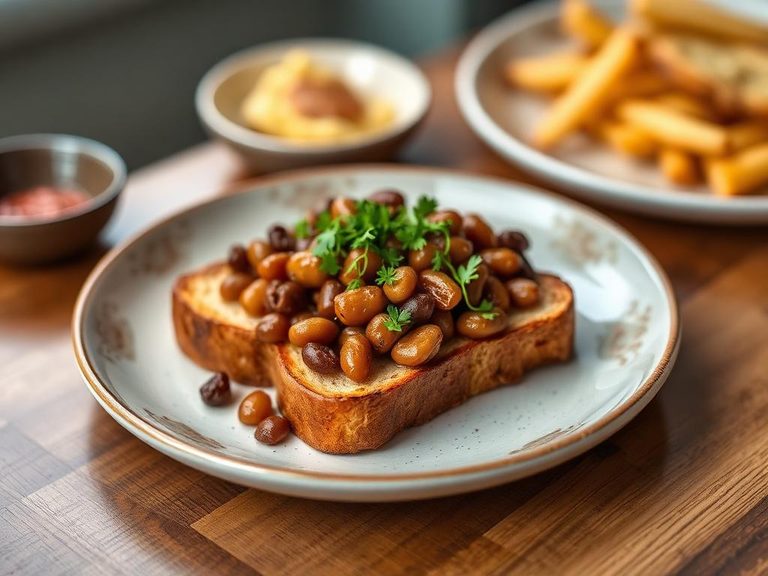
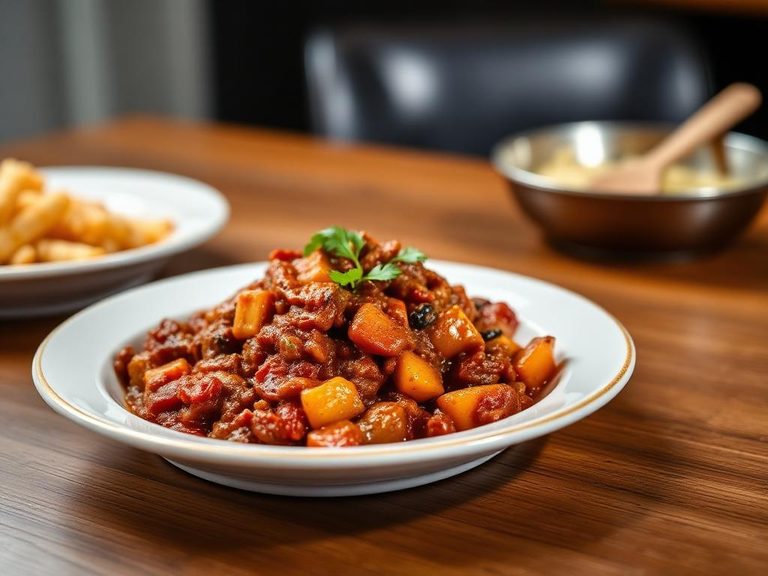
🌍 Where it's eaten
💡 Did you know?
The tradition of baking beans with molasses or sugar in North America was likely influenced by the Native American practice of slow-cooking beans with maple syrup and bear fat long before European settlers arrived.
Full nutrition (USDA data · scales with serving)
| Water | 72.0 g |
| Energy | 94.0 kcal |
| Energy | 393 kj |
| Protein | 4.8 g |
| Total lipid (fat) | 0.37 g |
| Ash | 1.8 g |
| Carbohydrate, by difference | 21.1 g |
| Fiber, total dietary | 4.1 g |
| Total Sugars | 8.0 g |
| Sucrose | 4.8 g |
| Glucose | 1.6 g |
| Fructose | 1.6 g |
| Lactose | 0.00 g |
| Maltose | 0.00 g |
| Galactose | 0.00 g |
| Starch | 7.4 g |
| Calcium, Ca | 34.0 mg |
| Iron, Fe | 1.2 mg |
| Magnesium, Mg | 27.0 mg |
| Phosphorus, P | 74.0 mg |
| Potassium, K | 224 mg |
| Sodium, Na | 343 mg |
| Zinc, Zn | 2.3 mg |
| Copper, Cu | 0.14 mg |
| Manganese, Mn | 0.11 mg |
| Selenium, Se | 5.0 ug |
| Vitamin C, total ascorbic acid | 0.00 mg |
| Thiamin | 0.10 mg |
| Riboflavin | 0.04 mg |
| Niacin | 0.43 mg |
| Pantothenic acid | 0.22 mg |
| Vitamin B-6 | 0.08 mg |
| Folate, total | 12.0 ug |
| Folic acid | 0.00 ug |
| Folate, food | 12.0 ug |
| Folate, DFE | 12.0 ug |
| Choline, total | 31.5 mg |
| Betaine | 0.10 mg |
| Vitamin B-12 | 0.00 ug |
| Vitamin B-12, added | 0.00 ug |
| Vitamin A, RAE | 5.0 ug |
| Retinol | 0.00 ug |
| Carotene, beta | 65.0 ug |
| Carotene, alpha | 0.00 ug |
| Cryptoxanthin, beta | 0.00 ug |
| Vitamin A, IU | 108 iu |
| Lycopene | 511 ug |
| Lutein + zeaxanthin | 16.0 ug |
| Vitamin E (alpha-tocopherol) | 0.15 mg |
| Vitamin E, added | 0.00 mg |
| Tocopherol, beta | 0.00 mg |
| Tocopherol, gamma | 0.71 mg |
| Tocopherol, delta | 0.05 mg |
| Tocotrienol, alpha | 0.00 mg |
| Tocotrienol, beta | 0.00 mg |
| Tocotrienol, gamma | 0.00 mg |
| Tocotrienol, delta | 0.00 mg |
| Vitamin D (D2 + D3), International Units | 0.00 iu |
| Vitamin D (D2 + D3) | 0.00 ug |
| Vitamin K (phylloquinone) | 0.80 ug |
| Vitamin K (Dihydrophylloquinone) | 0.00 ug |
| Alcohol, ethyl | 0.00 g |
| Caffeine | 0.00 mg |
| Theobromine | 0.00 mg |
Fat & fatty acid profile (per 100g)
| Fatty acids, total saturated | 0.07 g |
| SFA 4:0 | 0.00 g |
| SFA 6:0 | 0.00 g |
| SFA 8:0 | 0.00 g |
| SFA 10:0 | 0.00 g |
| SFA 12:0 | 0.00 g |
| SFA 13:0 | 0.00 g |
| SFA 14:0 | 0.00 g |
| SFA 15:0 | 0.00 g |
| SFA 16:0 | 0.05 g |
| SFA 17:0 | 0.00 g |
| SFA 18:0 | 0.02 g |
| SFA 20:0 | 0.00 g |
| SFA 22:0 | 0.00 g |
| SFA 24:0 | 0.00 g |
| Fatty acids, total monounsaturated | 0.10 g |
| MUFA 14:1 | 0.00 g |
| MUFA 15:1 | 0.00 g |
| MUFA 16:1 | 0.00 g |
| MUFA 17:1 | 0.00 g |
| MUFA 18:1 | 0.03 g |
| MUFA 18:1 c | 0.07 g |
| MUFA 20:1 | 0.00 g |
| MUFA 22:1 | 0.00 g |
| Fatty acids, total polyunsaturated | 0.12 g |
| PUFA 18:2 | 0.06 g |
| PUFA 18:3 | 0.01 g |
| PUFA 18:3 n-3 c,c,c (ALA) | 0.05 g |
| PUFA 18:3 n-6 c,c,c | 0.00 g |
| PUFA 18:4 | 0.00 g |
| PUFA 20:2 n-6 c,c | 0.00 g |
| PUFA 20:3 | 0.00 g |
| PUFA 20:4 | 0.00 g |
| PUFA 20:5 n-3 (EPA) | 0.00 g |
| PUFA 22:5 n-3 (DPA) | 0.00 g |
| PUFA 22:6 n-3 (DHA) | 0.00 g |
| Fatty acids, total trans | 0.00 g |
| Fatty acids, total trans-monoenoic | 0.00 g |
| TFA 18:1 t | 0.00 g |
| Cholesterol | 0.00 mg |
Amino acid profile (per 100g)
| Tryptophan | 0.05 g |
| Threonine | 0.15 g |
| Isoleucine | 0.23 g |
| Leucine | 0.41 g |
| Lysine | 0.30 g |
| Methionine | 0.05 g |
| Cystine | 0.04 g |
| Phenylalanine | 0.27 g |
| Tyrosine | 0.12 g |
| Valine | 0.26 g |
| Arginine | 0.23 g |
| Histidine | 0.13 g |
| Alanine | 0.20 g |
| Aspartic acid | 0.63 g |
| Glutamic acid | 0.80 g |
| Glycine | 0.19 g |
| Proline | 0.24 g |
| Serine | 0.32 g |
| Hydroxyproline | 0.00 g |
FAQ
Are baked beans a good source of protein?
Yes, a 100g serving provides about 4.75g of protein, making them a solid plant-based protein source, especially when combined with grains like bread or rice.
How can I reduce the sugar in canned baked beans?
Choose 'low sugar' or 'no added sugar' varieties. Alternatively, rinse the beans and heat them with a small amount of tomato paste and spices to control the flavor.
Can baked beans be part of a weight-loss diet?
Absolutely. Their high fiber and protein content helps you feel full longer. Stick to a standard serving (about 1/2 cup) and pair them with vegetables for a balanced, lower-calorie meal.
Nutrient density (calculated · NRF9.3)
Nutrient Rich Foods index: beneficial nutrients (protein, fiber, vitamins, minerals) minus saturated fat, added sugar & sodium, per 100 kcal.
NRF9.3 index — Fulgoni, Keast & Drewnowski, 2009. Computed from USDA nutrients.
Weight-loss friendliness (composite index)
Energy density 0.94 kcal/g · 20% calories from protein · 4.1 g fiber · 8.0 g sugar per 100 g.
Composite of energy density (Rolls et al., 1999), protein & fiber satiety, minus sugar. A calculated heuristic — ranks satiety-per-calorie, not a clinical measure.
Dietary load (calculated from USDA values)
Potential renal acid load. Positive = acid-forming, negative = alkaline-forming.
Sodium-to-potassium ratio: 1.53 (lower is better — aim for ≤ 1)
Sodium:potassium per WHO potassium guidance. Computed from USDA nutrients.