APPLEBEE'S, chicken tenders, from kids' menu
Whole food · Restaurant Foods

Photo: Wikipedia
These are classic, golden-brown chicken tenders from Applebee's kids' menu, offering a crispy, seasoned breading encasing juicy, tender white meat. Nutritionally, they are a protein-rich option, providing nearly 20 grams of protein per 100g, though the frying process contributes a notable fat content.
💚 Why it's loved
People love them for their universally appealing combination of a crunchy exterior and soft, savory interior, making them a reliable comfort food. They are also highly versatile, easily paired with a variety of dipping sauces from honey mustard to barbecue.
⚠️ Watch-outs & how to enjoy it better
The deep-frying method increases the fat and calorie density, which may not align with low-fat dietary goals. The breading also contains refined carbohydrates and common allergens like wheat and eggs; pairing them with a fiber-rich side like steamed vegetables or a side salad can help balance the meal and slow carbohydrate absorption.
Key benefits
- High-quality protein source for muscle maintenance
- Convenient, kid-friendly meal option
- Provides energy from a balance of protein, carbs, and fat
🍽️ Popular dishes
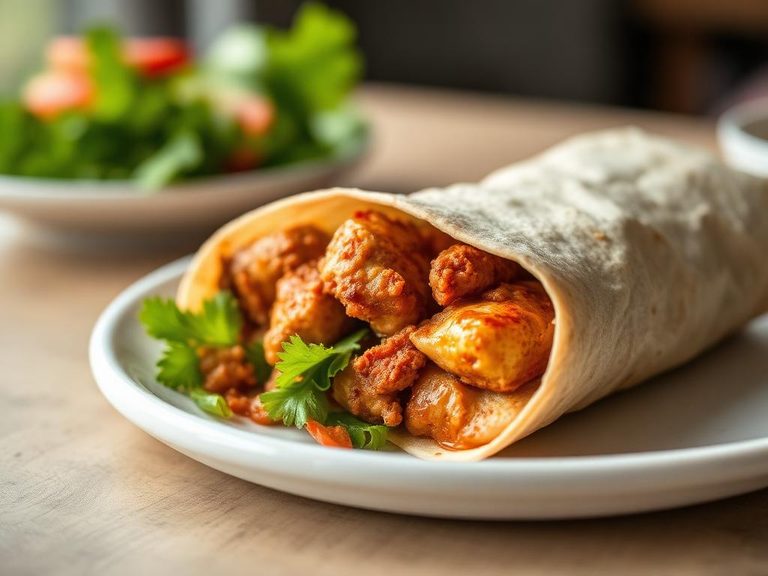
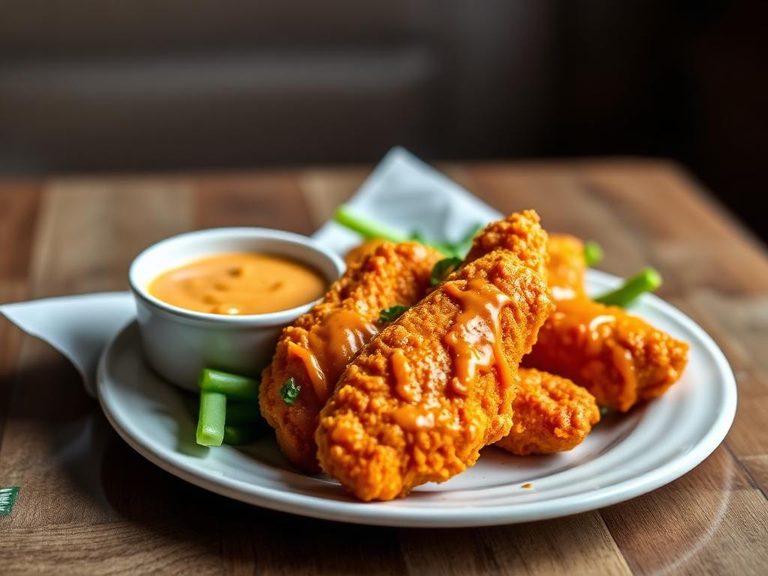
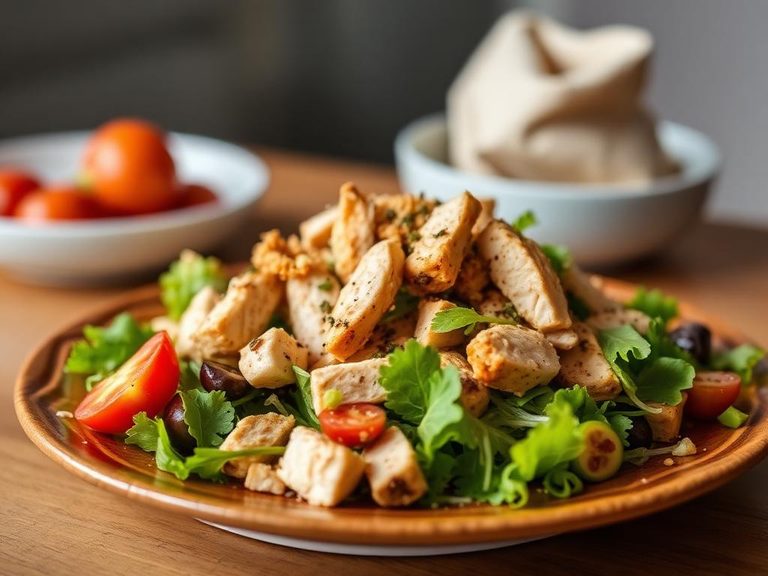
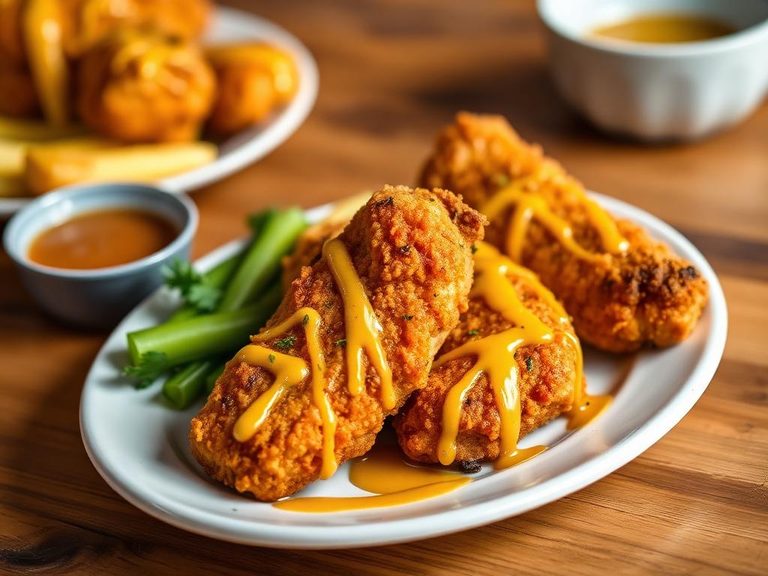
🌍 Where it's eaten
💡 Did you know?
Chicken tenders are not a specific cut of meat but are actually the pectoralis minor muscle, a small strip of meat located underneath the chicken breast.
Full nutrition (scales with serving)
| Water | 43.4 g |
| Energy | 296 kcal |
| Energy | 1238 kj |
| Protein | 19.3 g |
| Total lipid (fat) | 16.1 g |
| Ash | 2.8 g |
| Carbohydrate, by difference | 18.4 g |
| Fiber, total dietary | 1.2 g |
| Total Sugars | 0.39 g |
| Sucrose | 0.00 g |
| Glucose | 0.39 g |
| Fructose | 0.00 g |
| Lactose | 0.00 g |
| Maltose | 0.00 g |
| Galactose | 0.00 g |
| Starch | 17.0 g |
| Calcium, Ca | 23.0 mg |
| Iron, Fe | 0.90 mg |
| Magnesium, Mg | 30.0 mg |
| Phosphorus, P | 305 mg |
| Potassium, K | 337 mg |
| Sodium, Na | 763 mg |
| Zinc, Zn | 0.71 mg |
| Copper, Cu | 0.07 mg |
| Manganese, Mn | 0.26 mg |
| Selenium, Se | 16.9 ug |
| Thiamin | 0.10 mg |
| Riboflavin | 0.18 mg |
| Niacin | 7.9 mg |
| Pantothenic acid | 1.6 mg |
| Vitamin B-6 | 0.48 mg |
| Vitamin B-12 | 0.15 ug |
| Vitamin A, RAE | 10.0 ug |
| Retinol | 7.0 ug |
| Carotene, beta | 23.0 ug |
| Carotene, alpha | 0.00 ug |
| Cryptoxanthin, beta | 11.0 ug |
| Vitamin A, IU | 72.0 iu |
| Lycopene | 6.0 ug |
| Lutein + zeaxanthin | 72.0 ug |
| Vitamin E (alpha-tocopherol) | 1.3 mg |
| Tocopherol, beta | 0.17 mg |
| Tocopherol, gamma | 7.0 mg |
| Tocopherol, delta | 1.1 mg |
| Tocotrienol, alpha | 0.01 mg |
| Tocotrienol, beta | 0.08 mg |
| Tocotrienol, delta | 0.00 mg |
| Vitamin K (phylloquinone) | 25.1 ug |
| Vitamin K (Dihydrophylloquinone) | 0.20 ug |
| Vitamin K (Menaquinone-4) | 8.2 ug |
Fat & fatty acid profile (per 100g)
| Fatty acids, total saturated | 2.9 g |
| SFA 4:0 | 0.00 g |
| SFA 6:0 | 0.00 g |
| SFA 8:0 | 0.01 g |
| SFA 10:0 | 0.01 g |
| SFA 12:0 | 0.00 g |
| SFA 14:0 | 0.02 g |
| SFA 15:0 | 0.01 g |
| SFA 16:0 | 1.8 g |
| SFA 17:0 | 0.02 g |
| SFA 18:0 | 0.89 g |
| SFA 20:0 | 0.05 g |
| SFA 22:0 | 0.05 g |
| SFA 24:0 | 0.02 g |
| Fatty acids, total monounsaturated | 3.6 g |
| MUFA 14:1 | 0.00 g |
| MUFA 15:1 | 0.00 g |
| MUFA 16:1 | 0.06 g |
| MUFA 16:1 c | 0.06 g |
| MUFA 17:1 | 0.01 g |
| MUFA 18:1 | 3.4 g |
| MUFA 18:1 c | 3.4 g |
| MUFA 20:1 | 0.10 g |
| MUFA 22:1 | 0.00 g |
| MUFA 22:1 c | 0.00 g |
| MUFA 24:1 c | 0.00 g |
| Fatty acids, total polyunsaturated | 7.9 g |
| PUFA 18:2 | 6.9 g |
| PUFA 18:2 n-6 c,c | 6.8 g |
| PUFA 18:2 CLAs | 0.01 g |
| PUFA 18:3 | 0.92 g |
| PUFA 18:3 n-3 c,c,c (ALA) | 0.86 g |
| PUFA 18:3 n-6 c,c,c | 0.06 g |
| PUFA 18:3i | 0.00 g |
| PUFA 18:4 | 0.00 g |
| PUFA 20:2 n-6 c,c | 0.01 g |
| PUFA 20:3 | 0.01 g |
| PUFA 20:3 n-3 | 0.00 g |
| PUFA 20:3 n-6 | 0.01 g |
| PUFA 20:4 | 0.05 g |
| PUFA 20:5 n-3 (EPA) | 0.00 g |
| PUFA 22:4 | 0.02 g |
| PUFA 22:5 n-3 (DPA) | 0.01 g |
| PUFA 22:6 n-3 (DHA) | 0.00 g |
| Fatty acids, total trans | 0.12 g |
| Fatty acids, total trans-monoenoic | 0.04 g |
| TFA 16:1 t | 0.00 g |
| TFA 18:1 t | 0.04 g |
| TFA 22:1 t | 0.00 g |
| TFA 18:2 t not further defined | 0.08 g |
| Fatty acids, total trans-polyenoic | 0.08 g |
| Cholesterol | 51.0 mg |
Amino acid profile (per 100g)
| Tryptophan | 0.20 g |
| Threonine | 0.58 g |
| Isoleucine | 0.95 g |
| Leucine | 1.5 g |
| Lysine | 1.3 g |
| Methionine | 0.49 g |
| Cystine | 0.23 g |
| Phenylalanine | 0.76 g |
| Tyrosine | 0.51 g |
| Valine | 1.1 g |
| Arginine | 1.1 g |
| Histidine | 0.68 g |
| Alanine | 1.0 g |
| Aspartic acid | 1.7 g |
| Glutamic acid | 3.3 g |
| Glycine | 0.79 g |
| Proline | 1.2 g |
| Serine | 0.58 g |
| Hydroxyproline | 0.03 g |
FAQ
Are chicken tenders the same as chicken strips or chicken fingers?
Yes, these terms are generally used interchangeably in the United States to describe strips of boneless, breaded, and fried chicken breast meat.
What is the main allergen in breaded chicken tenders?
The most common allergens are wheat (in the breading) and eggs (often used in the batter or as a binder). Always check ingredient lists for specific allergens.
Can I make a healthier version at home?
Yes, you can bake or air-fry chicken tenders to significantly reduce the fat content. Using whole-grain breadcrumbs and seasoning the chicken well can maintain great flavor.