Restaurant, Chinese, sweet and sour pork
Whole food · Restaurant Foods
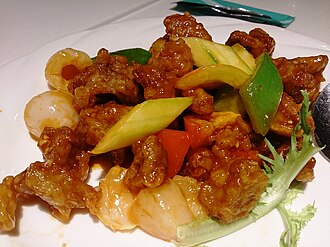
Photo: Wikipedia
Sweet and sour pork is a Cantonese classic of battered, deep-fried pork cubes tossed in a vibrant, glossy sauce that balances tangy vinegar, sweet sugar, and savory soy. The texture is a delightful contrast of crispy coating and tender meat, all enrobed in a sticky, often fruit-accented glaze. Nutritionally, it's a calorie-dense dish where the sauce contributes significant sugar and the frying adds substantial fat.
💚 Why it's loved
People love it for the perfect harmony of opposing flavors—the sharp tang of vinegar cutting through the sweet, sticky glaze and rich, crispy pork. It's a celebratory staple in Chinese banquets and a universal takeout favorite, symbolizing prosperity and joy.
⚠️ Watch-outs & how to enjoy it better
The dish is high in refined sugars and fats from the sauce and frying, which can cause rapid blood sugar spikes and is less ideal for those managing calorie intake. The batter often contains wheat, a common allergen, and the sauce can be high in sodium. To counteract this, pair it with fiber-rich steamed vegetables like bok choy, practice strict portion control, and consider homemade versions with air-fried pork and a sauce using less sugar.
Key benefits
- Provides a quick source of energy from carbohydrates and fats
- Offers complete protein from the pork for muscle maintenance
- Contains trace minerals like zinc and B vitamins from the meat
- The vinegar component can aid in mineral absorption
🍽️ Popular dishes

🌍 Where it's eaten
💡 Did you know?
The iconic bright red color in many restaurant versions comes from food coloring, not traditional ingredients, a practice popularized in Westernized Chinese cuisine to enhance visual appeal.
Full nutrition (scales with serving)
| Water | 50.8 g |
| Energy | 270 kcal |
| Energy | 1129 kj |
| Protein | 8.9 g |
| Total lipid (fat) | 15.7 g |
| Ash | 1.3 g |
| Carbohydrate, by difference | 23.3 g |
| Fiber, total dietary | 1.0 g |
| Total Sugars | 10.3 g |
| Sucrose | 4.5 g |
| Glucose | 3.0 g |
| Fructose | 2.9 g |
| Lactose | 0.00 g |
| Maltose | 0.00 g |
| Galactose | 0.00 g |
| Starch | 11.8 g |
| Calcium, Ca | 46.0 mg |
| Iron, Fe | 3.1 mg |
| Magnesium, Mg | 13.0 mg |
| Phosphorus, P | 133 mg |
| Potassium, K | 152 mg |
| Sodium, Na | 304 mg |
| Zinc, Zn | 1.1 mg |
| Copper, Cu | 0.06 mg |
| Manganese, Mn | 0.17 mg |
| Selenium, Se | 9.7 ug |
| Vitamin C, total ascorbic acid | 2.3 mg |
| Thiamin | 0.23 mg |
| Riboflavin | 0.10 mg |
| Niacin | 2.1 mg |
| Pantothenic acid | 0.44 mg |
| Vitamin B-6 | 0.17 mg |
| Choline, total | 32.5 mg |
| Betaine | 7.4 mg |
| Vitamin B-12 | 0.19 ug |
| Vitamin A, RAE | 29.0 ug |
| Retinol | 2.0 ug |
| Carotene, beta | 259 ug |
| Carotene, alpha | 139 ug |
| Cryptoxanthin, beta | 0.00 ug |
| Vitamin A, IU | 553 iu |
| Lycopene | 199 ug |
| Lutein + zeaxanthin | 22.0 ug |
| Vitamin E (alpha-tocopherol) | 0.89 mg |
| Tocopherol, beta | 0.06 mg |
| Tocopherol, gamma | 3.3 mg |
| Tocopherol, delta | 1.3 mg |
| Tocotrienol, alpha | 0.00 mg |
| Tocotrienol, beta | 0.00 mg |
| Tocotrienol, gamma | 0.01 mg |
| Tocotrienol, delta | 0.00 mg |
| Vitamin K (phylloquinone) | 27.9 ug |
| Vitamin K (Menaquinone-4) | 2.0 ug |
Fat & fatty acid profile (per 100g)
| Fatty acids, total saturated | 2.7 g |
| SFA 4:0 | 0.00 g |
| SFA 6:0 | 0.00 g |
| SFA 8:0 | 0.01 g |
| SFA 10:0 | 0.01 g |
| SFA 12:0 | 0.00 g |
| SFA 14:0 | 0.04 g |
| SFA 15:0 | 0.00 g |
| SFA 16:0 | 1.8 g |
| SFA 17:0 | 0.02 g |
| SFA 18:0 | 0.72 g |
| SFA 20:0 | 0.04 g |
| SFA 22:0 | 0.04 g |
| SFA 24:0 | 0.01 g |
| Fatty acids, total monounsaturated | 3.5 g |
| MUFA 14:1 | 0.00 g |
| MUFA 15:1 | 0.00 g |
| MUFA 16:1 | 0.07 g |
| MUFA 16:1 c | 0.07 g |
| MUFA 17:1 | 0.01 g |
| MUFA 18:1 | 3.4 g |
| MUFA 18:1 c | 3.3 g |
| MUFA 20:1 | 0.07 g |
| MUFA 22:1 | 0.01 g |
| MUFA 22:1 c | 0.00 g |
| MUFA 24:1 c | 0.00 g |
| Fatty acids, total polyunsaturated | 7.1 g |
| PUFA 18:2 | 6.3 g |
| PUFA 18:2 n-6 c,c | 6.2 g |
| PUFA 18:2 CLAs | 0.01 g |
| PUFA 18:3 | 0.79 g |
| PUFA 18:3 n-3 c,c,c (ALA) | 0.79 g |
| PUFA 18:3 n-6 c,c,c | 0.00 g |
| PUFA 18:4 | 0.00 g |
| PUFA 20:2 n-6 c,c | 0.01 g |
| PUFA 20:3 | 0.01 g |
| PUFA 20:3 n-3 | 0.00 g |
| PUFA 20:3 n-6 | 0.00 g |
| PUFA 20:4 | 0.03 g |
| PUFA 20:5 n-3 (EPA) | 0.00 g |
| PUFA 22:4 | 0.01 g |
| PUFA 22:5 n-3 (DPA) | 0.00 g |
| PUFA 22:6 n-3 (DHA) | 0.00 g |
| Fatty acids, total trans | 0.09 g |
| Fatty acids, total trans-monoenoic | 0.03 g |
| TFA 16:1 t | 0.00 g |
| TFA 18:1 t | 0.03 g |
| TFA 22:1 t | 0.00 g |
| TFA 18:2 t not further defined | 0.05 g |
| Fatty acids, total trans-polyenoic | 0.05 g |
| Cholesterol | 24.0 mg |
Amino acid profile (per 100g)
| Tryptophan | 0.10 g |
| Threonine | 0.38 g |
| Isoleucine | 0.38 g |
| Leucine | 0.72 g |
| Lysine | 0.68 g |
| Methionine | 0.21 g |
| Cystine | 0.11 g |
| Phenylalanine | 0.35 g |
| Tyrosine | 0.26 g |
| Valine | 0.42 g |
| Arginine | 0.55 g |
| Histidine | 0.29 g |
| Alanine | 0.48 g |
| Aspartic acid | 0.78 g |
| Glutamic acid | 1.9 g |
| Glycine | 0.41 g |
| Proline | 0.46 g |
| Serine | 0.39 g |
FAQ
Is sweet and sour pork the same as sweet and sour chicken?
No, while the sauce is similar, the protein is different. Sweet and sour pork uses pork, traditionally shoulder or loin, while sweet and sour chicken uses chicken, often breast or thigh. The texture and flavor of the meat differ accordingly.
Why is the pork battered and fried before saucing?
The batter creates a protective, crispy shell that keeps the pork juicy during high-heat frying. This crispy coating also provides a textured surface for the thick, sticky sweet and sour sauce to cling to, creating the signature contrast.
Can I make a healthier version at home?
Absolutely. You can use lean pork loin, coat it lightly in cornstarch, and air-fry or bake it until crispy. For the sauce, reduce sugar by using pineapple juice for sweetness, increase vinegar, and thicken with a small amount of cornstarch slurry.