

Plantains, yellow, fried, Latino restaurant
Whole food · Fruits and Fruit Juices
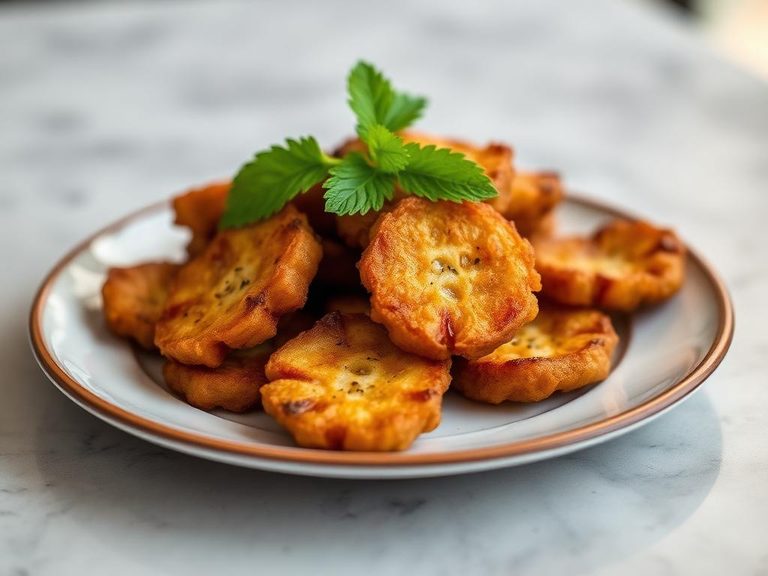
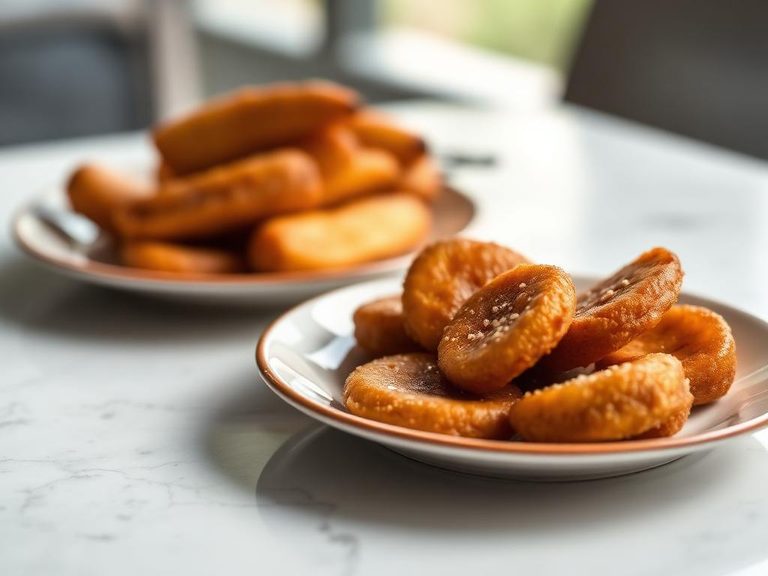
Golden-yellow plantains, sliced and deep-fried until the edges caramelize into a crisp, sweet crust while the interior becomes tender and custard-like. This staple Latino side dish delivers a satisfying contrast of textures with a pronounced, honeyed sweetness. Nutritionally, it's a significant source of quick-release carbohydrates and natural sugars for energy.
Calorie split: 2% protein · 69% carbs · 29% fat
↓ Full nutrition💚 Why it's loved
People adore fried sweet plantains for their addictive combination of caramelized, crispy exterior and soft, sweet interior, which acts as the perfect savory-sweet counterpart to rich, salty dishes. They are a beloved comfort food and a cultural cornerstone in many Latin American and Caribbean meals, symbolizing home cooking and tradition.
⚠️ Watch-outs & how to enjoy it better
The high carbohydrate and sugar content can cause rapid blood-sugar spikes, making portion control important for those managing diabetes or insulin resistance. The deep-frying method adds significant calories and saturated fat. To counteract, pair with a protein like black beans or grilled chicken, and consider baking or air-frying with a light oil spray for a lighter version.
Key benefits
- Excellent source of dietary potassium
- Provides vitamin A precursor (beta-carotene)
- Good source of quick energy from complex carbs
- Contains resistant starch which may support gut health
- Naturally gluten-free
🍽️ Popular dishes
🌍 Where it's eaten
💡 Did you know?
Botanically, the plantain is a fruit, but it's treated as a vegetable in cooking and is a primary staple crop for over 100 million people in tropical regions, often called the 'fruit of the people.'
Full nutrition (USDA data · scales with serving)
| Water | 49.0 g |
| Energy | 236 kcal |
| Energy | 989 kj |
| Protein | 1.4 g |
| Total lipid (fat) | 7.5 g |
| Ash | 1.3 g |
| Carbohydrate, by difference | 40.8 g |
| Fiber, total dietary | 3.2 g |
| Total Sugars | 21.8 g |
| Sucrose | 11.9 g |
| Glucose | 5.0 g |
| Fructose | 4.9 g |
| Lactose | 0.00 g |
| Maltose | 0.00 g |
| Galactose | 0.00 g |
| Starch | 13.3 g |
| Calcium, Ca | 6.0 mg |
| Iron, Fe | 0.62 mg |
| Magnesium, Mg | 45.0 mg |
| Phosphorus, P | 43.0 mg |
| Potassium, K | 507 mg |
| Sodium, Na | 6.0 mg |
| Zinc, Zn | 0.24 mg |
| Copper, Cu | 0.12 mg |
| Manganese, Mn | 0.28 mg |
| Selenium, Se | 0.40 ug |
| Thiamin | 0.07 mg |
| Riboflavin | 0.02 mg |
| Niacin | 0.84 mg |
| Pantothenic acid | 0.60 mg |
| Vitamin B-6 | 0.29 mg |
| Vitamin A, RAE | 66.0 ug |
| Carotene, beta | 582 ug |
| Carotene, alpha | 407 ug |
| Cryptoxanthin, beta | 11.0 ug |
| Vitamin A, IU | 1318 iu |
| Lycopene | 0.00 ug |
| Lutein + zeaxanthin | 100 ug |
| Vitamin E (alpha-tocopherol) | 1.1 mg |
| Tocopherol, beta | 0.02 mg |
| Tocopherol, gamma | 1.1 mg |
| Tocopherol, delta | 0.53 mg |
| Tocotrienol, alpha | 0.11 mg |
| Tocotrienol, beta | 0.00 mg |
| Tocotrienol, gamma | 0.04 mg |
| Tocotrienol, delta | 0.00 mg |
| Vitamin K (phylloquinone) | 31.8 ug |
| Vitamin K (Dihydrophylloquinone) | 0.80 ug |
| Vitamin K (Menaquinone-4) | 0.60 ug |
Fat & fatty acid profile (per 100g)
| Fatty acids, total saturated | 1.8 g |
| SFA 6:0 | 0.00 g |
| SFA 8:0 | 0.00 g |
| SFA 10:0 | 0.01 g |
| SFA 12:0 | 0.01 g |
| SFA 14:0 | 0.05 g |
| SFA 15:0 | 0.00 g |
| SFA 16:0 | 1.2 g |
| SFA 17:0 | 0.01 g |
| SFA 18:0 | 0.49 g |
| SFA 20:0 | 0.02 g |
| SFA 22:0 | 0.01 g |
| SFA 24:0 | 0.01 g |
| Fatty acids, total monounsaturated | 2.3 g |
| MUFA 14:1 | 0.00 g |
| MUFA 15:1 | 0.00 g |
| MUFA 16:1 | 0.08 g |
| MUFA 16:1 c | 0.07 g |
| MUFA 17:1 | 0.00 g |
| MUFA 18:1 | 2.2 g |
| MUFA 18:1 c | 2.1 g |
| MUFA 20:1 | 0.03 g |
| MUFA 22:1 | 0.00 g |
| MUFA 22:1 c | 0.00 g |
| MUFA 24:1 c | 0.00 g |
| Fatty acids, total polyunsaturated | 2.3 g |
| PUFA 18:2 | 2.0 g |
| PUFA 18:2 n-6 c,c | 2.0 g |
| PUFA 18:2 CLAs | 0.01 g |
| PUFA 18:3 | 0.22 g |
| PUFA 18:3 n-3 c,c,c (ALA) | 0.22 g |
| PUFA 18:3 n-6 c,c,c | 0.00 g |
| PUFA 18:4 | 0.00 g |
| PUFA 20:2 n-6 c,c | 0.02 g |
| PUFA 20:3 | 0.01 g |
| PUFA 20:3 n-3 | 0.00 g |
| PUFA 20:3 n-6 | 0.00 g |
| PUFA 20:4 | 0.01 g |
| PUFA 20:5 n-3 (EPA) | 0.00 g |
| PUFA 22:4 | 0.00 g |
| PUFA 22:5 n-3 (DPA) | 0.00 g |
| PUFA 22:6 n-3 (DHA) | 0.00 g |
| Fatty acids, total trans | 0.11 g |
| Fatty acids, total trans-monoenoic | 0.08 g |
| TFA 16:1 t | 0.00 g |
| TFA 18:1 t | 0.08 g |
| TFA 22:1 t | 0.00 g |
| TFA 18:2 t not further defined | 0.03 g |
| Fatty acids, total trans-polyenoic | 0.03 g |
Amino acid profile (per 100g)
Estimated from Plantains, green, boiled — USDA does not publish this profile for Plantains.
| Tryptophan | 0.01 g |
| Threonine | 0.02 g |
| Isoleucine | 0.02 g |
| Leucine | 0.04 g |
| Lysine | 0.05 g |
| Methionine | 0.01 g |
| Cystine | 0.02 g |
| Phenylalanine | 0.03 g |
| Tyrosine | 0.02 g |
| Valine | 0.02 g |
| Arginine | 0.06 g |
| Histidine | 0.06 g |
| Alanine | 0.03 g |
| Aspartic acid | 0.09 g |
| Glutamic acid | 0.08 g |
| Glycine | 0.03 g |
| Proline | 0.03 g |
| Serine | 0.03 g |
| Hydroxyproline | 0.00 g |
FAQ
What's the difference between tostones and maduros?
Tostones are made from green, unripe plantains that are fried, smashed flat, and fried again for a savory, starchy, crispy result. Maduros are made from yellow, ripe plantains that are fried once, resulting in a sweet, soft, caramelized interior.
Can I make fried plantains healthier?
Yes. Use very ripe (black-skinned) plantains for maximum natural sweetness, which reduces the need for added sugar. Instead of deep-frying, you can pan-fry in a small amount of healthy oil, bake at high heat, or use an air fryer with a light mist of oil.
Why are my fried plantains soggy?
This usually happens if the plantains aren't ripe enough (they need to be yellow with black spots) or if the oil isn't hot enough when they are added. Ensure the oil is at 325-350°F (160-175°C) and don't overcrowd the pan.
Nutrient density (calculated · NRF9.3)
Nutrient Rich Foods index: beneficial nutrients (protein, fiber, vitamins, minerals) minus saturated fat, added sugar & sodium, per 100 kcal.
NRF9.3 index — Fulgoni, Keast & Drewnowski, 2009. Computed from USDA nutrients.
Weight-loss friendliness (composite index)
Energy density 2.36 kcal/g · 2% calories from protein · 3.2 g fiber · 21.8 g sugar per 100 g.
Composite of energy density (Rolls et al., 1999), protein & fiber satiety, minus sugar. A calculated heuristic — ranks satiety-per-calorie, not a clinical measure.
Dietary load (calculated from USDA values)
Potential renal acid load. Positive = acid-forming, negative = alkaline-forming.
Sodium-to-potassium ratio: 0.01 (lower is better — aim for ≤ 1)
Sodium:potassium per WHO potassium guidance. Computed from USDA nutrients.