

Fast foods, english muffin, with egg, cheese, and canadian bacon
Whole food · Fast Foods

Photo: Wikipedia
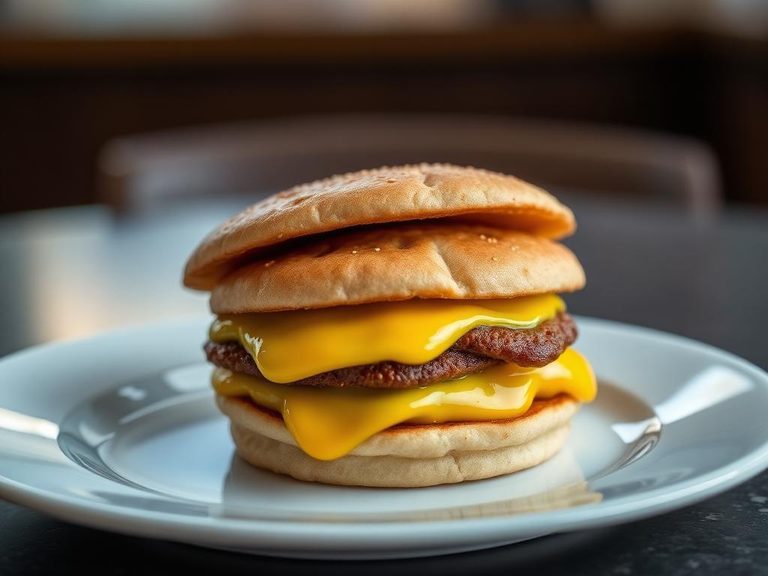
A classic fast-food breakfast sandwich, the Egg McMuffin-style creation features a toasted English muffin holding a folded egg, a slice of melted cheese, and a round of Canadian bacon. The texture is a satisfying contrast of soft, pillowy bread, a firm-yet-tender egg, and a slightly salty, lean meat bite. At around 228 calories per 100g, it's a relatively balanced option, offering a solid 13.64g of protein to help with satiety.
Calorie split: 24% protein · 38% carbs · 38% fat
↓ Full nutrition💚 Why it's loved
People love it for its reliable, savory flavor profile and the satisfying, handheld convenience that defines a classic breakfast-on-the-go. It's a cultural staple of the American fast-food morning, offering a comforting, familiar taste that's hard to resist.
⚠️ Watch-outs & how to enjoy it better
The high sodium content and refined carbohydrates can contribute to blood-sugar spikes and water retention, making it a poor choice for those managing hypertension or diabetes. To counteract this, pair it with a side of fruit or vegetables for fiber, and consider drinking water to help balance sodium intake. Those with gluten or dairy allergies should avoid it entirely.
Key benefits
- High-quality protein source for muscle maintenance and fullness.
- Provides a quick, convenient source of energy from carbohydrates.
- Contains calcium and vitamin D from the cheese.
- Lower in fat compared to many other breakfast sandwiches.
- Portable and easy to eat on the go.
🍽️ Popular dishes


🌍 Where it's eaten
💡 Did you know?
The Canadian bacon used in these sandwiches is often made from pork loin, not the back bacon traditionally known as 'Canadian bacon' in Canada, where it's called 'peameal bacon'.
Full nutrition (USDA data · scales with serving)
| Water | 52.6 g |
| Energy | 228 kcal |
| Energy | 955 kj |
| Protein | 13.6 g |
| Total lipid (fat) | 9.7 g |
| Ash | 2.5 g |
| Carbohydrate, by difference | 21.7 g |
| Fiber, total dietary | 0.40 g |
| Total Sugars | 2.1 g |
| Sucrose | 0.40 g |
| Glucose | 0.40 g |
| Fructose | 0.43 g |
| Lactose | 0.33 g |
| Maltose | 0.57 g |
| Galactose | 0.00 g |
| Calcium, Ca | 192 mg |
| Iron, Fe | 2.3 mg |
| Magnesium, Mg | 20.0 mg |
| Phosphorus, P | 200 mg |
| Potassium, K | 173 mg |
| Sodium, Na | 617 mg |
| Zinc, Zn | 1.3 mg |
| Copper, Cu | 0.08 mg |
| Manganese, Mn | 0.23 mg |
| Selenium, Se | 30.3 ug |
| Vitamin C, total ascorbic acid | 1.1 mg |
| Thiamin | 0.38 mg |
| Riboflavin | 0.29 mg |
| Niacin | 3.2 mg |
| Vitamin B-6 | 0.07 mg |
| Folate, total | 71.0 ug |
| Folic acid | 51.0 ug |
| Folate, food | 20.0 ug |
| Folate, DFE | 107 ug |
| Choline, total | 93.3 mg |
| Vitamin B-12 | 0.81 ug |
| Vitamin B-12, added | 0.00 ug |
| Vitamin A, RAE | 98.0 ug |
| Retinol | 97.0 ug |
| Carotene, beta | 12.0 ug |
| Carotene, alpha | 0.00 ug |
| Cryptoxanthin, beta | 3.0 ug |
| Vitamin A, IU | 347 iu |
| Lycopene | 0.00 ug |
| Lutein + zeaxanthin | 140 ug |
| Vitamin E (alpha-tocopherol) | 0.91 mg |
| Vitamin E, added | 0.00 mg |
| Vitamin D (D2 + D3), International Units | 26.0 iu |
| Vitamin D (D2 + D3) | 0.60 ug |
| Vitamin K (phylloquinone) | 0.80 ug |
| Alcohol, ethyl | 0.00 g |
| Caffeine | 0.00 mg |
| Theobromine | 0.00 mg |
Fat & fatty acid profile (per 100g)
| Fatty acids, total saturated | 3.6 g |
| SFA 4:0 | 0.06 g |
| SFA 6:0 | 0.05 g |
| SFA 8:0 | 0.08 g |
| SFA 10:0 | 0.11 g |
| SFA 12:0 | 0.10 g |
| SFA 14:0 | 0.33 g |
| SFA 15:0 | 0.04 g |
| SFA 16:0 | 2.0 g |
| SFA 17:0 | 0.03 g |
| SFA 18:0 | 0.76 g |
| SFA 20:0 | 0.01 g |
| SFA 22:0 | 0.01 g |
| SFA 24:0 | 0.01 g |
| Fatty acids, total monounsaturated | 2.7 g |
| MUFA 14:1 | 0.03 g |
| MUFA 15:1 | 0.00 g |
| MUFA 16:1 | 0.15 g |
| MUFA 16:1 c | 0.14 g |
| MUFA 17:1 | 0.01 g |
| MUFA 18:1 | 2.5 g |
| MUFA 18:1 c | 2.4 g |
| MUFA 20:1 | 0.03 g |
| MUFA 22:1 | 0.00 g |
| MUFA 22:1 c | 0.00 g |
| MUFA 24:1 c | 0.00 g |
| Fatty acids, total polyunsaturated | 1.7 g |
| PUFA 18:2 | 1.5 g |
| PUFA 18:2 n-6 c,c | 1.4 g |
| PUFA 18:2 CLAs | 0.02 g |
| PUFA 18:3 | 0.12 g |
| PUFA 18:3 n-3 c,c,c (ALA) | 0.11 g |
| PUFA 18:3 n-6 c,c,c | 0.00 g |
| PUFA 18:4 | 0.00 g |
| PUFA 20:2 n-6 c,c | 0.01 g |
| PUFA 20:3 | 0.01 g |
| PUFA 20:3 n-3 | 0.00 g |
| PUFA 20:3 n-6 | 0.01 g |
| PUFA 20:4 | 0.09 g |
| PUFA 20:5 n-3 (EPA) | 0.00 g |
| PUFA 22:4 | 0.01 g |
| PUFA 22:5 n-3 (DPA) | 0.01 g |
| PUFA 22:6 n-3 (DHA) | 0.02 g |
| Fatty acids, total trans | 0.11 g |
| Fatty acids, total trans-monoenoic | 0.08 g |
| TFA 16:1 t | 0.01 g |
| TFA 18:1 t | 0.06 g |
| TFA 22:1 t | 0.00 g |
| TFA 18:2 t not further defined | 0.03 g |
| Fatty acids, total trans-polyenoic | 0.03 g |
| Cholesterol | 168 mg |
Amino acid profile (per 100g)
Estimated from Fast foods, english muffin, with egg, cheese, and sausage — USDA does not publish this profile for Fast foods.
| Tryptophan | 0.16 g |
| Threonine | 0.52 g |
| Isoleucine | 0.54 g |
| Leucine | 0.98 g |
| Lysine | 0.75 g |
| Methionine | 0.29 g |
| Cystine | 0.20 g |
| Phenylalanine | 0.59 g |
| Tyrosine | 0.41 g |
| Valine | 0.65 g |
| Arginine | 0.65 g |
| Histidine | 0.33 g |
| Alanine | 0.60 g |
| Aspartic acid | 1.1 g |
| Glutamic acid | 2.5 g |
| Glycine | 0.54 g |
| Proline | 0.90 g |
| Serine | 0.70 g |
FAQ
Is this a healthy breakfast option?
It can be part of a balanced diet due to its protein content, but it's high in sodium and refined carbs. Pairing it with fiber-rich foods and water can help mitigate some downsides.
What makes the English muffin different from regular bread?
English muffins are typically made with a yeast-leavened dough that's cooked on a griddle, giving them a slightly chewy texture and a distinctive nooks-and-crannies surface that holds toppings well.
Can I make this at home?
Absolutely. Toast a split English muffin, cook an egg (fried, poached, or scrambled), add a slice of cheese and a round of Canadian bacon or ham, and assemble. It's a quick, customizable breakfast.
Nutrient density (calculated · NRF9.3)
Nutrient Rich Foods index: beneficial nutrients (protein, fiber, vitamins, minerals) minus saturated fat, added sugar & sodium, per 100 kcal.
NRF9.3 index — Fulgoni, Keast & Drewnowski, 2009. Computed from USDA nutrients.
Weight-loss friendliness (composite index)
Energy density 2.28 kcal/g · 24% calories from protein · 0.4 g fiber · 2.1 g sugar per 100 g.
Composite of energy density (Rolls et al., 1999), protein & fiber satiety, minus sugar. A calculated heuristic — ranks satiety-per-calorie, not a clinical measure.
Dietary load (calculated from USDA values)
Potential renal acid load. Positive = acid-forming, negative = alkaline-forming.
Sodium-to-potassium ratio: 3.57 (lower is better — aim for ≤ 1)
Sodium:potassium per WHO potassium guidance. Computed from USDA nutrients.