

Egg, white, dried, stabilized, glucose reduced
Whole food · Dairy and Egg Products

Photo: Wikipedia
This is a highly concentrated, shelf-stable powder made from pasteurized egg whites, with glucose removed to enhance purity and reduce carbs. It has a neutral, slightly sulfurous taste and a fine, chalky texture that dissolves into a smooth, protein-rich foam or binder. Nutritionally, it's a powerhouse, delivering over 84 grams of pure, complete protein per 100g with virtually no fat or sugar.
Calorie split: 94% protein · 5% carbs · 1% fat
↓ Full nutrition💚 Why it's loved
Chefs and home cooks love it for its unmatched ability to add pure protein and create stable foams, meringues, and binders without adding fat or cholesterol from yolks. It's a staple in sports nutrition for its clean, efficient protein delivery.
⚠️ Watch-outs & how to enjoy it better
The primary caution is for individuals with egg allergies, as it is a potent allergen source. The sulfurous taste can be noticeable if used raw in large quantities. To mitigate, always cook it into dishes (like baked goods or scrambles) to mellow the flavor, and ensure it's fully incorporated into recipes rather than consumed alone.
Key benefits
- Exceptionally high in complete protein for muscle repair and satiety.
- Virtually fat-free and carbohydrate-free, ideal for strict macro diets.
- Glucose-reduced formulation minimizes blood sugar impact.
- Long shelf life without refrigeration, great for food storage and emergency kits.
- Neutral flavor allows it to boost protein in sweet and savory dishes without altering taste.
🍽️ Popular dishes

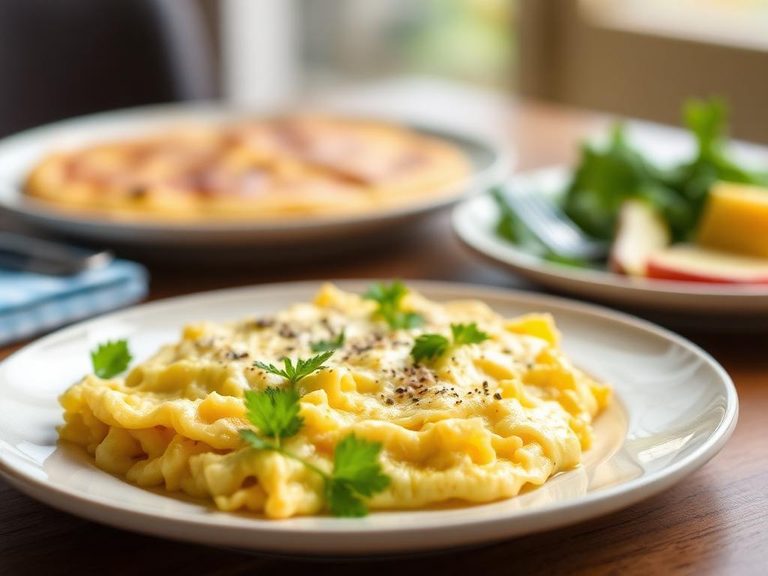

🌍 Where it's eaten
💡 Did you know?
The 'stabilized' and 'glucose reduced' processing allows this powder to be whipped into stiff peaks that hold for hours, a key reason it's preferred over fresh egg whites in commercial baking for consistent results.
Full nutrition (USDA data · scales with serving)
| Water | 5.5 g |
| Energy | 357 kcal |
| Energy | 1495 kj |
| Protein | 84.1 g |
| Total lipid (fat) | 0.32 g |
| Ash | 5.6 g |
| Carbohydrate, by difference | 4.5 g |
| Fiber, total dietary | 0.00 g |
| Total Sugars | 0.00 g |
| Sucrose | 0.00 g |
| Glucose | 0.00 g |
| Fructose | 0.00 g |
| Lactose | 0.00 g |
| Maltose | 0.00 g |
| Galactose | 0.00 g |
| Calcium, Ca | 101 mg |
| Iron, Fe | 0.18 mg |
| Magnesium, Mg | 82.0 mg |
| Phosphorus, P | 104 mg |
| Potassium, K | 884 mg |
| Sodium, Na | 1299 mg |
| Zinc, Zn | 0.13 mg |
| Copper, Cu | 0.13 mg |
| Manganese, Mn | 0.00 mg |
| Selenium, Se | 192 ug |
| Vitamin C, total ascorbic acid | 0.00 mg |
| Thiamin | 0.00 mg |
| Riboflavin | 3.7 mg |
| Niacin | 0.77 mg |
| Pantothenic acid | 0.67 mg |
| Vitamin B-6 | 0.03 mg |
| Folate, total | 0.00 ug |
| Folic acid | 0.00 ug |
| Folate, food | 0.00 ug |
| Folate, DFE | 0.00 ug |
| Choline, total | 10.7 mg |
| Vitamin B-12 | 0.20 ug |
| Vitamin B-12, added | 0.00 ug |
| Vitamin A, RAE | 0.00 ug |
| Retinol | 0.00 ug |
| Carotene, beta | 0.00 ug |
| Carotene, alpha | 0.00 ug |
| Cryptoxanthin, beta | 0.00 ug |
| Vitamin A, IU | 0.00 iu |
| Lycopene | 0.00 ug |
| Lutein + zeaxanthin | 20.0 ug |
| Vitamin E (alpha-tocopherol) | 0.00 mg |
| Vitamin E, added | 0.00 mg |
| Vitamin D (D2 + D3), International Units | 0.00 iu |
| Vitamin D (D2 + D3) | 0.00 ug |
| Vitamin D3 (cholecalciferol) | 0.00 ug |
| Vitamin K (phylloquinone) | 0.00 ug |
| Alcohol, ethyl | 0.00 g |
| Caffeine | 0.00 mg |
| Theobromine | 0.00 mg |
Fat & fatty acid profile (per 100g)
| Fatty acids, total saturated | 0.12 g |
| SFA 4:0 | 0.00 g |
| SFA 6:0 | 0.00 g |
| SFA 8:0 | 0.00 g |
| SFA 10:0 | 0.00 g |
| SFA 12:0 | 0.00 g |
| SFA 14:0 | 0.00 g |
| SFA 15:0 | 0.00 g |
| SFA 16:0 | 0.08 g |
| SFA 17:0 | 0.00 g |
| SFA 18:0 | 0.04 g |
| SFA 20:0 | 0.00 g |
| SFA 22:0 | 0.00 g |
| SFA 24:0 | 0.00 g |
| Fatty acids, total monounsaturated | 0.13 g |
| MUFA 14:1 | 0.00 g |
| MUFA 15:1 | 0.00 g |
| MUFA 16:1 | 0.00 g |
| MUFA 17:1 | 0.00 g |
| MUFA 18:1 | 0.13 g |
| MUFA 18:1 c | 0.13 g |
| MUFA 20:1 | 0.00 g |
| MUFA 22:1 | 0.00 g |
| Fatty acids, total polyunsaturated | 0.04 g |
| PUFA 18:2 | 0.04 g |
| PUFA 18:2 n-6 c,c | 0.04 g |
| PUFA 18:3 | 0.00 g |
| PUFA 18:3 n-3 c,c,c (ALA) | 0.00 g |
| PUFA 18:3 n-6 c,c,c | 0.00 g |
| PUFA 18:3i | 0.00 g |
| PUFA 18:4 | 0.00 g |
| PUFA 20:2 n-6 c,c | 0.00 g |
| PUFA 20:3 | 0.00 g |
| PUFA 20:4 | 0.00 g |
| PUFA 20:5 n-3 (EPA) | 0.00 g |
| PUFA 22:5 n-3 (DPA) | 0.00 g |
| PUFA 22:6 n-3 (DHA) | 0.00 g |
| Fatty acids, total trans | 0.00 g |
| Fatty acids, total trans-monoenoic | 0.00 g |
| TFA 18:1 t | 0.00 g |
| TFA 18:2 t,t | 0.00 g |
| Fatty acids, total trans-polyenoic | 0.00 g |
| Cholesterol | 0.00 mg |
Amino acid profile (per 100g)
| Tryptophan | 1.4 g |
| Threonine | 3.6 g |
| Isoleucine | 4.4 g |
| Leucine | 7.4 g |
| Lysine | 5.9 g |
| Methionine | 3.0 g |
| Cystine | 2.2 g |
| Phenylalanine | 5.1 g |
| Tyrosine | 3.4 g |
| Valine | 5.7 g |
| Arginine | 4.9 g |
| Histidine | 2.0 g |
| Alanine | 5.1 g |
| Aspartic acid | 9.1 g |
| Glutamic acid | 11.7 g |
| Glycine | 3.0 g |
| Proline | 3.2 g |
| Serine | 6.2 g |
FAQ
How does it differ from regular dried egg whites?
The 'glucose reduced' and 'stabilized' processing removes more sugars and adds a stabilizing agent (like sodium lauryl sulfate), giving it a longer shelf life, more consistent whipping performance, and a slightly lower carbohydrate count.
Can I use it as a 1:1 replacement for fresh egg whites in recipes?
Generally, yes, but rehydration is key. A common ratio is 1 tablespoon of powder mixed with 2 tablespoons of water to equal one fresh large egg white. Always check the package for specific instructions.
Is the protein quality as good as from whole eggs?
Yes, the protein from dried egg whites is complete and has a high biological value, meaning it contains all essential amino acids in ratios well-suited for human nutrition, similar to whole eggs.
Nutrient density (calculated · NRF9.3)
Nutrient Rich Foods index: beneficial nutrients (protein, fiber, vitamins, minerals) minus saturated fat, added sugar & sodium, per 100 kcal.
NRF9.3 index — Fulgoni, Keast & Drewnowski, 2009. Computed from USDA nutrients.
Weight-loss friendliness (composite index)
Energy density 3.57 kcal/g · 94% calories from protein · 0.0 g fiber · 0.0 g sugar per 100 g.
Composite of energy density (Rolls et al., 1999), protein & fiber satiety, minus sugar. A calculated heuristic — ranks satiety-per-calorie, not a clinical measure.
Dietary load (calculated from USDA values)
Potential renal acid load. Positive = acid-forming, negative = alkaline-forming.
Sodium-to-potassium ratio: 1.47 (lower is better — aim for ≤ 1)
Sodium:potassium per WHO potassium guidance. Computed from USDA nutrients.