

DENNY'S, onion rings
Whole food · Restaurant Foods

Photo: Wikipedia
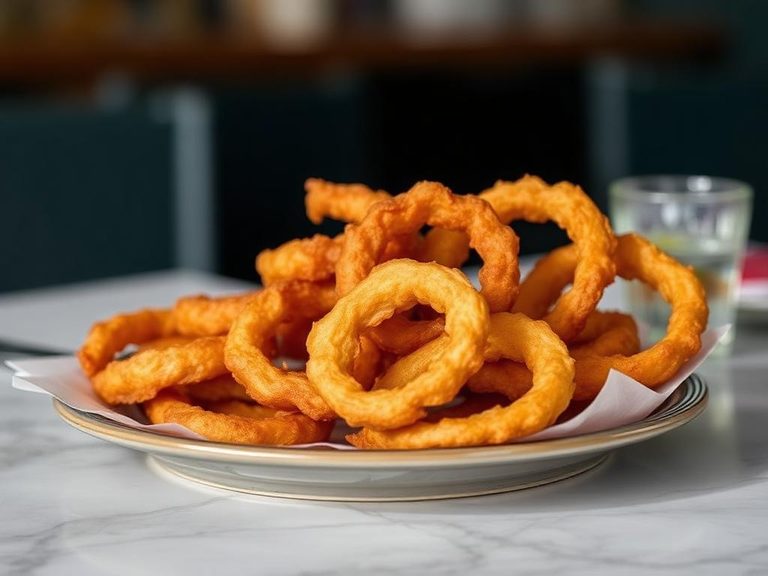
Denny's onion rings are golden, deep-fried rings of white onion coated in a seasoned batter, offering a satisfying crunch that gives way to a soft, sweet interior. Nutritionally, they are a high-calorie, high-fat side, with a single serving providing a significant portion of daily fat needs.
Calorie split: 5% protein · 43% carbs · 52% fat
↓ Full nutrition💚 Why it's loved
People love them for the irresistible contrast between the crispy, savory batter and the sweet, tender onion inside, making them a classic comfort food. They are a versatile side, perfect for dipping in ketchup, ranch, or other sauces.
⚠️ Watch-outs & how to enjoy it better
They are high in calories, sodium, and unhealthy fats from deep-frying, which can contribute to blood sugar spikes and are not ideal for those monitoring heart health or weight. To counteract, practice strict portion control, share an order, and pair them with a protein-rich main like a grilled chicken sandwich to slow digestion.
Key benefits
- Quick source of energy from carbohydrates and fats
- Contains small amounts of dietary fiber and B vitamins from the onion
- Provides a satisfying, crunchy texture
- A popular, comforting side dish in American diner culture
🍽️ Popular dishes
🌍 Where it's eaten
💡 Did you know?
The batter for onion rings can be made from a variety of bases, including beer, buttermilk, or tempura, each creating a distinct texture and flavor profile.
Full nutrition (USDA data · scales with serving)
| Water | 28.9 g |
| Energy | 385 kcal |
| Energy | 1613 kj |
| Protein | 5.3 g |
| Total lipid (fat) | 22.2 g |
| Ash | 2.5 g |
| Carbohydrate, by difference | 41.0 g |
| Fiber, total dietary | 2.4 g |
| Total Sugars | 4.8 g |
| Sucrose | 0.95 g |
| Glucose | 1.2 g |
| Fructose | 1.2 g |
| Lactose | 0.00 g |
| Maltose | 1.4 g |
| Galactose | 0.00 g |
| Starch | 33.8 g |
| Calcium, Ca | 22.0 mg |
| Iron, Fe | 0.74 mg |
| Magnesium, Mg | 20.0 mg |
| Phosphorus, P | 92.0 mg |
| Potassium, K | 150 mg |
| Sodium, Na | 780 mg |
| Zinc, Zn | 0.55 mg |
| Copper, Cu | 0.09 mg |
| Manganese, Mn | 0.40 mg |
| Selenium, Se | 5.2 ug |
| Thiamin | 0.12 mg |
| Riboflavin | 0.07 mg |
| Niacin | 0.86 mg |
| Pantothenic acid | 0.38 mg |
| Vitamin B-6 | 0.09 mg |
| Folate, total | 13.0 ug |
| Vitamin A, RAE | 0.00 ug |
| Retinol | 0.00 ug |
| Carotene, beta | 2.0 ug |
| Carotene, alpha | 0.00 ug |
| Cryptoxanthin, beta | 2.0 ug |
| Vitamin A, IU | 5.0 iu |
| Lycopene | 0.00 ug |
| Lutein + zeaxanthin | 44.0 ug |
| Vitamin E (alpha-tocopherol) | 1.2 mg |
| Tocopherol, beta | 0.18 mg |
| Tocopherol, gamma | 8.3 mg |
| Tocopherol, delta | 3.2 mg |
| Tocotrienol, alpha | 0.04 mg |
| Tocotrienol, beta | 0.15 mg |
| Tocotrienol, gamma | 0.04 mg |
| Tocotrienol, delta | 0.00 mg |
| Vitamin K (phylloquinone) | 50.6 ug |
| Vitamin K (Dihydrophylloquinone) | 0.10 ug |
Fat & fatty acid profile (per 100g)
| Fatty acids, total saturated | 3.7 g |
| SFA 4:0 | 0.00 g |
| SFA 6:0 | 0.00 g |
| SFA 8:0 | 0.01 g |
| SFA 10:0 | 0.01 g |
| SFA 12:0 | 0.01 g |
| SFA 14:0 | 0.03 g |
| SFA 15:0 | 0.01 g |
| SFA 16:0 | 2.2 g |
| SFA 17:0 | 0.02 g |
| SFA 18:0 | 1.2 g |
| SFA 20:0 | 0.07 g |
| SFA 22:0 | 0.06 g |
| SFA 24:0 | 0.03 g |
| Fatty acids, total monounsaturated | 4.6 g |
| MUFA 14:1 | 0.00 g |
| MUFA 15:1 | 0.00 g |
| MUFA 16:1 | 0.03 g |
| MUFA 16:1 c | 0.03 g |
| MUFA 17:1 | 0.01 g |
| MUFA 18:1 | 4.5 g |
| MUFA 18:1 c | 4.4 g |
| MUFA 20:1 | 0.07 g |
| MUFA 22:1 | 0.01 g |
| MUFA 22:1 c | 0.01 g |
| MUFA 24:1 c | 0.00 g |
| Fatty acids, total polyunsaturated | 10.6 g |
| PUFA 18:2 | 9.3 g |
| PUFA 18:2 n-6 c,c | 9.1 g |
| PUFA 18:2 CLAs | 0.03 g |
| PUFA 18:3 | 1.2 g |
| PUFA 18:3 n-3 c,c,c (ALA) | 1.1 g |
| PUFA 18:3 n-6 c,c,c | 0.10 g |
| PUFA 18:3i | 0.00 g |
| PUFA 18:4 | 0.00 g |
| PUFA 20:2 n-6 c,c | 0.01 g |
| PUFA 20:3 | 0.00 g |
| PUFA 20:3 n-3 | 0.00 g |
| PUFA 20:3 n-6 | 0.00 g |
| PUFA 20:4 | 0.01 g |
| PUFA 20:5 n-3 (EPA) | 0.00 g |
| PUFA 22:4 | 0.00 g |
| PUFA 22:5 n-3 (DPA) | 0.00 g |
| PUFA 22:6 n-3 (DHA) | 0.00 g |
| Fatty acids, total trans | 0.21 g |
| Fatty acids, total trans-monoenoic | 0.07 g |
| TFA 16:1 t | 0.00 g |
| TFA 18:1 t | 0.06 g |
| TFA 22:1 t | 0.01 g |
| TFA 18:2 t not further defined | 0.14 g |
| Fatty acids, total trans-polyenoic | 0.14 g |
Amino acid profile (per 100g)
| Tryptophan | 0.05 g |
| Threonine | 0.14 g |
| Isoleucine | 0.18 g |
| Leucine | 0.36 g |
| Lysine | 0.14 g |
| Methionine | 0.08 g |
| Cystine | 0.13 g |
| Phenylalanine | 0.25 g |
| Tyrosine | 0.11 g |
| Valine | 0.22 g |
| Arginine | 0.24 g |
| Histidine | 0.12 g |
| Alanine | 0.17 g |
| Aspartic acid | 0.24 g |
| Glutamic acid | 1.7 g |
| Glycine | 0.19 g |
| Proline | 0.60 g |
| Serine | 0.22 g |
| Hydroxyproline | 0.00 g |
FAQ
Are onion rings gluten-free?
No, traditional onion rings are not gluten-free as the batter typically contains wheat flour. Gluten-free versions use alternative flours like rice or cornmeal.
What is the best way to reheat leftover onion rings?
Reheat them in an oven or air fryer at 350°F (175°C) for 5-10 minutes to restore crispiness. Microwaving will make them soggy.
How do they differ from French fries nutritionally?
Onion rings generally have more calories, fat, and sodium per gram than French fries due to the batter and frying process, but they offer slightly more fiber from the onion.
Nutrient density (calculated · NRF9.3)
Nutrient Rich Foods index: beneficial nutrients (protein, fiber, vitamins, minerals) minus saturated fat, added sugar & sodium, per 100 kcal.
NRF9.3 index — Fulgoni, Keast & Drewnowski, 2009. Computed from USDA nutrients.
Weight-loss friendliness (composite index)
Energy density 3.85 kcal/g · 5% calories from protein · 2.4 g fiber · 4.8 g sugar per 100 g.
Composite of energy density (Rolls et al., 1999), protein & fiber satiety, minus sugar. A calculated heuristic — ranks satiety-per-calorie, not a clinical measure.
Dietary load (calculated from USDA values)
Potential renal acid load. Positive = acid-forming, negative = alkaline-forming.
Sodium-to-potassium ratio: 5.20 (lower is better — aim for ≤ 1)
Sodium:potassium per WHO potassium guidance. Computed from USDA nutrients.