

Chicken, dark meat, drumstick, meat only, with added solution, cooked, braised
Whole food · Poultry Products
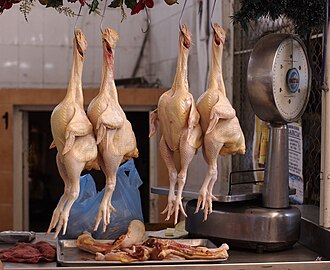
Photo: Wikipedia
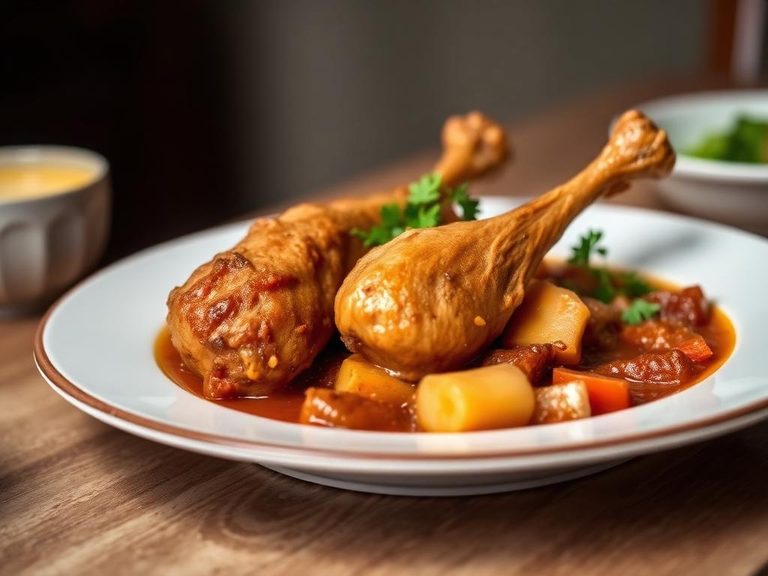
This is the tender, juicy meat from a chicken drumstick, cooked low and slow in a flavorful liquid until it practically falls off the bone. The braising process yields a rich, savory taste with a succulent, melt-in-your-mouth texture. It's a protein powerhouse, delivering nearly 23 grams of high-quality protein per 100 grams with minimal fat.
Calorie split: 62% protein · 0% carbs · 38% fat
↓ Full nutrition💚 Why it's loved
People adore it for the deep, savory flavor that comes from the braising liquid infusing the dark meat, and its incredibly tender, forgiving texture that's hard to overcook. It's a comforting, versatile staple in home cooking across countless cultures.
⚠️ Watch-outs & how to enjoy it better
The braising liquid can be high in sodium, which may be a concern for those monitoring blood pressure. To counteract this, you can use low-sodium broth, rinse the meat lightly after cooking, or balance the meal with potassium-rich vegetables like spinach or sweet potato. The skin, if left on, adds saturated fat; simply remove it before or after cooking to reduce fat content.
Key benefits
- Excellent source of complete protein for muscle maintenance.
- Rich in essential minerals like iron and zinc.
- Braising makes it tender and easy to digest.
- Zero carbohydrates, suitable for low-carb diets.
- Contains B vitamins, particularly niacin and B6.
🍽️ Popular dishes
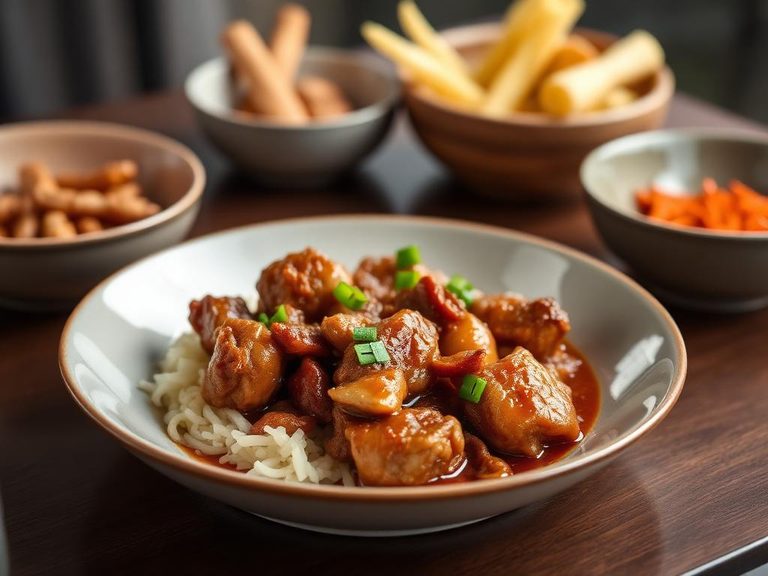
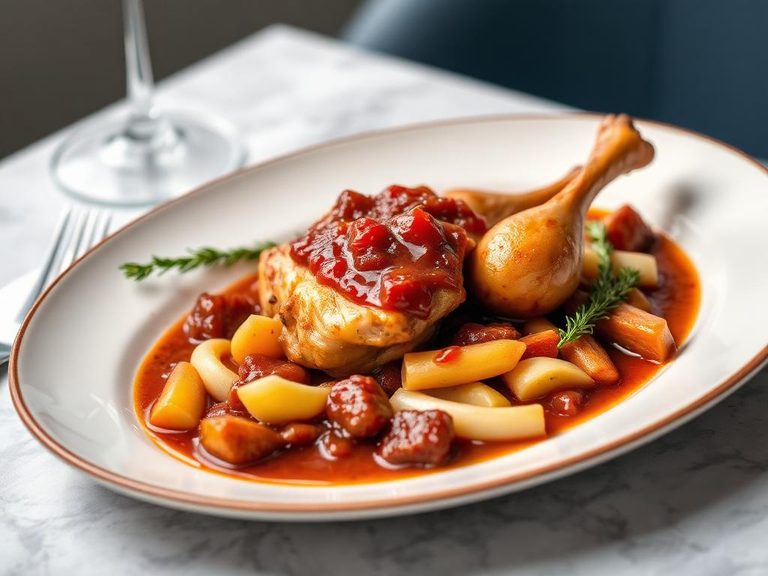
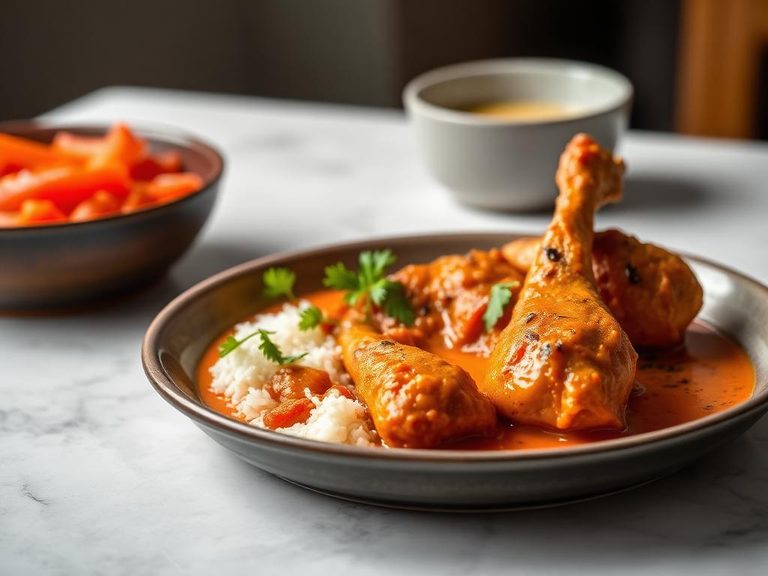

🌍 Where it's eaten
💡 Did you know?
Dark meat chicken, like drumsticks, contains about twice the amount of myoglobin (an oxygen-storing protein) as white meat, which is why it's darker and has a richer, more 'meaty' flavor.
Full nutrition (USDA data · scales with serving)
| Water | 70.2 g |
| Energy | 149 kcal |
| Energy | 623 kj |
| Protein | 23.0 g |
| Total lipid (fat) | 6.3 g |
| Ash | 1.1 g |
| Carbohydrate, by difference | 0.00 g |
| Fiber, total dietary | 0.00 g |
| Total Sugars | 0.00 g |
| Calcium, Ca | 14.0 mg |
| Iron, Fe | 0.78 mg |
| Magnesium, Mg | 21.0 mg |
| Phosphorus, P | 170 mg |
| Potassium, K | 229 mg |
| Sodium, Na | 169 mg |
| Zinc, Zn | 2.3 mg |
| Copper, Cu | 0.05 mg |
| Manganese, Mn | 0.01 mg |
| Selenium, Se | 29.8 ug |
| Vitamin C, total ascorbic acid | 0.00 mg |
| Thiamin | 0.08 mg |
| Riboflavin | 0.16 mg |
| Niacin | 5.1 mg |
| Vitamin B-6 | 0.31 mg |
| Folate, total | 4.0 ug |
| Folic acid | 0.00 ug |
| Folate, food | 4.0 ug |
| Folate, DFE | 4.0 ug |
| Choline, total | 69.2 mg |
| Betaine | 10.7 mg |
| Vitamin B-12 | 0.31 ug |
| Vitamin B-12, added | 0.00 ug |
| Vitamin A, RAE | 7.0 ug |
| Retinol | 7.0 ug |
| Carotene, beta | 0.00 ug |
| Carotene, alpha | 0.00 ug |
| Cryptoxanthin, beta | 0.00 ug |
| Vitamin A, IU | 23.0 iu |
| Lycopene | 0.00 ug |
| Lutein + zeaxanthin | 0.00 ug |
| Vitamin E (alpha-tocopherol) | 0.17 mg |
| Vitamin E, added | 0.00 mg |
| Vitamin D (D2 + D3), International Units | 2.0 iu |
| Vitamin D (D2 + D3) | 0.10 ug |
| Vitamin D3 (cholecalciferol) | 0.10 ug |
| Vitamin K (phylloquinone) | 3.7 ug |
| Alcohol, ethyl | 0.00 g |
| Caffeine | 0.00 mg |
| Theobromine | 0.00 mg |
Fat & fatty acid profile (per 100g)
| Fatty acids, total saturated | 1.7 g |
| SFA 4:0 | 0.00 g |
| SFA 6:0 | 0.00 g |
| SFA 8:0 | 0.00 g |
| SFA 10:0 | 0.00 g |
| SFA 12:0 | 0.00 g |
| SFA 14:0 | 0.03 g |
| SFA 15:0 | 0.01 g |
| SFA 16:0 | 1.3 g |
| SFA 17:0 | 0.01 g |
| SFA 18:0 | 0.37 g |
| SFA 20:0 | 0.01 g |
| SFA 22:0 | 0.01 g |
| SFA 24:0 | 0.00 g |
| Fatty acids, total monounsaturated | 2.6 g |
| MUFA 14:1 | 0.01 g |
| MUFA 15:1 | 0.00 g |
| MUFA 16:1 | 0.45 g |
| MUFA 16:1 c | 0.44 g |
| MUFA 17:1 | 0.00 g |
| MUFA 18:1 | 2.1 g |
| MUFA 18:1 c | 2.1 g |
| MUFA 20:1 | 0.03 g |
| MUFA 22:1 | 0.00 g |
| MUFA 22:1 c | 0.00 g |
| MUFA 24:1 c | 0.00 g |
| Fatty acids, total polyunsaturated | 1.3 g |
| PUFA 18:2 | 1.1 g |
| PUFA 18:2 n-6 c,c | 1.1 g |
| PUFA 18:2 CLAs | 0.01 g |
| PUFA 18:3 | 0.06 g |
| PUFA 18:3 n-3 c,c,c (ALA) | 0.05 g |
| PUFA 18:3 n-6 c,c,c | 0.01 g |
| PUFA 18:4 | 0.00 g |
| PUFA 20:2 n-6 c,c | 0.01 g |
| PUFA 20:3 | 0.02 g |
| PUFA 20:3 n-3 | 0.00 g |
| PUFA 20:3 n-6 | 0.02 g |
| PUFA 20:4 | 0.09 g |
| PUFA 20:5 n-3 (EPA) | 0.00 g |
| PUFA 22:4 | 0.02 g |
| PUFA 22:5 n-3 (DPA) | 0.01 g |
| PUFA 22:6 n-3 (DHA) | 0.01 g |
| Fatty acids, total trans | 0.04 g |
| Fatty acids, total trans-monoenoic | 0.03 g |
| TFA 16:1 t | 0.00 g |
| TFA 18:1 t | 0.02 g |
| TFA 22:1 t | 0.00 g |
| TFA 18:2 t not further defined | 0.01 g |
| Fatty acids, total trans-polyenoic | 0.01 g |
| Cholesterol | 135 mg |
Amino acid profile (per 100g)
| Tryptophan | 0.26 g |
| Threonine | 1.1 g |
| Isoleucine | 1.1 g |
| Leucine | 2.0 g |
| Lysine | 2.2 g |
| Methionine | 0.66 g |
| Cystine | 0.27 g |
| Phenylalanine | 0.92 g |
| Tyrosine | 0.86 g |
| Valine | 1.1 g |
| Arginine | 1.6 g |
| Histidine | 0.69 g |
| Alanine | 1.4 g |
| Aspartic acid | 2.3 g |
| Glutamic acid | 3.8 g |
| Glycine | 1.1 g |
| Proline | 0.93 g |
| Serine | 0.96 g |
FAQ
Is braised chicken drumstick healthy?
Yes, it's a nutritious choice. It's high in protein, low in carbs, and the braising method can retain nutrients. The healthiness depends on the braising liquid (watch sodium) and whether you eat the skin.
How is this different from roasted chicken drumstick?
Braising is a wet-heat method (cooked in liquid), resulting in very tender, moist meat infused with the liquid's flavor. Roasting uses dry heat, which can create a crispier skin but may result in slightly firmer meat.
Can I use frozen drumsticks for braising?
Absolutely. You can braise them directly from frozen, but you'll need to increase the cooking time by about 50% to ensure they cook through safely and become tender.
Nutrient density (calculated · NRF9.3)
Nutrient Rich Foods index: beneficial nutrients (protein, fiber, vitamins, minerals) minus saturated fat, added sugar & sodium, per 100 kcal.
NRF9.3 index — Fulgoni, Keast & Drewnowski, 2009. Computed from USDA nutrients.
Weight-loss friendliness (composite index)
Energy density 1.49 kcal/g · 62% calories from protein · 0.0 g fiber · 0.0 g sugar per 100 g.
Composite of energy density (Rolls et al., 1999), protein & fiber satiety, minus sugar. A calculated heuristic — ranks satiety-per-calorie, not a clinical measure.
Dietary load (calculated from USDA values)
Potential renal acid load. Positive = acid-forming, negative = alkaline-forming.
Sodium-to-potassium ratio: 0.74 (lower is better — aim for ≤ 1)
Sodium:potassium per WHO potassium guidance. Computed from USDA nutrients.