

Carrots, cooked, boiled, drained, without salt
Whole food · Vegetables and Vegetable Products
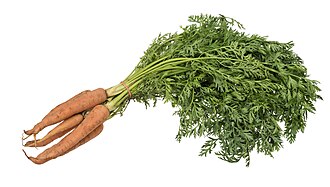
Photo: Wikipedia
Boiled carrots transform from a hard root into a tender, sweet, and vibrant orange vegetable. Their texture becomes soft and yielding, with a natural sweetness that intensifies through cooking. At just 35 kcal per 100g, they are a low-calorie source of fiber and beta-carotene.
Calorie split: 8% protein · 88% carbs · 4% fat
↓ Full nutrition💚 Why it's loved
People love their natural, caramel-like sweetness and soft texture that makes them a comforting, kid-friendly vegetable. They are incredibly versatile, serving as a base for soups, a sweet side dish, or a nutritious snack.
⚠️ Watch-outs & how to enjoy it better
Their high natural sugar content can cause a quicker blood sugar rise compared to non-starchy vegetables. To mitigate this, pair them with a protein or healthy fat (like hummus or a drizzle of olive oil) to slow digestion. Overcooking can also make them mushy and bland.
Key benefits
- Excellent source of beta-carotene, converted by the body to vitamin A.
- High in soluble fiber, which supports digestive health.
- Very low in fat and calories, aiding weight management.
- Contains antioxidants like lutein and lycopene.
- Provides a good amount of potassium.
🍽️ Popular dishes

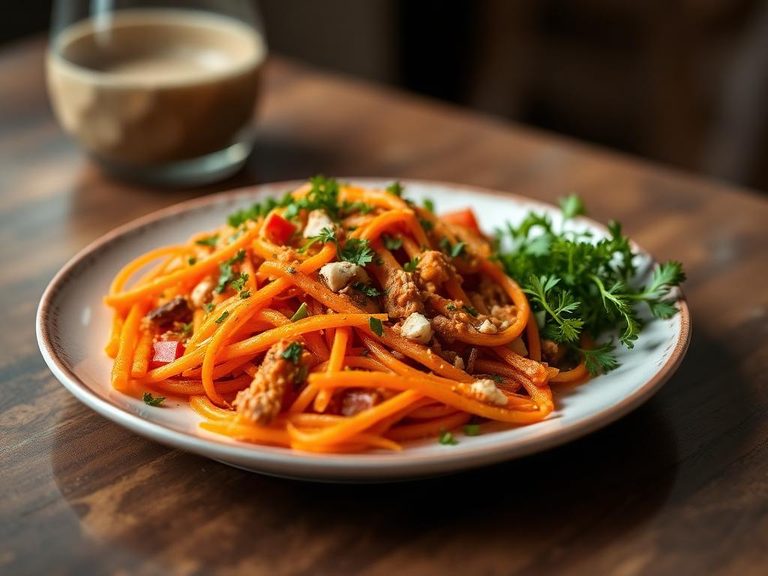

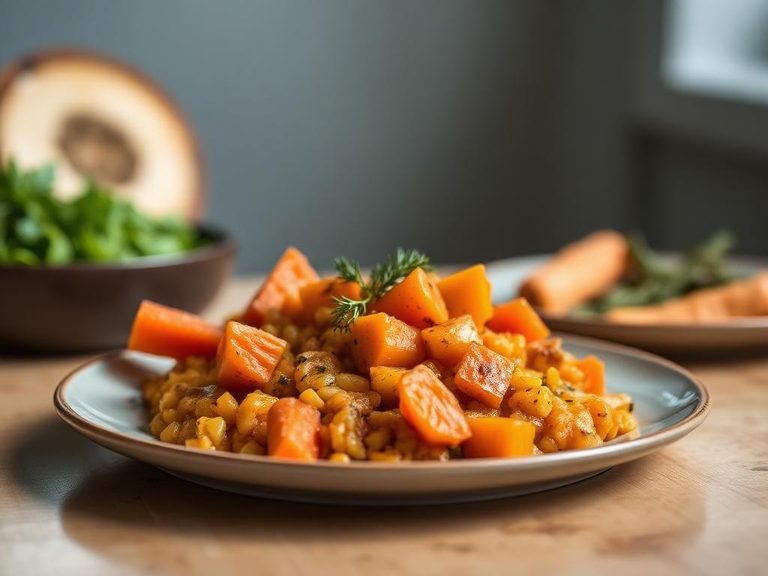

🌍 Where it's eaten
💡 Did you know?
Cooking carrots actually makes their beta-carotene more bioavailable for your body to absorb compared to eating them raw.
Full nutrition (USDA data · scales with serving)
| Water | 90.2 g |
| Energy | 35.0 kcal |
| Energy | 147 kj |
| Protein | 0.76 g |
| Total lipid (fat) | 0.18 g |
| Ash | 0.67 g |
| Carbohydrate, by difference | 8.2 g |
| Fiber, total dietary | 3.0 g |
| Total Sugars | 3.5 g |
| Sucrose | 2.7 g |
| Glucose | 0.40 g |
| Fructose | 0.36 g |
| Lactose | 0.00 g |
| Maltose | 0.00 g |
| Galactose | 0.00 g |
| Starch | 0.17 g |
| Calcium, Ca | 30.0 mg |
| Iron, Fe | 0.34 mg |
| Magnesium, Mg | 10.0 mg |
| Phosphorus, P | 30.0 mg |
| Potassium, K | 235 mg |
| Sodium, Na | 58.0 mg |
| Zinc, Zn | 0.20 mg |
| Copper, Cu | 0.02 mg |
| Manganese, Mn | 0.15 mg |
| Selenium, Se | 0.70 ug |
| Fluoride, F | 47.5 ug |
| Vitamin C, total ascorbic acid | 3.6 mg |
| Thiamin | 0.07 mg |
| Riboflavin | 0.04 mg |
| Niacin | 0.65 mg |
| Pantothenic acid | 0.23 mg |
| Vitamin B-6 | 0.15 mg |
| Folate, total | 14.0 ug |
| Folic acid | 0.00 ug |
| Folate, food | 14.0 ug |
| Folate, DFE | 14.0 ug |
| Choline, total | 8.8 mg |
| Betaine | 0.10 mg |
| Vitamin B-12 | 0.00 ug |
| Vitamin B-12, added | 0.00 ug |
| Vitamin A, RAE | 852 ug |
| Retinol | 0.00 ug |
| Carotene, beta | 8332 ug |
| Carotene, alpha | 3776 ug |
| Cryptoxanthin, beta | 0.00 ug |
| Vitamin A, IU | 17033 iu |
| Lycopene | 0.00 ug |
| Lutein + zeaxanthin | 687 ug |
| Vitamin E (alpha-tocopherol) | 1.0 mg |
| Vitamin E, added | 0.00 mg |
| Tocopherol, beta | 0.02 mg |
| Tocopherol, gamma | 0.01 mg |
| Tocopherol, delta | 0.00 mg |
| Tocotrienol, alpha | 0.05 mg |
| Tocotrienol, beta | 0.00 mg |
| Tocotrienol, gamma | 0.00 mg |
| Tocotrienol, delta | 0.00 mg |
| Vitamin D (D2 + D3), International Units | 0.00 iu |
| Vitamin D (D2 + D3) | 0.00 ug |
| Vitamin K (phylloquinone) | 13.7 ug |
| Vitamin K (Dihydrophylloquinone) | 0.00 ug |
| Alcohol, ethyl | 0.00 g |
| Caffeine | 0.00 mg |
| Theobromine | 0.00 mg |
Fat & fatty acid profile (per 100g)
| Fatty acids, total saturated | 0.03 g |
| SFA 4:0 | 0.00 g |
| SFA 6:0 | 0.00 g |
| SFA 8:0 | 0.00 g |
| SFA 10:0 | 0.00 g |
| SFA 12:0 | 0.00 g |
| SFA 14:0 | 0.00 g |
| SFA 15:0 | 0.00 g |
| SFA 16:0 | 0.03 g |
| SFA 17:0 | 0.00 g |
| SFA 18:0 | 0.00 g |
| SFA 20:0 | 0.00 g |
| SFA 22:0 | 0.00 g |
| SFA 24:0 | 0.00 g |
| Fatty acids, total monounsaturated | 0.01 g |
| MUFA 14:1 | 0.00 g |
| MUFA 15:1 | 0.00 g |
| MUFA 16:1 | 0.00 g |
| MUFA 17:1 | 0.00 g |
| MUFA 18:1 | 0.01 g |
| MUFA 20:1 | 0.00 g |
| MUFA 22:1 | 0.00 g |
| Fatty acids, total polyunsaturated | 0.09 g |
| PUFA 18:2 | 0.09 g |
| PUFA 18:3 | 0.00 g |
| PUFA 18:4 | 0.00 g |
| PUFA 20:2 n-6 c,c | 0.00 g |
| PUFA 20:3 | 0.00 g |
| PUFA 20:4 | 0.00 g |
| PUFA 20:5 n-3 (EPA) | 0.00 g |
| PUFA 22:5 n-3 (DPA) | 0.00 g |
| PUFA 22:6 n-3 (DHA) | 0.00 g |
| Fatty acids, total trans | 0.00 g |
| Cholesterol | 0.00 mg |
Amino acid profile (per 100g)
| Tryptophan | 0.01 g |
| Threonine | 0.16 g |
| Isoleucine | 0.06 g |
| Leucine | 0.08 g |
| Lysine | 0.08 g |
| Methionine | 0.02 g |
| Cystine | 0.07 g |
| Phenylalanine | 0.05 g |
| Tyrosine | 0.04 g |
| Valine | 0.06 g |
| Arginine | 0.07 g |
| Histidine | 0.03 g |
| Alanine | 0.09 g |
| Aspartic acid | 0.16 g |
| Glutamic acid | 0.30 g |
| Glycine | 0.04 g |
| Proline | 0.04 g |
| Serine | 0.04 g |
FAQ
Are boiled carrots healthy?
Yes, they are a nutritious, low-calorie vegetable rich in fiber, vitamin A (from beta-carotene), and antioxidants. Boiling is a healthy preparation method, especially without added salt or fat.
Do boiled carrots have a lot of sugar?
They contain natural sugars (about 3.45g per 100g), which become more perceptible after cooking. However, this is not 'added sugar' and comes packaged with fiber, which helps moderate blood sugar impact.
Why do boiled carrots taste sweet?
Heat breaks down the carrot's cell walls and converts some starches into simpler sugars, concentrating their natural sweetness.
Nutrient density (calculated · NRF9.3)
Nutrient Rich Foods index: beneficial nutrients (protein, fiber, vitamins, minerals) minus saturated fat, added sugar & sodium, per 100 kcal.
NRF9.3 index — Fulgoni, Keast & Drewnowski, 2009. Computed from USDA nutrients.
Weight-loss friendliness (composite index)
Energy density 0.35 kcal/g · 9% calories from protein · 3.0 g fiber · 3.5 g sugar per 100 g.
Composite of energy density (Rolls et al., 1999), protein & fiber satiety, minus sugar. A calculated heuristic — ranks satiety-per-calorie, not a clinical measure.
Dietary load (calculated from USDA values)
Potential renal acid load. Positive = acid-forming, negative = alkaline-forming.
Sodium-to-potassium ratio: 0.25 (lower is better — aim for ≤ 1)
Sodium:potassium per WHO potassium guidance. Computed from USDA nutrients.