

Babyfood, vegetables, peas, strained
Whole food · Baby Foods

Photo: Wikipedia
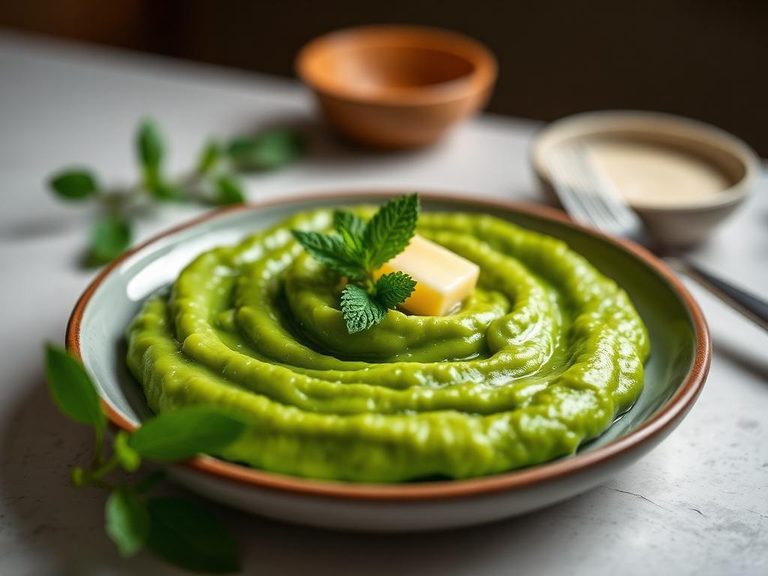
This is a smooth, vibrant green purée made from finely strained garden peas, offering a naturally sweet and earthy flavor with a velvety, spoonable texture. It's a nutritional powerhouse for its calorie count, delivering a solid 3.27g of plant-based protein and 2g of fiber per 100g, making it a surprisingly filling and nutrient-dense option for infants and toddlers.
Calorie split: 26% protein · 66% carbs · 8% fat
↓ Full nutrition💚 Why it's loved
Parents love it for its gentle, sweet taste that is often a baby's first positive experience with green vegetables, and its smooth consistency is perfect for early eaters. Its versatility allows it to be easily mixed with other purées, cereals, or meats to create balanced meals.
⚠️ Watch-outs & how to enjoy it better
Some babies may find the natural sweetness less appealing if they prefer milder flavors, and the high fiber content can occasionally cause gas or bloating in very sensitive digestive systems. To mitigate this, introduce it gradually in small portions and pair it with a little fat (like a drop of olive oil) to aid nutrient absorption and ease digestion.
Key benefits
- Excellent source of plant-based protein for growth and development.
- High in dietary fiber to support healthy digestion.
- Rich in vitamins A and C, which support immune function.
- Provides iron and folate, essential for cellular health.
- Naturally low in fat and contains no added sugars.
🍽️ Popular dishes
🌍 Where it's eaten
💡 Did you know?
Peas are technically a fruit, as they develop from a flower and contain seeds, though they are culinarily treated as a vegetable.
Full nutrition (USDA data · scales with serving)
| Water | 87.5 g |
| Energy | 50.0 kcal |
| Energy | 211 kj |
| Protein | 3.3 g |
| Total lipid (fat) | 0.43 g |
| Ash | 0.42 g |
| Carbohydrate, by difference | 8.4 g |
| Fiber, total dietary | 2.0 g |
| Total Sugars | 2.0 g |
| Sucrose | 2.0 g |
| Glucose | 0.00 g |
| Fructose | 0.00 g |
| Lactose | 0.00 g |
| Maltose | 0.00 g |
| Galactose | 0.00 g |
| Starch | 2.3 g |
| Calcium, Ca | 18.0 mg |
| Iron, Fe | 0.95 mg |
| Magnesium, Mg | 17.0 mg |
| Phosphorus, P | 50.0 mg |
| Potassium, K | 106 mg |
| Sodium, Na | 5.0 mg |
| Zinc, Zn | 0.47 mg |
| Copper, Cu | 0.06 mg |
| Manganese, Mn | 0.22 mg |
| Selenium, Se | 0.10 ug |
| Fluoride, F | 22.8 ug |
| Vitamin C, total ascorbic acid | 0.60 mg |
| Thiamin | 0.09 mg |
| Riboflavin | 0.07 mg |
| Niacin | 1.1 mg |
| Pantothenic acid | 0.07 mg |
| Vitamin B-6 | 0.02 mg |
| Folate, total | 28.0 ug |
| Folic acid | 0.00 ug |
| Folate, food | 28.0 ug |
| Folate, DFE | 28.0 ug |
| Choline, total | 32.2 mg |
| Betaine | 0.50 mg |
| Vitamin B-12 | 0.00 ug |
| Vitamin B-12, added | 0.00 ug |
| Vitamin A, RAE | 11.0 ug |
| Retinol | 0.00 ug |
| Carotene, beta | 124 ug |
| Carotene, alpha | 11.0 ug |
| Cryptoxanthin, beta | 0.00 ug |
| Vitamin A, IU | 216 iu |
| Lycopene | 0.00 ug |
| Lutein + zeaxanthin | 1465 ug |
| Vitamin E (alpha-tocopherol) | 0.02 mg |
| Vitamin E, added | 0.00 mg |
| Tocopherol, beta | 0.00 mg |
| Tocopherol, gamma | 0.67 mg |
| Tocopherol, delta | 0.02 mg |
| Tocotrienol, alpha | 0.01 mg |
| Tocotrienol, beta | 0.00 mg |
| Tocotrienol, gamma | 0.00 mg |
| Tocotrienol, delta | 0.00 mg |
| Vitamin D (D2 + D3), International Units | 0.00 iu |
| Vitamin D (D2 + D3) | 0.00 ug |
| Vitamin K (phylloquinone) | 15.5 ug |
| Vitamin K (Dihydrophylloquinone) | 0.00 ug |
| Vitamin K (Menaquinone-4) | 0.00 ug |
| Alcohol, ethyl | 0.00 g |
| Caffeine | 0.00 mg |
| Theobromine | 0.00 mg |
Fat & fatty acid profile (per 100g)
| Fatty acids, total saturated | 0.07 g |
| SFA 4:0 | 0.00 g |
| SFA 6:0 | 0.00 g |
| SFA 8:0 | 0.00 g |
| SFA 10:0 | 0.00 g |
| SFA 12:0 | 0.00 g |
| SFA 14:0 | 0.00 g |
| SFA 15:0 | 0.00 g |
| SFA 16:0 | 0.07 g |
| SFA 17:0 | 0.00 g |
| SFA 18:0 | 0.00 g |
| SFA 20:0 | 0.00 g |
| SFA 22:0 | 0.00 g |
| SFA 24:0 | 0.00 g |
| Fatty acids, total monounsaturated | 0.05 g |
| MUFA 14:1 | 0.00 g |
| MUFA 15:1 | 0.00 g |
| MUFA 16:1 | 0.00 g |
| MUFA 17:1 | 0.00 g |
| MUFA 18:1 | 0.05 g |
| MUFA 20:1 | 0.00 g |
| MUFA 22:1 | 0.00 g |
| MUFA 24:1 c | 0.00 g |
| Fatty acids, total polyunsaturated | 0.20 g |
| PUFA 18:2 | 0.17 g |
| PUFA 18:3 | 0.03 g |
| PUFA 18:4 | 0.00 g |
| PUFA 20:2 n-6 c,c | 0.00 g |
| PUFA 20:3 | 0.00 g |
| PUFA 20:4 | 0.00 g |
| PUFA 20:5 n-3 (EPA) | 0.00 g |
| PUFA 21:5 | 0.00 g |
| PUFA 22:4 | 0.00 g |
| PUFA 22:5 n-3 (DPA) | 0.00 g |
| PUFA 22:6 n-3 (DHA) | 0.00 g |
| Cholesterol | 0.00 mg |
Amino acid profile (per 100g)
Estimated from Babyfood, grape juice, no sugar, canned — USDA does not publish this profile for Babyfood.
| Threonine | 0.02 g |
| Isoleucine | 0.01 g |
| Leucine | 0.02 g |
| Lysine | 0.02 g |
| Methionine | 0.03 g |
| Cystine | 0.01 g |
| Phenylalanine | 0.02 g |
| Tyrosine | 0.02 g |
| Valine | 0.02 g |
| Arginine | 0.06 g |
| Histidine | 0.03 g |
| Alanine | 0.04 g |
| Aspartic acid | 0.10 g |
| Glutamic acid | 0.18 g |
| Glycine | 0.03 g |
| Proline | 0.03 g |
| Serine | 0.04 g |
FAQ
Is this suitable for a 6-month-old baby?
Yes, strained pea purée is typically introduced around 6 months when babies start solids, as its smooth texture is easy to swallow and digest.
Can I mix it with other foods?
Absolutely. It blends well with other vegetable or fruit purées, infant cereals, or puréed meats to create a more complex flavor and balanced nutrition.
How should I store it after opening?
Once opened, transfer any unused purée to a sealed container, refrigerate, and use within 48 hours for optimal freshness and safety.
Nutrient density (calculated · NRF9.3)
Nutrient Rich Foods index: beneficial nutrients (protein, fiber, vitamins, minerals) minus saturated fat, added sugar & sodium, per 100 kcal.
NRF9.3 index — Fulgoni, Keast & Drewnowski, 2009. Computed from USDA nutrients.
Weight-loss friendliness (composite index)
Energy density 0.50 kcal/g · 26% calories from protein · 2.0 g fiber · 2.0 g sugar per 100 g.
Composite of energy density (Rolls et al., 1999), protein & fiber satiety, minus sugar. A calculated heuristic — ranks satiety-per-calorie, not a clinical measure.
Dietary load (calculated from USDA values)
Potential renal acid load. Positive = acid-forming, negative = alkaline-forming.
Sodium-to-potassium ratio: 0.05 (lower is better — aim for ≤ 1)
Sodium:potassium per WHO potassium guidance. Computed from USDA nutrients.