

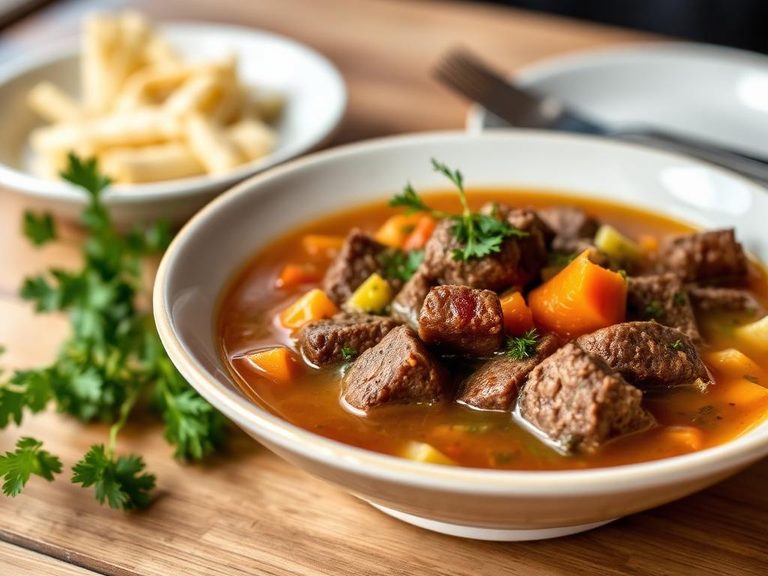
Babyfood, dinner, vegetables and beef, strained
Whole food · Baby Foods

Photo: Wikipedia
A smooth, savory purée of finely strained vegetables and tender beef, this baby food offers a mild, earthy sweetness with a velvety texture. It's a nutrient-dense first food, packing a solid protein punch (2.21g) and a balanced mix of carbs and healthy fats (3.6g) for growing bodies. The gentle cooking process preserves the natural flavors while ensuring easy digestion for tiny tummies.
Calorie split: 12% protein · 46% carbs · 42% fat
↓ Full nutrition💚 Why it's loved
Parents appreciate its reliable, balanced nutrition in a convenient, no-fuss format that babies readily accept. The familiar, comforting flavors of beef and vegetables make it a staple in many cultures' first-food traditions, symbolizing a wholesome start.
⚠️ Watch-outs & how to enjoy it better
The mild, uniform flavor can be unexciting for older toddlers or adults seeking complexity. Some brands may have a slightly metallic aftertaste from the canning process. To counteract this, mix a small spoonful with a bit of the baby's familiar fruit purée or offer it at room temperature to enhance its natural flavors.
Key benefits
- Excellent source of high-quality protein for muscle and tissue development.
- Contains iron from beef, crucial for cognitive function and preventing anemia.
- Provides a balanced mix of complex carbohydrates and healthy fats for sustained energy.
- Naturally low in sugar (2.34g) and free from added salts or preservatives.
- The smooth, strained texture is ideal for babies transitioning to solid foods.
🍽️ Popular dishes
🌍 Where it's eaten
💡 Did you know?
The 'strained' process, which gives this food its signature smoothness, was pioneered in the early 20th century by companies like Gerber, revolutionizing infant feeding by making commercial baby food widely accessible and safe.
Full nutrition (USDA data · scales with serving)
| Water | 84.9 g |
| Energy | 77.0 kcal |
| Energy | 321 kj |
| Protein | 2.2 g |
| Total lipid (fat) | 3.6 g |
| Ash | 0.41 g |
| Carbohydrate, by difference | 8.8 g |
| Fiber, total dietary | 1.3 g |
| Total Sugars | 2.3 g |
| Sucrose | 1.0 g |
| Glucose | 0.63 g |
| Fructose | 0.58 g |
| Lactose | 0.00 g |
| Maltose | 0.12 g |
| Galactose | 0.00 g |
| Starch | 0.03 g |
| Calcium, Ca | 17.0 mg |
| Iron, Fe | 0.35 mg |
| Magnesium, Mg | 10.0 mg |
| Phosphorus, P | 33.0 mg |
| Potassium, K | 145 mg |
| Sodium, Na | 31.0 mg |
| Zinc, Zn | 0.38 mg |
| Copper, Cu | 0.03 mg |
| Manganese, Mn | 0.18 mg |
| Selenium, Se | 2.2 ug |
| Vitamin C, total ascorbic acid | 0.20 mg |
| Thiamin | 0.01 mg |
| Riboflavin | 0.05 mg |
| Niacin | 0.79 mg |
| Pantothenic acid | 0.10 mg |
| Vitamin B-6 | 0.06 mg |
| Folate, total | 6.0 ug |
| Folic acid | 3.0 ug |
| Folate, food | 3.0 ug |
| Folate, DFE | 7.0 ug |
| Choline, total | 16.5 mg |
| Betaine | 1.1 mg |
| Vitamin B-12 | 0.18 ug |
| Vitamin B-12, added | 0.00 ug |
| Vitamin A, RAE | 246 ug |
| Retinol | 0.00 ug |
| Carotene, beta | 2545 ug |
| Carotene, alpha | 810 ug |
| Cryptoxanthin, beta | 11.0 ug |
| Vitamin A, IU | 4926 iu |
| Lycopene | 627 ug |
| Lutein + zeaxanthin | 51.0 ug |
| Vitamin E (alpha-tocopherol) | 0.49 mg |
| Vitamin E, added | 0.00 mg |
| Tocopherol, beta | 0.00 mg |
| Tocopherol, gamma | 0.17 mg |
| Tocopherol, delta | 0.00 mg |
| Tocotrienol, alpha | 0.03 mg |
| Tocotrienol, beta | 0.00 mg |
| Tocotrienol, gamma | 0.01 mg |
| Tocotrienol, delta | 0.00 mg |
| Vitamin D (D2 + D3), International Units | 1.0 iu |
| Vitamin D (D2 + D3) | 0.00 ug |
| Vitamin K (phylloquinone) | 5.2 ug |
| Vitamin K (Dihydrophylloquinone) | 0.00 ug |
| Vitamin K (Menaquinone-4) | 0.40 ug |
| Alcohol, ethyl | 0.00 g |
| Caffeine | 0.00 mg |
| Theobromine | 0.00 mg |
Fat & fatty acid profile (per 100g)
| Fatty acids, total saturated | 0.87 g |
| SFA 4:0 | 0.00 g |
| SFA 6:0 | 0.00 g |
| SFA 8:0 | 0.00 g |
| SFA 10:0 | 0.00 g |
| SFA 12:0 | 0.00 g |
| SFA 14:0 | 0.07 g |
| SFA 15:0 | 0.01 g |
| SFA 16:0 | 0.47 g |
| SFA 17:0 | 0.02 g |
| SFA 18:0 | 0.30 g |
| SFA 20:0 | 0.00 g |
| SFA 22:0 | 0.00 g |
| SFA 24:0 | 0.00 g |
| Fatty acids, total monounsaturated | 0.82 g |
| MUFA 14:1 | 0.02 g |
| MUFA 15:1 | 0.00 g |
| MUFA 16:1 | 0.07 g |
| MUFA 17:1 | 0.02 g |
| MUFA 18:1 | 0.71 g |
| MUFA 20:1 | 0.00 g |
| MUFA 22:1 | 0.00 g |
| MUFA 24:1 c | 0.00 g |
| Fatty acids, total polyunsaturated | 0.19 g |
| PUFA 18:2 | 0.14 g |
| PUFA 18:3 | 0.03 g |
| PUFA 18:4 | 0.02 g |
| PUFA 20:2 n-6 c,c | 0.00 g |
| PUFA 20:3 | 0.00 g |
| PUFA 20:4 | 0.00 g |
| PUFA 20:5 n-3 (EPA) | 0.00 g |
| PUFA 21:5 | 0.00 g |
| PUFA 22:4 | 0.00 g |
| PUFA 22:5 n-3 (DPA) | 0.00 g |
| PUFA 22:6 n-3 (DHA) | 0.00 g |
| Cholesterol | 7.0 mg |
| Phytosterols | 0.00 mg |
Amino acid profile (per 100g)
| Tryptophan | 0.02 g |
| Threonine | 0.10 g |
| Isoleucine | 0.11 g |
| Leucine | 0.19 g |
| Lysine | 0.18 g |
| Methionine | 0.06 g |
| Cystine | 0.03 g |
| Phenylalanine | 0.10 g |
| Tyrosine | 0.09 g |
| Valine | 0.13 g |
| Arginine | 0.16 g |
| Histidine | 0.07 g |
| Alanine | 0.15 g |
| Aspartic acid | 0.25 g |
| Glutamic acid | 0.40 g |
| Glycine | 0.14 g |
| Proline | 0.12 g |
| Serine | 0.10 g |
| Hydroxyproline | 0.02 g |
FAQ
At what age can I introduce this to my baby?
This strained, smooth texture is typically suitable for babies around 4-6 months old who are showing signs of readiness for solids, such as good head control and interest in food. Always consult your pediatrician.
Is the beef in this a common allergen?
Beef is a less common allergen than milk, eggs, or soy, but it can still cause reactions. Introduce it alone for a few days before mixing with other new foods to monitor for any signs of allergy.
How does the nutrition compare to homemade puréed beef and vegetables?
Commercial versions are formulated for consistent nutrition and safety. Homemade allows you to control texture, salt, and specific ingredients, but both can be part of a healthy diet. The commercial option offers convenience and guaranteed fortification.
Nutrient density (calculated · NRF9.3)
Nutrient Rich Foods index: beneficial nutrients (protein, fiber, vitamins, minerals) minus saturated fat, added sugar & sodium, per 100 kcal.
NRF9.3 index — Fulgoni, Keast & Drewnowski, 2009. Computed from USDA nutrients.
Weight-loss friendliness (composite index)
Energy density 0.77 kcal/g · 11% calories from protein · 1.3 g fiber · 2.3 g sugar per 100 g.
Composite of energy density (Rolls et al., 1999), protein & fiber satiety, minus sugar. A calculated heuristic — ranks satiety-per-calorie, not a clinical measure.
Dietary load (calculated from USDA values)
Potential renal acid load. Positive = acid-forming, negative = alkaline-forming.
Sodium-to-potassium ratio: 0.21 (lower is better — aim for ≤ 1)
Sodium:potassium per WHO potassium guidance. Computed from USDA nutrients.