OLIVE GARDEN, chicken parmigiana without pasta
Whole food · Restaurant Foods

Photo: Wikipedia
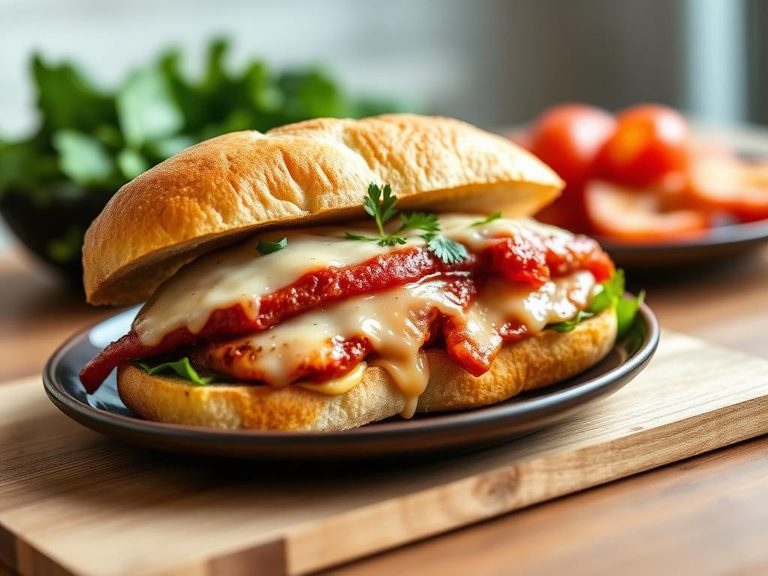
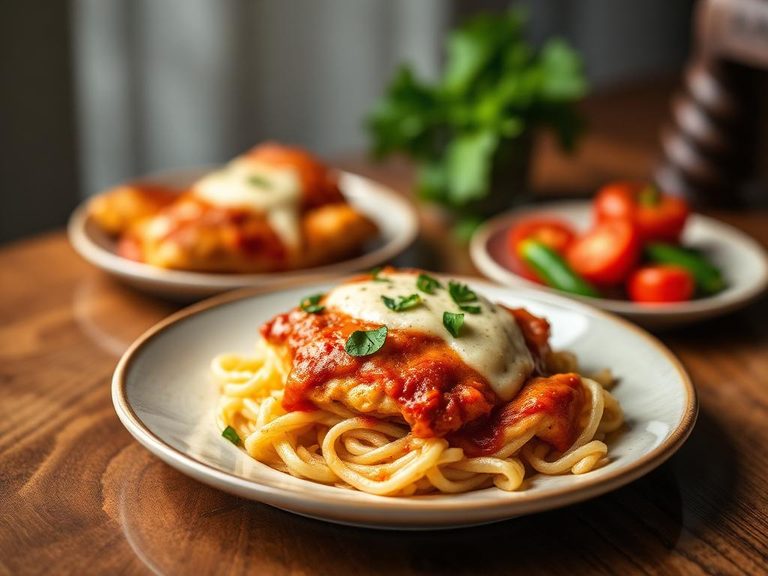
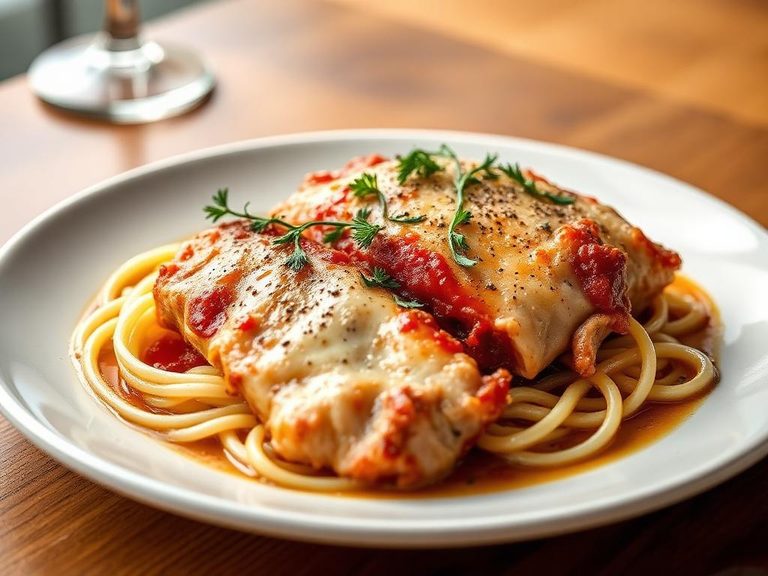
This is a classic Italian-American comfort dish: a breaded and fried chicken cutlet topped with marinara sauce and melted mozzarella and Parmesan cheeses. The texture is a satisfying contrast of crispy breading, tender chicken, and gooey, savory cheese. Nutritionally, it's a protein-rich main, but the breading and cheese add significant fat and calories.
💚 Why it's loved
People adore the universal appeal of crispy, cheesy, tomato-sauced chicken—it's a crowd-pleaser that balances savory, salty, and tangy flavors. It's also a versatile centerpiece that can be paired with many sides.
⚠️ Watch-outs & how to enjoy it better
The dish can be high in sodium, saturated fat, and refined carbs from the breading, which may not suit low-sodium or low-fat diets. To mitigate, pair it with a large, non-starchy vegetable side like steamed broccoli or a salad to add fiber and volume, and practice portion control by enjoying a single cutlet.
Key benefits
- High-quality protein source for muscle maintenance
- Contains calcium from the cheese topping
- Provides energy from carbohydrates and fats
- A familiar, satisfying comfort food
🍽️ Popular dishes
🌍 Where it's eaten
💡 Did you know?
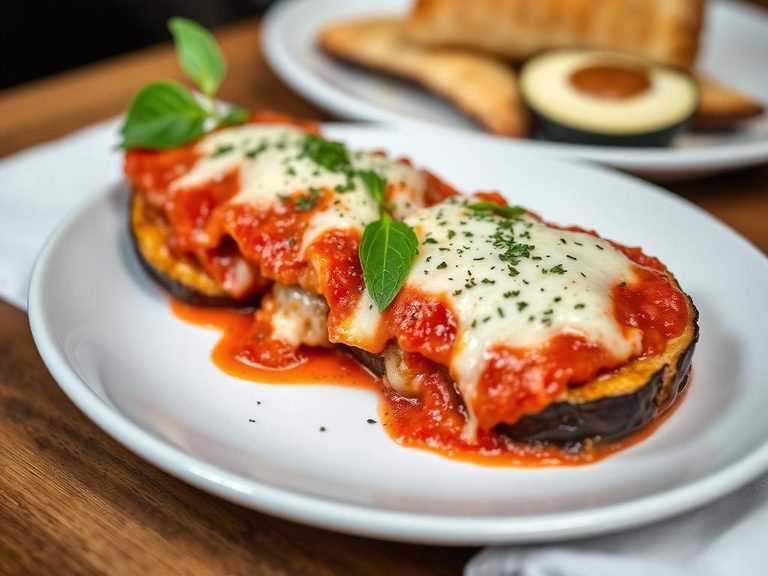
While inspired by Italian dishes like *melanzane alla parmigiana* (eggplant parm), Chicken Parmesan as we know it is largely an Italian-American invention, popularized by Italian immigrants in the United States in the mid-20th century.
Full nutrition (scales with serving)
| Water | 58.6 g |
| Energy | 211 kcal |
| Energy | 885 kj |
| Protein | 15.3 g |
| Total lipid (fat) | 11.2 g |
| Ash | 2.5 g |
| Carbohydrate, by difference | 12.3 g |
| Fiber, total dietary | 0.90 g |
| Total Sugars | 2.7 g |
| Sucrose | 0.00 g |
| Glucose | 1.0 g |
| Fructose | 0.72 g |
| Lactose | 0.51 g |
| Maltose | 0.44 g |
| Galactose | 0.00 g |
| Starch | 8.5 g |
| Calcium, Ca | 95.0 mg |
| Iron, Fe | 0.58 mg |
| Magnesium, Mg | 25.0 mg |
| Phosphorus, P | 236 mg |
| Potassium, K | 277 mg |
| Sodium, Na | 625 mg |
| Zinc, Zn | 0.86 mg |
| Copper, Cu | 0.06 mg |
| Manganese, Mn | 0.13 mg |
| Selenium, Se | 24.0 ug |
| Thiamin | 0.06 mg |
| Riboflavin | 0.16 mg |
| Niacin | 5.6 mg |
| Pantothenic acid | 0.95 mg |
| Vitamin B-6 | 0.18 mg |
| Folate, total | 16.0 ug |
| Vitamin B-12 | 0.34 ug |
| Vitamin A, RAE | 37.0 ug |
| Retinol | 29.0 ug |
| Carotene, beta | 97.0 ug |
| Carotene, alpha | 0.00 ug |
| Cryptoxanthin, beta | 0.00 ug |
| Vitamin A, IU | 259 iu |
| Lycopene | 1211 ug |
| Lutein + zeaxanthin | 59.0 ug |
| Vitamin E (alpha-tocopherol) | 1.6 mg |
| Tocopherol, beta | 0.04 mg |
| Tocopherol, gamma | 2.2 mg |
| Tocopherol, delta | 0.19 mg |
| Tocotrienol, alpha | 0.06 mg |
| Tocotrienol, beta | 0.00 mg |
| Tocotrienol, gamma | 0.07 mg |
| Tocotrienol, delta | 0.00 mg |
Fat & fatty acid profile (per 100g)
| Fatty acids, total saturated | 2.1 g |
| SFA 4:0 | 0.05 g |
| SFA 6:0 | 0.03 g |
| SFA 8:0 | 0.02 g |
| SFA 10:0 | 0.05 g |
| SFA 12:0 | 0.06 g |
| SFA 14:0 | 0.21 g |
| SFA 15:0 | 0.02 g |
| SFA 16:0 | 1.1 g |
| SFA 17:0 | 0.02 g |
| SFA 18:0 | 0.44 g |
| SFA 20:0 | 0.05 g |
| SFA 22:0 | 0.03 g |
| SFA 24:0 | 0.01 g |
| Fatty acids, total monounsaturated | 5.8 g |
| MUFA 14:1 | 0.02 g |
| MUFA 15:1 | 0.00 g |
| MUFA 16:1 | 0.09 g |
| MUFA 16:1 c | 0.09 g |
| MUFA 17:1 | 0.01 g |
| MUFA 18:1 | 5.6 g |
| MUFA 18:1 c | 5.5 g |
| MUFA 20:1 | 0.10 g |
| MUFA 22:1 | 0.00 g |
| MUFA 22:1 c | 0.00 g |
| MUFA 24:1 c | 0.01 g |
| Fatty acids, total polyunsaturated | 2.0 g |
| PUFA 18:2 | 1.7 g |
| PUFA 18:2 n-6 c,c | 1.7 g |
| PUFA 18:2 CLAs | 0.01 g |
| PUFA 18:3 | 0.23 g |
| PUFA 18:3 n-3 c,c,c (ALA) | 0.22 g |
| PUFA 18:3 n-6 c,c,c | 0.01 g |
| PUFA 18:3i | 0.00 g |
| PUFA 18:4 | 0.00 g |
| PUFA 20:2 n-6 c,c | 0.01 g |
| PUFA 20:3 | 0.01 g |
| PUFA 20:3 n-3 | 0.00 g |
| PUFA 20:3 n-6 | 0.01 g |
| PUFA 20:4 | 0.03 g |
| PUFA 20:5 n-3 (EPA) | 0.00 g |
| PUFA 22:4 | 0.01 g |
| PUFA 22:5 n-3 (DPA) | 0.00 g |
| PUFA 22:6 n-3 (DHA) | 0.00 g |
| Fatty acids, total trans | 0.10 g |
| Fatty acids, total trans-monoenoic | 0.07 g |
| TFA 16:1 t | 0.01 g |
| TFA 18:1 t | 0.06 g |
| TFA 22:1 t | 0.00 g |
| TFA 18:2 t not further defined | 0.03 g |
| Fatty acids, total trans-polyenoic | 0.03 g |
| Cholesterol | 40.0 mg |
Amino acid profile (per 100g)
| Tryptophan | 0.19 g |
| Threonine | 0.60 g |
| Isoleucine | 0.66 g |
| Leucine | 1.2 g |
| Lysine | 1.3 g |
| Methionine | 0.38 g |
| Cystine | 0.19 g |
| Phenylalanine | 1.00 g |
| Tyrosine | 0.47 g |
| Valine | 0.74 g |
| Arginine | 0.87 g |
| Histidine | 0.48 g |
| Alanine | 0.73 g |
| Aspartic acid | 1.2 g |
| Glutamic acid | 2.6 g |
| Glycine | 0.58 g |
| Proline | 1.1 g |
| Serine | 0.64 g |
| Hydroxyproline | 0.02 g |
FAQ
Is Olive Garden's chicken parmigiana baked or fried?
Typically, restaurant versions like Olive Garden's are pan-fried or deep-fried for crispiness before being topped with sauce and cheese and baked to melt.
What's the main difference between chicken parmigiana and eggplant parmigiana?
The primary difference is the main ingredient: chicken parmigiana uses a breaded chicken cutlet, while eggplant parmigiana uses slices of breaded and fried eggplant.
Can I make a lighter version at home?
Yes. You can use whole-wheat breadcrumbs, bake instead of fry the chicken, use part-skim mozzarella, and load up on the marinara sauce for flavor without extra fat.