

Yogurt, Greek, plain, whole milk
Whole food · Dairy and Egg Products

Photo: Wikipedia
Greek yogurt, plain and whole-milk, is a thick, strained dairy product with a luxuriously creamy texture and a clean, tangy flavor profile. Its straining process concentrates its nutrients, making it a protein powerhouse with a satisfying richness that sets it apart from regular yogurt.
Calorie split: 37% protein · 16% carbs · 46% fat
↓ Full nutrition💚 Why it's loved
People adore its versatile, blank-canvas tang that can be sweet or savory, and its thick, spoonable texture makes it a satisfying snack or ingredient. It's a staple in Mediterranean diets and a modern kitchen hero for adding creaminess without heavy cream.
⚠️ Watch-outs & how to enjoy it better
Its tartness can be off-putting to some, and the full-fat version is calorie-dense. Those with severe lactose intolerance or a milk protein allergy should avoid it. To mitigate the tang, pair it with sweet fruits or a drizzle of honey; for calorie control, use it as a portioned topping or mix with plain low-fat versions.
Key benefits
- Excellent source of complete protein for muscle maintenance.
- Contains probiotics that support gut health.
- Rich in calcium for bone strength.
- Provides conjugated linoleic acid (CLA), a beneficial fatty acid.
- Low in lactose compared to regular milk due to straining.
🍽️ Popular dishes
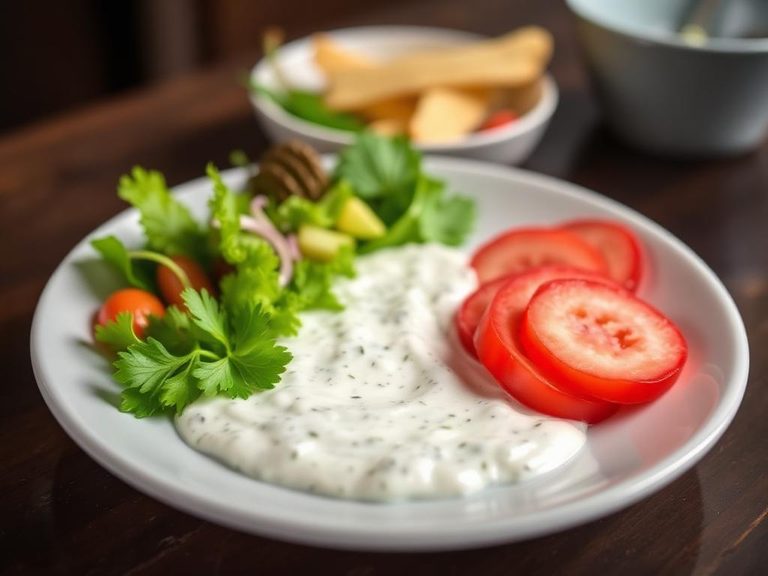


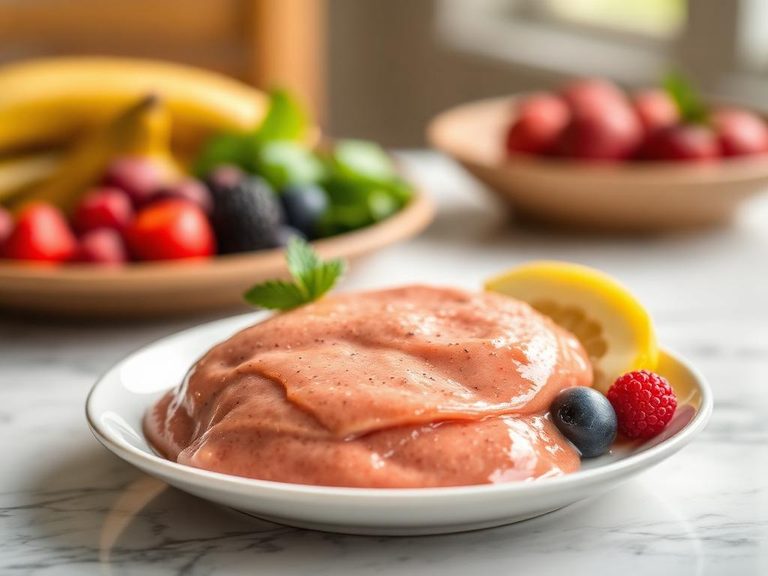

🌍 Where it's eaten
💡 Did you know?
The straining process that defines Greek yogurt can remove up to three-quarters of the original whey, concentrating the milk solids and resulting in its signature thickness and higher protein content.
Full nutrition (USDA data · scales with serving)
| Water | 81.3 g |
| Energy | 97.0 kcal |
| Energy | 406 kj |
| Protein | 9.0 g |
| Total lipid (fat) | 5.0 g |
| Ash | 0.72 g |
| Carbohydrate, by difference | 4.0 g |
| Fiber, total dietary | 0.00 g |
| Total Sugars | 4.0 g |
| Calcium, Ca | 100 mg |
| Iron, Fe | 0.00 mg |
| Magnesium, Mg | 11.0 mg |
| Phosphorus, P | 135 mg |
| Potassium, K | 141 mg |
| Sodium, Na | 35.0 mg |
| Zinc, Zn | 0.52 mg |
| Copper, Cu | 0.02 mg |
| Manganese, Mn | 0.01 mg |
| Selenium, Se | 9.7 ug |
| Vitamin C, total ascorbic acid | 0.00 mg |
| Thiamin | 0.02 mg |
| Riboflavin | 0.28 mg |
| Niacin | 0.21 mg |
| Pantothenic acid | 0.33 mg |
| Vitamin B-6 | 0.06 mg |
| Folate, total | 5.0 ug |
| Folic acid | 0.00 ug |
| Folate, food | 5.0 ug |
| Folate, DFE | 5.0 ug |
| Choline, total | 15.1 mg |
| Vitamin B-12 | 0.75 ug |
| Vitamin B-12, added | 0.00 ug |
| Vitamin A, RAE | 2.0 ug |
| Retinol | 1.0 ug |
| Carotene, beta | 7.0 ug |
| Carotene, alpha | 0.00 ug |
| Cryptoxanthin, beta | 0.00 ug |
| Vitamin A, IU | 15.0 iu |
| Lycopene | 0.00 ug |
| Lutein + zeaxanthin | 0.00 ug |
| Vitamin E (alpha-tocopherol) | 0.01 mg |
| Vitamin E, added | 0.00 mg |
| Vitamin D (D2 + D3), International Units | 0.00 iu |
| Vitamin D (D2 + D3) | 0.00 ug |
| Vitamin D2 (ergocalciferol) | 0.00 ug |
| Vitamin D3 (cholecalciferol) | 0.00 ug |
| Vitamin K (phylloquinone) | 0.00 ug |
| Alcohol, ethyl | 0.00 g |
| Caffeine | 0.00 mg |
| Theobromine | 0.00 mg |
Fat & fatty acid profile (per 100g)
| Fatty acids, total saturated | 2.4 g |
| SFA 4:0 | 0.00 g |
| SFA 6:0 | 0.05 g |
| SFA 8:0 | 0.09 g |
| SFA 10:0 | 0.26 g |
| SFA 12:0 | 0.13 g |
| SFA 14:0 | 0.32 g |
| SFA 15:0 | 0.07 g |
| SFA 16:0 | 1.0 g |
| SFA 17:0 | 0.06 g |
| SFA 18:0 | 0.42 g |
| SFA 20:0 | 0.00 g |
| SFA 22:0 | 0.00 g |
| SFA 24:0 | 0.00 g |
| Fatty acids, total monounsaturated | 2.1 g |
| MUFA 14:1 | 0.02 g |
| MUFA 15:1 | 0.00 g |
| MUFA 16:1 | 0.05 g |
| MUFA 16:1 c | 0.04 g |
| MUFA 17:1 | 0.00 g |
| MUFA 18:1 | 0.99 g |
| MUFA 18:1 c | 0.88 g |
| MUFA 20:1 | 0.03 g |
| MUFA 22:1 | 0.00 g |
| MUFA 22:1 c | 0.00 g |
| MUFA 24:1 c | 0.00 g |
| Fatty acids, total polyunsaturated | 0.47 g |
| PUFA 18:2 | 0.21 g |
| PUFA 18:2 n-6 c,c | 0.21 g |
| PUFA 18:2 CLAs | 0.00 g |
| PUFA 18:3 | 0.02 g |
| PUFA 18:3 n-3 c,c,c (ALA) | 0.02 g |
| PUFA 18:3 n-6 c,c,c | 0.00 g |
| PUFA 18:3i | 0.00 g |
| PUFA 18:4 | 0.00 g |
| PUFA 20:2 n-6 c,c | 0.00 g |
| PUFA 20:3 | 0.00 g |
| PUFA 20:3 n-3 | 0.00 g |
| PUFA 20:3 n-6 | 0.00 g |
| PUFA 20:4 | 0.00 g |
| PUFA 20:5 n-3 (EPA) | 0.00 g |
| PUFA 22:4 | 0.00 g |
| PUFA 22:5 n-3 (DPA) | 0.00 g |
| PUFA 22:6 n-3 (DHA) | 0.00 g |
| Fatty acids, total trans | 0.00 g |
| TFA 16:1 t | 0.01 g |
| TFA 18:1 t | 0.11 g |
| TFA 22:1 t | 0.00 g |
| TFA 18:2 t not further defined | 0.00 g |
| Cholesterol | 13.0 mg |
Amino acid profile (per 100g)
Estimated from Yogurt, fruit variety, nonfat — USDA does not publish this profile for Yogurt.
| Tryptophan | 0.03 g |
| Threonine | 0.20 g |
| Isoleucine | 0.27 g |
| Leucine | 0.50 g |
| Lysine | 0.44 g |
| Methionine | 0.14 g |
| Cystine | 0.04 g |
| Phenylalanine | 0.27 g |
| Tyrosine | 0.25 g |
| Valine | 0.41 g |
| Arginine | 0.15 g |
| Histidine | 0.12 g |
| Alanine | 0.21 g |
| Aspartic acid | 0.39 g |
| Glutamic acid | 0.97 g |
| Glycine | 0.12 g |
| Proline | 0.58 g |
| Serine | 0.30 g |
FAQ
What's the difference between Greek yogurt and regular yogurt?
Greek yogurt is strained to remove most of the liquid whey, resulting in a thicker, creamier texture and a higher concentration of protein and fat compared to regular, unstrained yogurt.
Is plain Greek yogurt high in sugar?
No, plain Greek yogurt contains only naturally occurring milk sugars (lactose), typically around 4g per 100g. Flavored varieties can have significantly added sugars.
Can I use Greek yogurt in cooking and baking?
Absolutely. It's a popular substitute for sour cream, mayonnaise, or buttermilk in recipes, adding moisture, tang, and protein while reducing fat content in some dishes.
Nutrient density (calculated · NRF9.3)
Nutrient Rich Foods index: beneficial nutrients (protein, fiber, vitamins, minerals) minus saturated fat, added sugar & sodium, per 100 kcal.
NRF9.3 index — Fulgoni, Keast & Drewnowski, 2009. Computed from USDA nutrients.
Weight-loss friendliness (composite index)
Energy density 0.97 kcal/g · 37% calories from protein · 0.0 g fiber · 4.0 g sugar per 100 g.
Composite of energy density (Rolls et al., 1999), protein & fiber satiety, minus sugar. A calculated heuristic — ranks satiety-per-calorie, not a clinical measure.
Dietary load (calculated from USDA values)
Potential renal acid load. Positive = acid-forming, negative = alkaline-forming.
Sodium-to-potassium ratio: 0.25 (lower is better — aim for ≤ 1)
Sodium:potassium per WHO potassium guidance. Computed from USDA nutrients.