

Fast foods, cheeseburger; single, regular patty, with condiments
Whole food · Fast Foods
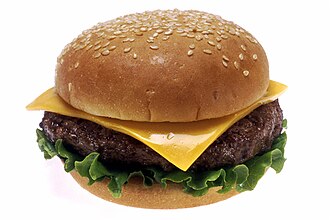
Photo: Wikipedia
The classic single-patty cheeseburger is a handheld icon of American fast food, featuring a seared beef patty melted with American cheese, nestled in a soft, toasted bun and dressed with ketchup, mustard, and pickles. Its texture is a satisfying contrast of juicy, savory meat, gooey cheese, and a soft, slightly sweet bun. Nutritionally, it's a dense source of protein and energy, with over 13g of protein per 100g.
Calorie split: 20% protein · 37% carbs · 43% fat
↓ Full nutrition💚 Why it's loved
People love it for the umami-rich, savory flavor combination of beef, melted cheese, and tangy condiments, all in a convenient, handheld package. It's a cultural staple of casual dining, cookouts, and late-night cravings, symbolizing comfort and simplicity.
⚠️ Watch-outs & how to enjoy it better
The high sodium content from processed cheese, condiments, and bun can contribute to water retention and is a concern for those monitoring blood pressure. The refined white bun and sugary ketchup can cause a rapid blood-sugar spike. To counteract, pair it with a side salad or non-starchy vegetables for fiber, choose mustard over ketchup to reduce sugar, and be mindful of portion size.
Key benefits
- Provides a complete protein source from beef and dairy
- Offers quick energy from carbohydrates
- Contains essential minerals like iron and zinc from beef
- A convenient, calorie-dense meal for active individuals
- The cheese adds calcium and vitamin B12
🍽️ Popular dishes

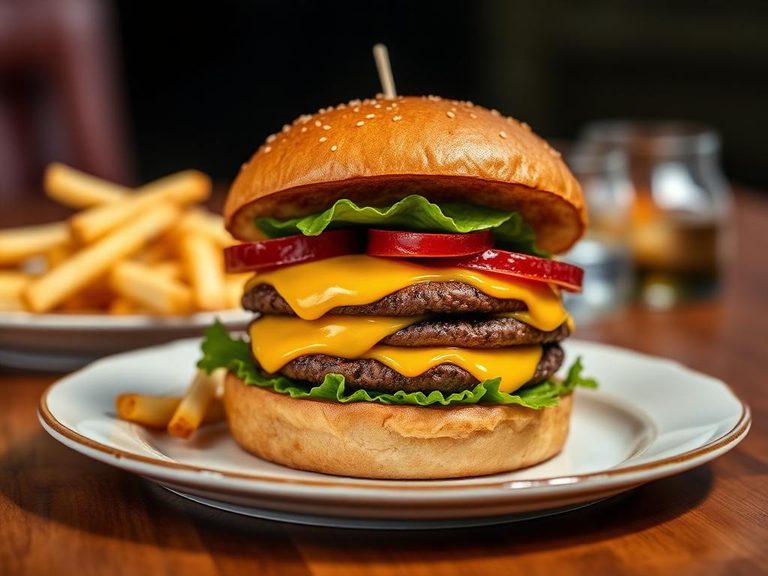
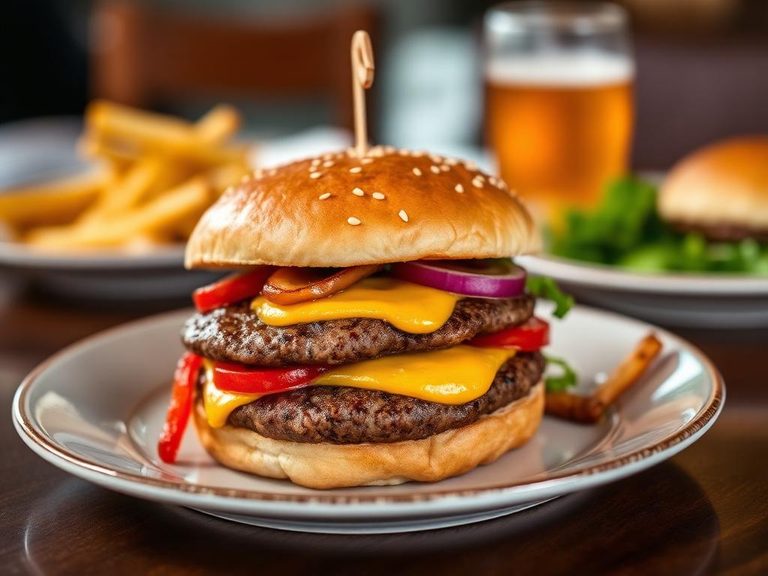

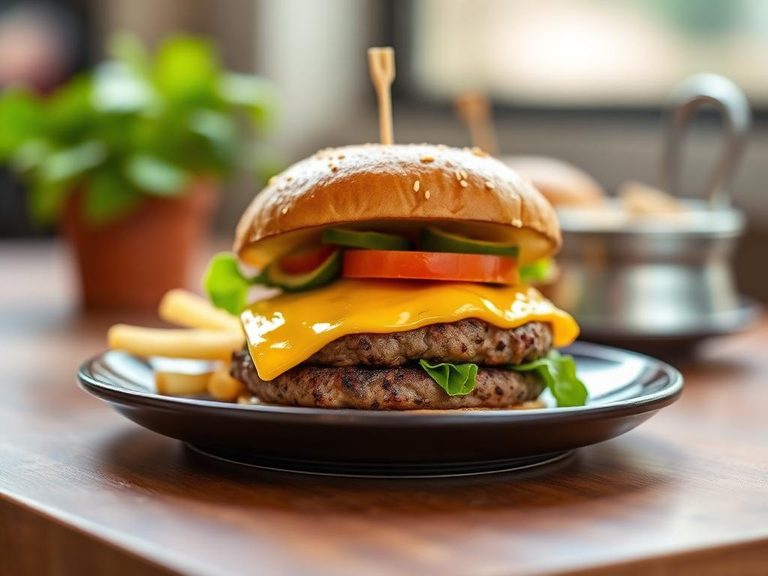
🌍 Where it's eaten
💡 Did you know?
The cheeseburger was reportedly invented in the 1920s or 1930s by multiple claimants, but a 1934 trademark application by Louis Ballast of Denver, Colorado, for a 'cheeseburger' sandwich is often cited as a key moment.
Full nutrition (USDA data · scales with serving)
| Water | 45.8 g |
| Energy | 270 kcal |
| Energy | 1128 kj |
| Protein | 13.5 g |
| Total lipid (fat) | 12.9 g |
| Ash | 2.4 g |
| Carbohydrate, by difference | 25.5 g |
| Fiber, total dietary | 1.9 g |
| Total Sugars | 5.2 g |
| Sucrose | 0.61 g |
| Glucose | 1.8 g |
| Fructose | 2.0 g |
| Lactose | 0.24 g |
| Maltose | 0.48 g |
| Galactose | 0.15 g |
| Starch | 18.2 g |
| Calcium, Ca | 123 mg |
| Iron, Fe | 2.3 mg |
| Magnesium, Mg | 23.0 mg |
| Phosphorus, P | 142 mg |
| Potassium, K | 184 mg |
| Sodium, Na | 628 mg |
| Zinc, Zn | 2.2 mg |
| Copper, Cu | 0.10 mg |
| Manganese, Mn | 0.25 mg |
| Selenium, Se | 22.7 ug |
| Vitamin C, total ascorbic acid | 0.40 mg |
| Thiamin | 0.32 mg |
| Riboflavin | 0.19 mg |
| Niacin | 3.5 mg |
| Pantothenic acid | 0.42 mg |
| Vitamin B-6 | 0.37 mg |
| Folate, total | 26.0 ug |
| Folic acid | 19.0 ug |
| Folate, food | 7.0 ug |
| Folate, DFE | 39.0 ug |
| Choline, total | 33.4 mg |
| Vitamin B-12 | 1.3 ug |
| Vitamin B-12, added | 0.00 ug |
| Vitamin A, RAE | 55.0 ug |
| Retinol | 50.0 ug |
| Carotene, beta | 55.0 ug |
| Carotene, alpha | 1.0 ug |
| Cryptoxanthin, beta | 2.0 ug |
| Vitamin A, IU | 261 iu |
| Lycopene | 1003 ug |
| Lutein + zeaxanthin | 22.0 ug |
| Vitamin E (alpha-tocopherol) | 0.09 mg |
| Vitamin E, added | 0.00 mg |
| Tocopherol, beta | 0.00 mg |
| Tocopherol, gamma | 0.34 mg |
| Tocopherol, delta | 0.10 mg |
| Tocotrienol, beta | 0.00 mg |
| Tocotrienol, gamma | 0.00 mg |
| Tocotrienol, delta | 0.00 mg |
| Vitamin D (D2 + D3), International Units | 3.0 iu |
| Vitamin D (D2 + D3) | 0.10 ug |
| Vitamin K (phylloquinone) | 5.5 ug |
| Vitamin K (Dihydrophylloquinone) | 0.20 ug |
| Alcohol, ethyl | 0.00 g |
| Caffeine | 0.00 mg |
| Theobromine | 0.00 mg |
Fat & fatty acid profile (per 100g)
| Fatty acids, total saturated | 5.8 g |
| SFA 4:0 | 0.09 g |
| SFA 6:0 | 0.06 g |
| SFA 8:0 | 0.04 g |
| SFA 10:0 | 0.08 g |
| SFA 12:0 | 0.10 g |
| SFA 14:0 | 0.58 g |
| SFA 15:0 | 0.07 g |
| SFA 16:0 | 3.0 g |
| SFA 17:0 | 0.12 g |
| SFA 18:0 | 1.6 g |
| SFA 20:0 | 0.02 g |
| SFA 22:0 | 0.01 g |
| SFA 24:0 | 0.01 g |
| Fatty acids, total monounsaturated | 5.0 g |
| MUFA 14:1 | 0.08 g |
| MUFA 15:1 | 0.00 g |
| MUFA 16:1 | 0.42 g |
| MUFA 16:1 c | 0.38 g |
| MUFA 17:1 | 0.04 g |
| MUFA 18:1 | 4.5 g |
| MUFA 18:1 c | 4.0 g |
| MUFA 20:1 | 0.03 g |
| MUFA 22:1 | 0.01 g |
| Fatty acids, total polyunsaturated | 1.4 g |
| PUFA 18:2 | 1.2 g |
| PUFA 18:2 n-6 c,c | 1.1 g |
| PUFA 18:2 i | 0.07 g |
| PUFA 18:3 | 0.12 g |
| PUFA 18:3 n-3 c,c,c (ALA) | 0.12 g |
| PUFA 18:4 | 0.03 g |
| PUFA 20:2 n-6 c,c | 0.00 g |
| PUFA 20:3 | 0.00 g |
| PUFA 20:3 n-6 | 0.00 g |
| PUFA 20:4 | 0.02 g |
| PUFA 20:4 n-6 | 0.02 g |
| PUFA 20:5 n-3 (EPA) | 0.00 g |
| PUFA 22:5 n-3 (DPA) | 0.00 g |
| PUFA 22:6 n-3 (DHA) | 0.00 g |
| TFA 16:1 t | 0.04 g |
| TFA 18:1 t | 0.51 g |
| Cholesterol | 39.0 mg |
Amino acid profile (per 100g)
Estimated from Fast foods, english muffin, with egg, cheese, and sausage — USDA does not publish this profile for Fast foods.
| Tryptophan | 0.16 g |
| Threonine | 0.52 g |
| Isoleucine | 0.54 g |
| Leucine | 0.98 g |
| Lysine | 0.75 g |
| Methionine | 0.29 g |
| Cystine | 0.20 g |
| Phenylalanine | 0.59 g |
| Tyrosine | 0.41 g |
| Valine | 0.65 g |
| Arginine | 0.65 g |
| Histidine | 0.33 g |
| Alanine | 0.60 g |
| Aspartic acid | 1.1 g |
| Glutamic acid | 2.5 g |
| Glycine | 0.54 g |
| Proline | 0.90 g |
| Serine | 0.70 g |
FAQ
Is a cheeseburger a good source of protein?
Yes, a standard single-patty cheeseburger provides a significant amount of high-quality complete protein, essential for muscle repair and growth.
How can I make a cheeseburger healthier?
You can opt for a leaner ground beef or turkey patty, use a whole-grain bun, load up on vegetable toppings like lettuce, tomato, and onion, and choose mustard or salsa instead of sugary ketchup.
What is the main nutritional concern with fast-food cheeseburgers?
The primary concerns are typically high sodium content, which can affect blood pressure, and the presence of refined carbohydrates and added sugars in the bun and condiments, which can impact blood sugar levels.
Nutrient density (calculated · NRF9.3)
Nutrient Rich Foods index: beneficial nutrients (protein, fiber, vitamins, minerals) minus saturated fat, added sugar & sodium, per 100 kcal.
NRF9.3 index — Fulgoni, Keast & Drewnowski, 2009. Computed from USDA nutrients.
Weight-loss friendliness (composite index)
Energy density 2.70 kcal/g · 20% calories from protein · 1.9 g fiber · 5.2 g sugar per 100 g.
Composite of energy density (Rolls et al., 1999), protein & fiber satiety, minus sugar. A calculated heuristic — ranks satiety-per-calorie, not a clinical measure.
Dietary load (calculated from USDA values)
Potential renal acid load. Positive = acid-forming, negative = alkaline-forming.
Sodium-to-potassium ratio: 3.41 (lower is better — aim for ≤ 1)
Sodium:potassium per WHO potassium guidance. Computed from USDA nutrients.