

Fast Food, Pizza Chain, 14" pizza, pepperoni topping, thick crust
Whole food · Fast Foods

Photo: Wikipedia
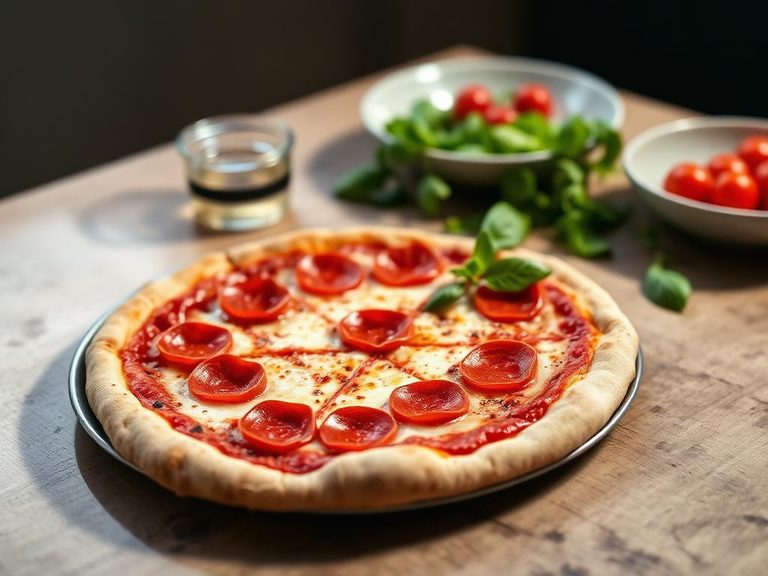
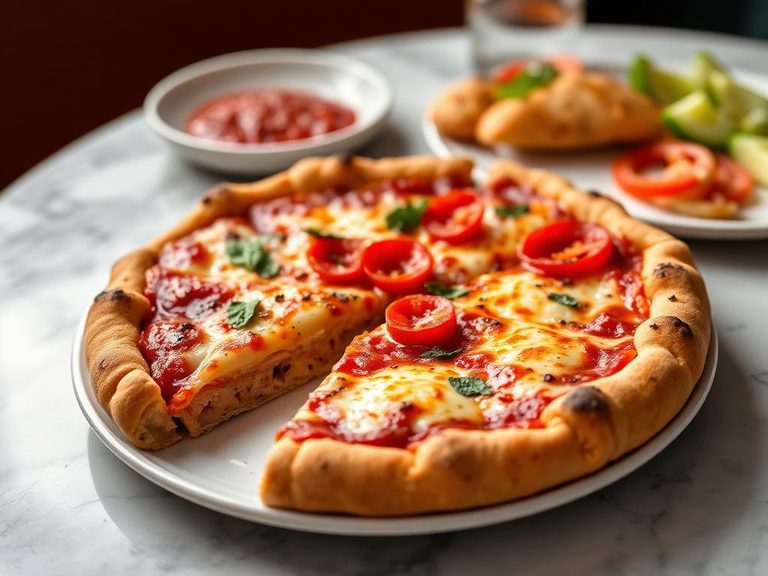
This is a hearty slice of pepperoni pizza from a major chain, featuring a thick, bready crust that offers a chewy, satisfying bite. The salty, spicy pepperoni curls and crisps, releasing savory oils that meld with the melted cheese and tangy tomato sauce. Nutritionally, it's a calorie-dense meal, with over 12g of fat and nearly 32g of carbs per 100g, making it a substantial source of energy.
Calorie split: 16% protein · 44% carbs · 40% fat
↓ Full nutrition💚 Why it's loved
People love it for the iconic, craveable combination of salty, spicy pepperoni, gooey cheese, and a sturdy, bready crust that holds up to the toppings. It's a cultural staple for casual gatherings, game nights, and quick family meals, embodying comfort and convenience.
⚠️ Watch-outs & how to enjoy it better
The high sodium, saturated fat, and refined carbohydrate content can contribute to blood-sugar spikes and is less ideal for those managing heart health or diabetes. To counteract, practice portion control (stick to 1-2 slices), pair it with a large, vinegar-dressed side salad to add fiber and slow digestion, and ensure the rest of your day's meals are lower in sodium and refined carbs.
Key benefits
- Provides a quick and dense source of energy from carbohydrates and fats
- Offers a good amount of protein (11.49g per 100g) for muscle maintenance
- Contains calcium from the cheese, important for bone health
- Convenient and widely available for a satisfying meal
🍽️ Popular dishes

🌍 Where it's eaten
💡 Did you know?
The classic pepperoni used on American pizza is actually an Italian-American invention; in Italy, 'peperoni' (with one 'p') are bell peppers.
Full nutrition (USDA data · scales with serving)
| Water | 41.5 g |
| Energy | 287 kcal |
| Energy | 1199 kj |
| Protein | 11.5 g |
| Total lipid (fat) | 12.6 g |
| Ash | 2.5 g |
| Carbohydrate, by difference | 31.8 g |
| Fiber, total dietary | 2.2 g |
| Total Sugars | 2.9 g |
| Sucrose | 0.17 g |
| Glucose | 0.47 g |
| Fructose | 0.65 g |
| Lactose | 0.52 g |
| Maltose | 1.1 g |
| Galactose | 0.08 g |
| Starch | 24.9 g |
| Calcium, Ca | 148 mg |
| Iron, Fe | 2.5 mg |
| Magnesium, Mg | 23.0 mg |
| Phosphorus, P | 195 mg |
| Potassium, K | 189 mg |
| Sodium, Na | 684 mg |
| Zinc, Zn | 1.4 mg |
| Copper, Cu | 0.11 mg |
| Manganese, Mn | 0.36 mg |
| Selenium, Se | 20.0 ug |
| Vitamin C, total ascorbic acid | 0.70 mg |
| Thiamin | 0.39 mg |
| Riboflavin | 0.20 mg |
| Niacin | 3.5 mg |
| Vitamin B-6 | 0.08 mg |
| Folate, total | 103 ug |
| Folic acid | 57.0 ug |
| Folate, food | 46.0 ug |
| Folate, DFE | 143 ug |
| Choline, total | 24.8 mg |
| Vitamin B-12 | 0.51 ug |
| Vitamin B-12, added | 0.00 ug |
| Vitamin A, RAE | 71.0 ug |
| Retinol | 63.0 ug |
| Carotene, beta | 95.0 ug |
| Carotene, alpha | 0.00 ug |
| Cryptoxanthin, beta | 0.00 ug |
| Vitamin A, IU | 367 iu |
| Lycopene | 1966 ug |
| Lutein + zeaxanthin | 23.0 ug |
| Vitamin E (alpha-tocopherol) | 0.87 mg |
| Vitamin E, added | 0.00 mg |
| Vitamin D (D2 + D3), International Units | 0.00 iu |
| Vitamin D (D2 + D3) | 0.00 ug |
| Vitamin K (phylloquinone) | 11.5 ug |
| Alcohol, ethyl | 0.00 g |
| Caffeine | 0.00 mg |
| Theobromine | 0.00 mg |
Fat & fatty acid profile (per 100g)
| Fatty acids, total saturated | 4.8 g |
| SFA 4:0 | 0.09 g |
| SFA 6:0 | 0.07 g |
| SFA 8:0 | 0.04 g |
| SFA 10:0 | 0.12 g |
| SFA 12:0 | 0.14 g |
| SFA 14:0 | 0.53 g |
| SFA 15:0 | 0.06 g |
| SFA 16:0 | 2.5 g |
| SFA 17:0 | 0.06 g |
| SFA 18:0 | 1.1 g |
| SFA 20:0 | 0.03 g |
| SFA 22:0 | 0.02 g |
| SFA 24:0 | 0.01 g |
| Fatty acids, total monounsaturated | 3.7 g |
| MUFA 14:1 | 0.05 g |
| MUFA 15:1 | 0.00 g |
| MUFA 16:1 | 0.18 g |
| MUFA 16:1 c | 0.16 g |
| MUFA 17:1 | 0.03 g |
| MUFA 18:1 | 3.4 g |
| MUFA 18:1 c | 3.2 g |
| MUFA 20:1 | 0.07 g |
| MUFA 22:1 | 0.01 g |
| MUFA 22:1 c | 0.01 g |
| MUFA 24:1 c | 0.00 g |
| Fatty acids, total polyunsaturated | 3.0 g |
| PUFA 18:2 | 2.6 g |
| PUFA 18:2 n-6 c,c | 2.5 g |
| PUFA 18:2 CLAs | 0.04 g |
| PUFA 18:3 | 0.30 g |
| PUFA 18:3 n-3 c,c,c (ALA) | 0.30 g |
| PUFA 18:3 n-6 c,c,c | 0.00 g |
| PUFA 18:4 | 0.00 g |
| PUFA 20:2 n-6 c,c | 0.02 g |
| PUFA 20:3 | 0.01 g |
| PUFA 20:3 n-3 | 0.00 g |
| PUFA 20:3 n-6 | 0.01 g |
| PUFA 20:4 | 0.02 g |
| PUFA 20:5 n-3 (EPA) | 0.00 g |
| PUFA 22:4 | 0.01 g |
| PUFA 22:5 n-3 (DPA) | 0.01 g |
| PUFA 22:6 n-3 (DHA) | 0.00 g |
| Fatty acids, total trans | 0.30 g |
| Fatty acids, total trans-monoenoic | 0.24 g |
| TFA 16:1 t | 0.02 g |
| TFA 18:1 t | 0.22 g |
| TFA 22:1 t | 0.00 g |
| TFA 18:2 t not further defined | 0.06 g |
| Fatty acids, total trans-polyenoic | 0.06 g |
| Cholesterol | 24.0 mg |
Amino acid profile (per 100g)
Estimated from Fast foods, nachos, with cheese — USDA does not publish this profile for Fast Food.
| Tryptophan | 0.04 g |
| Threonine | 0.16 g |
| Isoleucine | 0.19 g |
| Leucine | 0.52 g |
| Lysine | 0.16 g |
| Methionine | 0.09 g |
| Phenylalanine | 0.23 g |
| Tyrosine | 0.14 g |
| Valine | 0.25 g |
| Arginine | 0.21 g |
| Histidine | 0.14 g |
| Alanine | 0.29 g |
| Aspartic acid | 0.34 g |
| Glutamic acid | 0.92 g |
| Glycine | 0.15 g |
| Proline | 0.53 g |
| Serine | 0.22 g |
| Hydroxyproline | 0.00 g |
FAQ
Is this type of pizza a good source of protein?
Yes, it provides a moderate amount of protein (11.49g per 100g), primarily from the cheese and pepperoni, which can help with satiety and muscle maintenance.
How does the thick crust affect its nutrition compared to thin crust?
The thick, bready crust significantly increases the carbohydrate and calorie content per slice compared to a thin-crust version, making it more filling but also more energy-dense.
What is the main nutritional concern with pepperoni as a topping?
Pepperoni is a processed meat that is high in sodium and saturated fat. Consuming it in large quantities is often advised against for long-term heart health.
Nutrient density (calculated · NRF9.3)
Nutrient Rich Foods index: beneficial nutrients (protein, fiber, vitamins, minerals) minus saturated fat, added sugar & sodium, per 100 kcal.
NRF9.3 index — Fulgoni, Keast & Drewnowski, 2009. Computed from USDA nutrients.
Weight-loss friendliness (composite index)
Energy density 2.87 kcal/g · 16% calories from protein · 2.2 g fiber · 2.9 g sugar per 100 g.
Composite of energy density (Rolls et al., 1999), protein & fiber satiety, minus sugar. A calculated heuristic — ranks satiety-per-calorie, not a clinical measure.
Dietary load (calculated from USDA values)
Potential renal acid load. Positive = acid-forming, negative = alkaline-forming.
Sodium-to-potassium ratio: 3.62 (lower is better — aim for ≤ 1)
Sodium:potassium per WHO potassium guidance. Computed from USDA nutrients.