

Chicken, dark meat, drumstick, meat and skin, with added solution, cooked, braised
Whole food · Poultry Products
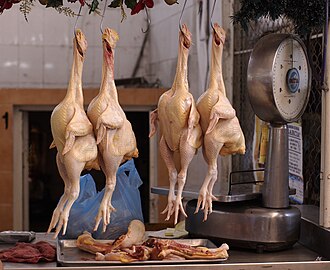
Photo: Wikipedia
This is a succulent chicken drumstick, braised with its skin on in a flavorful liquid solution, resulting in a deeply savory, fall-off-the-bone tender piece of meat. The skin renders into a rich, gelatinous layer, while the dark meat becomes incredibly moist and infused with the cooking broth. It's a high-protein, low-carb staple that delivers substantial flavor and satiety.
Calorie split: 47% protein · 0% carbs · 53% fat
↓ Full nutrition💚 Why it's loved
People adore it for the unparalleled savory depth and comforting, home-cooked flavor that braising develops. The combination of tender meat and flavorful, softened skin makes it a universally satisfying centerpiece for a hearty meal.
⚠️ Watch-outs & how to enjoy it better
The braising solution can be high in sodium, and the skin adds significant saturated fat. Those monitoring sodium intake or heart health should be cautious. To counteract, use a low-sodium broth for braising, remove the skin before eating, and pair with a large serving of potassium-rich vegetables like steamed broccoli or a fresh salad to help balance sodium.
Key benefits
- Excellent source of complete protein for muscle maintenance
- Rich in iron and zinc from dark poultry meat
- Provides B vitamins, especially niacin and B6
- Low in carbohydrates, suitable for low-carb diets
- Braising helps retain moisture and nutrients
🍽️ Popular dishes
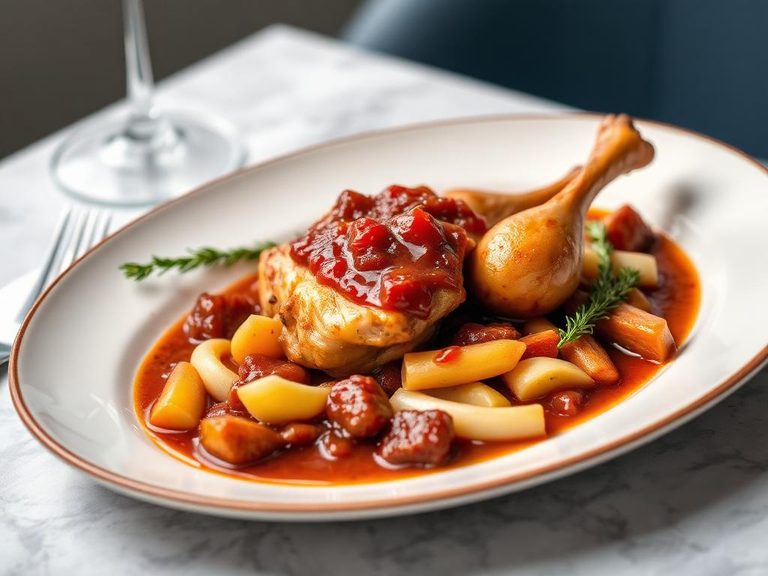
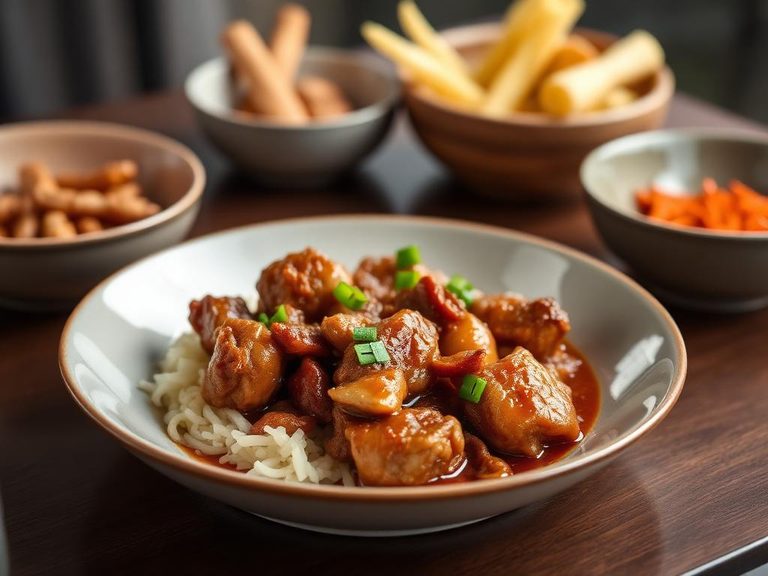


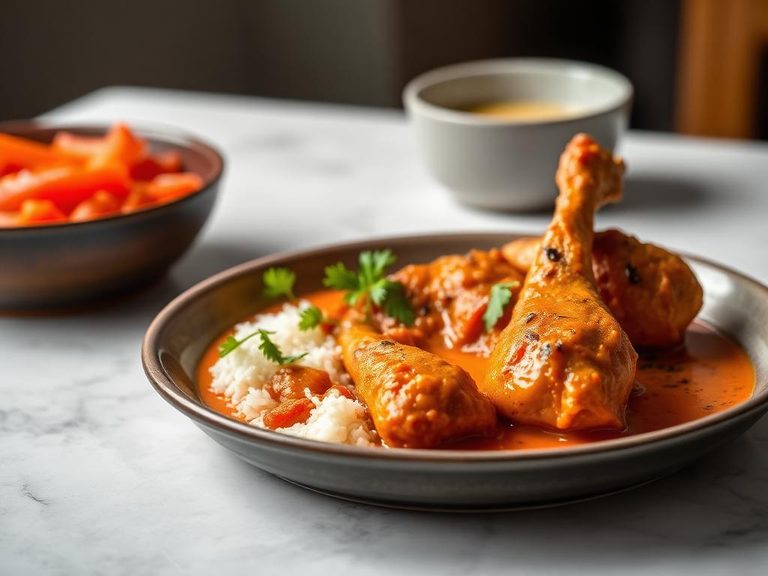
🌍 Where it's eaten
💡 Did you know?
The 'added solution' in the description often refers to a brine or stock that can increase the raw weight by up to 15%, meaning you're paying for and cooking with added liquid that becomes part of the final flavorful braise.
Full nutrition (USDA data · scales with serving)
| Water | 67.1 g |
| Energy | 183 kcal |
| Energy | 766 kj |
| Protein | 21.6 g |
| Total lipid (fat) | 10.7 g |
| Ash | 1.1 g |
| Carbohydrate, by difference | 0.13 g |
| Fiber, total dietary | 0.00 g |
| Total Sugars | 0.00 g |
| Calcium, Ca | 14.0 mg |
| Iron, Fe | 0.76 mg |
| Magnesium, Mg | 20.0 mg |
| Phosphorus, P | 162 mg |
| Potassium, K | 218 mg |
| Sodium, Na | 165 mg |
| Zinc, Zn | 2.1 mg |
| Copper, Cu | 0.05 mg |
| Manganese, Mn | 0.01 mg |
| Selenium, Se | 27.9 ug |
| Vitamin C, total ascorbic acid | 0.00 mg |
| Thiamin | 0.08 mg |
| Riboflavin | 0.14 mg |
| Niacin | 4.8 mg |
| Vitamin B-6 | 0.29 mg |
| Folate, total | 4.0 ug |
| Folic acid | 0.00 ug |
| Folate, food | 4.0 ug |
| Folate, DFE | 4.0 ug |
| Choline, total | 64.7 mg |
| Betaine | 10.7 mg |
| Vitamin B-12 | 0.30 ug |
| Vitamin B-12, added | 0.00 ug |
| Vitamin A, RAE | 12.0 ug |
| Retinol | 12.0 ug |
| Carotene, beta | 0.00 ug |
| Carotene, alpha | 0.00 ug |
| Cryptoxanthin, beta | 0.00 ug |
| Vitamin A, IU | 40.0 iu |
| Lycopene | 0.00 ug |
| Lutein + zeaxanthin | 0.00 ug |
| Vitamin E (alpha-tocopherol) | 0.17 mg |
| Vitamin E, added | 0.00 mg |
| Vitamin D (D2 + D3), International Units | 3.0 iu |
| Vitamin D (D2 + D3) | 0.10 ug |
| Vitamin D3 (cholecalciferol) | 0.10 ug |
| Vitamin K (phylloquinone) | 3.3 ug |
| Alcohol, ethyl | 0.00 g |
| Caffeine | 0.00 mg |
| Theobromine | 0.00 mg |
Fat & fatty acid profile (per 100g)
| Fatty acids, total saturated | 2.9 g |
| SFA 4:0 | 0.00 g |
| SFA 6:0 | 0.00 g |
| SFA 8:0 | 0.00 g |
| SFA 10:0 | 0.00 g |
| SFA 12:0 | 0.01 g |
| SFA 14:0 | 0.06 g |
| SFA 15:0 | 0.01 g |
| SFA 16:0 | 2.3 g |
| SFA 17:0 | 0.01 g |
| SFA 18:0 | 0.57 g |
| SFA 20:0 | 0.01 g |
| SFA 22:0 | 0.01 g |
| SFA 24:0 | 0.00 g |
| Fatty acids, total monounsaturated | 4.6 g |
| MUFA 14:1 | 0.02 g |
| MUFA 15:1 | 0.00 g |
| MUFA 16:1 | 0.75 g |
| MUFA 16:1 c | 0.74 g |
| MUFA 17:1 | 0.01 g |
| MUFA 18:1 | 3.7 g |
| MUFA 18:1 c | 3.7 g |
| MUFA 20:1 | 0.05 g |
| MUFA 22:1 | 0.00 g |
| MUFA 22:1 c | 0.00 g |
| MUFA 24:1 c | 0.00 g |
| Fatty acids, total polyunsaturated | 2.2 g |
| PUFA 18:2 | 2.0 g |
| PUFA 18:2 n-6 c,c | 1.9 g |
| PUFA 18:2 CLAs | 0.01 g |
| PUFA 18:3 | 0.10 g |
| PUFA 18:3 n-3 c,c,c (ALA) | 0.09 g |
| PUFA 18:3 n-6 c,c,c | 0.01 g |
| PUFA 18:4 | 0.00 g |
| PUFA 20:2 n-6 c,c | 0.01 g |
| PUFA 20:3 | 0.03 g |
| PUFA 20:3 n-3 | 0.00 g |
| PUFA 20:3 n-6 | 0.03 g |
| PUFA 20:4 | 0.09 g |
| PUFA 20:5 n-3 (EPA) | 0.00 g |
| PUFA 22:4 | 0.02 g |
| PUFA 22:5 n-3 (DPA) | 0.01 g |
| PUFA 22:6 n-3 (DHA) | 0.01 g |
| Fatty acids, total trans | 0.06 g |
| Fatty acids, total trans-monoenoic | 0.04 g |
| TFA 16:1 t | 0.01 g |
| TFA 18:1 t | 0.04 g |
| TFA 22:1 t | 0.00 g |
| TFA 18:2 t not further defined | 0.02 g |
| Fatty acids, total trans-polyenoic | 0.02 g |
| Cholesterol | 133 mg |
Amino acid profile (per 100g)
| Tryptophan | 0.23 g |
| Threonine | 0.99 g |
| Isoleucine | 1.00 g |
| Leucine | 1.8 g |
| Lysine | 2.0 g |
| Methionine | 0.60 g |
| Cystine | 0.25 g |
| Phenylalanine | 0.84 g |
| Tyrosine | 0.79 g |
| Valine | 1.0 g |
| Arginine | 1.5 g |
| Histidine | 0.63 g |
| Alanine | 1.3 g |
| Aspartic acid | 2.1 g |
| Glutamic acid | 3.5 g |
| Glycine | 1.1 g |
| Proline | 0.93 g |
| Serine | 0.89 g |
FAQ
Is braised chicken drumstick healthy?
It's a nutritious source of protein and minerals. Healthiness depends on preparation; using a low-sodium solution and removing the skin reduces fat and salt while retaining the protein and key nutrients.
How do I get the meat to fall off the bone?
The key is low, slow cooking. Braise at a gentle simmer (around 325°F/160°C) for 45-60 minutes until the internal temperature reaches 165°F (74°C) and the meat is very tender.
What's the difference between this and roasted chicken drumstick?
Braising cooks the chicken in liquid, resulting in very moist, tender meat infused with the broth's flavor. Roasting uses dry heat, which crisps the skin more but can dry out the meat if overcooked.
Nutrient density (calculated · NRF9.3)
Nutrient Rich Foods index: beneficial nutrients (protein, fiber, vitamins, minerals) minus saturated fat, added sugar & sodium, per 100 kcal.
NRF9.3 index — Fulgoni, Keast & Drewnowski, 2009. Computed from USDA nutrients.
Weight-loss friendliness (composite index)
Energy density 1.83 kcal/g · 47% calories from protein · 0.0 g fiber · 0.0 g sugar per 100 g.
Composite of energy density (Rolls et al., 1999), protein & fiber satiety, minus sugar. A calculated heuristic — ranks satiety-per-calorie, not a clinical measure.
Dietary load (calculated from USDA values)
Potential renal acid load. Positive = acid-forming, negative = alkaline-forming.
Sodium-to-potassium ratio: 0.76 (lower is better — aim for ≤ 1)
Sodium:potassium per WHO potassium guidance. Computed from USDA nutrients.