

Cheese, cream, low fat
Whole food · Dairy and Egg Products

Photo: Wikipedia
Low-fat cream cheese is a smooth, spreadable dairy product with a mild, tangy flavor and a rich, creamy texture, though slightly less decadent than its full-fat counterpart. Nutritionally, it provides a good source of protein (7.85g per 100g) while significantly reducing the fat content compared to regular cream cheese. It's a versatile staple for both sweet and savory applications.
Calorie split: 15% protein · 13% carbs · 72% fat
↓ Full nutrition💚 Why it's loved
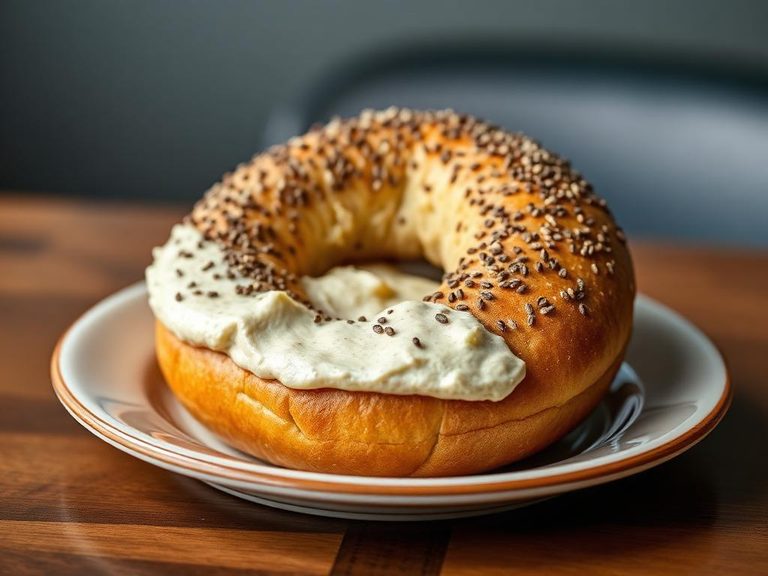
People love its incredibly smooth, spreadable texture and mild tang that enhances flavors without overpowering them. Its versatility makes it a kitchen workhorse, equally at home on a bagel, in a cheesecake, or as a base for savory dips and sauces.
⚠️ Watch-outs & how to enjoy it better
As a dairy product, it's a common allergen and contains lactose, which can cause digestive issues for some. Its sodium content can be notable, and it's often used in dishes high in sugar or refined carbs. To counteract, pair it with fiber-rich foods like vegetables or whole-grain crackers, and be mindful of portion sizes in sweet applications.
Key benefits
- Good source of protein per serving
- Significantly lower in fat than regular cream cheese
- Provides calcium and some B vitamins
- Versatile for both sweet and savory recipes
- Can help with portion control in calorie-conscious diets
🍽️ Popular dishes

🌍 Where it's eaten
💡 Did you know?
Cream cheese was first made in America in 1872 by William Lawrence, who was trying to replicate the French cheese Neufchâtel and accidentally created a richer, spreadable version.
Full nutrition (USDA data · scales with serving)
| Water | 66.7 g |
| Energy | 208 kcal |
| Energy | 872 kj |
| Protein | 7.8 g |
| Total lipid (fat) | 16.7 g |
| Ash | 2.0 g |
| Carbohydrate, by difference | 6.7 g |
| Fiber, total dietary | 0.00 g |
| Total Sugars | 3.3 g |
| Sucrose | 0.00 g |
| Glucose | 0.00 g |
| Fructose | 0.00 g |
| Lactose | 3.3 g |
| Maltose | 0.00 g |
| Galactose | 0.00 g |
| Starch | 1.4 g |
| Calcium, Ca | 148 mg |
| Iron, Fe | 0.17 mg |
| Magnesium, Mg | 8.0 mg |
| Phosphorus, P | 152 mg |
| Potassium, K | 247 mg |
| Sodium, Na | 317 mg |
| Zinc, Zn | 0.57 mg |
| Copper, Cu | 0.03 mg |
| Manganese, Mn | 0.01 mg |
| Selenium, Se | 4.0 ug |
| Vitamin C, total ascorbic acid | 0.00 mg |
| Thiamin | 0.04 mg |
| Riboflavin | 0.18 mg |
| Niacin | 0.13 mg |
| Pantothenic acid | 0.84 mg |
| Vitamin B-6 | 0.04 mg |
| Folate, total | 19.0 ug |
| Folic acid | 0.00 ug |
| Folate, food | 19.0 ug |
| Folate, DFE | 19.0 ug |
| Choline, total | 12.1 mg |
| Vitamin B-12 | 0.92 ug |
| Vitamin B-12, added | 0.00 ug |
| Vitamin A, RAE | 161 ug |
| Retinol | 160 ug |
| Carotene, beta | 11.0 ug |
| Carotene, alpha | 0.00 ug |
| Cryptoxanthin, beta | 0.00 ug |
| Vitamin A, IU | 552 iu |
| Lycopene | 0.00 ug |
| Lutein + zeaxanthin | 0.00 ug |
| Vitamin E (alpha-tocopherol) | 0.27 mg |
| Vitamin E, added | 0.00 mg |
| Tocopherol, beta | 0.00 mg |
| Tocopherol, gamma | 0.02 mg |
| Tocopherol, delta | 0.00 mg |
| Tocotrienol, alpha | 0.00 mg |
| Tocotrienol, beta | 0.00 mg |
| Tocotrienol, gamma | 0.00 mg |
| Tocotrienol, delta | 0.00 mg |
| Vitamin D (D2 + D3), International Units | 11.0 iu |
| Vitamin D (D2 + D3) | 0.30 ug |
| Vitamin D3 (cholecalciferol) | 0.30 ug |
| Vitamin K (phylloquinone) | 1.1 ug |
| Vitamin K (Dihydrophylloquinone) | 0.00 ug |
| Vitamin K (Menaquinone-4) | 5.4 ug |
| Alcohol, ethyl | 0.00 g |
| Caffeine | 0.00 mg |
| Theobromine | 0.00 mg |
Fat & fatty acid profile (per 100g)
| Fatty acids, total saturated | 10.0 g |
| SFA 4:0 | 0.51 g |
| SFA 6:0 | 0.15 g |
| SFA 8:0 | 0.17 g |
| SFA 10:0 | 0.40 g |
| SFA 12:0 | 0.44 g |
| SFA 14:0 | 1.4 g |
| SFA 15:0 | 0.15 g |
| SFA 16:0 | 4.0 g |
| SFA 17:0 | 0.08 g |
| SFA 18:0 | 1.7 g |
| SFA 20:0 | 0.02 g |
| SFA 22:0 | 0.00 g |
| Fatty acids, total monounsaturated | 4.0 g |
| MUFA 14:1 | 0.12 g |
| MUFA 15:1 | 0.00 g |
| MUFA 16:1 | 0.21 g |
| MUFA 17:1 | 0.02 g |
| MUFA 18:1 | 3.6 g |
| MUFA 20:1 | 0.01 g |
| MUFA 22:1 | 0.00 g |
| Fatty acids, total polyunsaturated | 0.57 g |
| PUFA 18:2 | 0.46 g |
| PUFA 18:3 | 0.08 g |
| PUFA 18:3 n-3 c,c,c (ALA) | 0.08 g |
| PUFA 18:3 n-6 c,c,c | 0.00 g |
| PUFA 18:4 | 0.00 g |
| PUFA 20:2 n-6 c,c | 0.00 g |
| PUFA 20:3 | 0.00 g |
| PUFA 20:4 | 0.03 g |
| PUFA 20:5 n-3 (EPA) | 0.00 g |
| PUFA 22:5 n-3 (DPA) | 0.00 g |
| PUFA 22:6 n-3 (DHA) | 0.00 g |
| Cholesterol | 54.0 mg |
Amino acid profile (per 100g)
| Tryptophan | 0.09 g |
| Threonine | 0.31 g |
| Isoleucine | 0.43 g |
| Leucine | 0.87 g |
| Lysine | 0.75 g |
| Methionine | 0.25 g |
| Cystine | 0.06 g |
| Phenylalanine | 0.38 g |
| Tyrosine | 0.40 g |
| Valine | 0.52 g |
| Arginine | 0.31 g |
| Histidine | 0.23 g |
| Alanine | 0.24 g |
| Aspartic acid | 0.68 g |
| Glutamic acid | 1.7 g |
| Glycine | 0.19 g |
| Proline | 0.88 g |
| Serine | 0.49 g |
| Hydroxyproline | 0.00 g |
FAQ
How is low-fat cream cheese made?
It's made by blending cream and milk, then adding lactic acid bacteria to thicken it. For the low-fat version, a significant portion of the milkfat is removed before or during processing, resulting in a product with less fat but a similar tangy flavor and texture.
Can I substitute it for regular cream cheese in recipes?
Yes, but with adjustments. It has a higher water content and less fat, so baked goods like cheesecake may be less rich and could weep. For dips and frostings, it works well. For baking, consider adding a tablespoon of butter or oil to compensate for the missing fat.
Is it a good source of calcium?
Yes, it provides a decent amount of calcium, which is important for bone health. A typical serving contributes a noticeable portion of your daily recommended intake.
Nutrient density (calculated · NRF9.3)
Nutrient Rich Foods index: beneficial nutrients (protein, fiber, vitamins, minerals) minus saturated fat, added sugar & sodium, per 100 kcal.
NRF9.3 index — Fulgoni, Keast & Drewnowski, 2009. Computed from USDA nutrients.
Weight-loss friendliness (composite index)
Energy density 2.08 kcal/g · 15% calories from protein · 0.0 g fiber · 3.3 g sugar per 100 g.
Composite of energy density (Rolls et al., 1999), protein & fiber satiety, minus sugar. A calculated heuristic — ranks satiety-per-calorie, not a clinical measure.
Dietary load (calculated from USDA values)
Potential renal acid load. Positive = acid-forming, negative = alkaline-forming.
Sodium-to-potassium ratio: 1.28 (lower is better — aim for ≤ 1)
Sodium:potassium per WHO potassium guidance. Computed from USDA nutrients.