

Babyfood, vegetables, squash, junior
Whole food · Baby Foods

Photo: Wikipedia
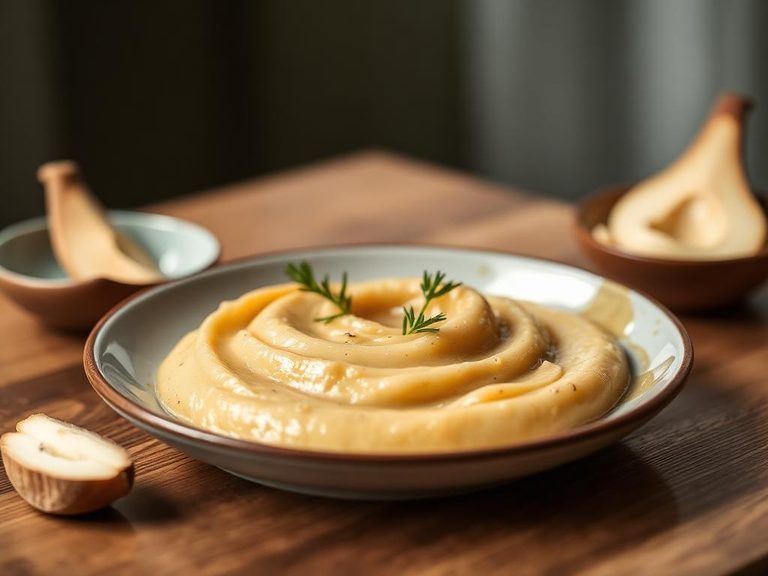
This is a smooth, velvety puree of winter squash, specifically prepared for babies transitioning to more complex flavors. Its naturally sweet, mild taste and silky texture make it a gentle introduction to vegetables, offering a comforting, earthy sweetness without any added sugars or salt. Nutritionally, it's a light, low-calorie source of carbs and fiber, perfect for tiny tummies.
Calorie split: 12% protein · 82% carbs · 6% fat
↓ Full nutrition💚 Why it's loved
Parents love it for its mild, crowd-pleasing sweetness that even picky eaters often accept. Its smooth consistency makes it incredibly versatile—it can be mixed into cereals, yogurt, or other purees to add nutrients and flavor.
⚠️ Watch-outs & how to enjoy it better
The high natural sugar content (3.24g per 100g) can cause rapid blood sugar spikes if served alone in large portions. To counteract this, always pair it with a source of protein or fat, like a spoonful of full-fat yogurt, mashed lentils, or a sprinkle of ground flaxseed, to slow sugar absorption.
Key benefits
- Naturally sweet flavor encourages vegetable acceptance in infants.
- Good source of dietary fiber for digestive health.
- Provides beta-carotene (vitamin A precursor) for vision and immunity.
- Low in fat and contains no added sodium or sugars.
- Smooth texture is ideal for early spoon-feeding stages.
🍽️ Popular dishes
🌍 Where it's eaten
💡 Did you know?
Winter squash like butternut, which is commonly used for this baby food, is botanically a fruit but treated as a culinary vegetable. Its seeds are edible and packed with protein and magnesium.
Full nutrition (USDA data · scales with serving)
| Water | 92.7 g |
| Energy | 24.0 kcal |
| Energy | 101 kj |
| Protein | 0.81 g |
| Total lipid (fat) | 0.20 g |
| Ash | 0.60 g |
| Carbohydrate, by difference | 5.7 g |
| Fiber, total dietary | 0.90 g |
| Total Sugars | 3.2 g |
| Sucrose | 1.2 g |
| Glucose | 1.1 g |
| Fructose | 0.96 g |
| Lactose | 0.00 g |
| Maltose | 0.00 g |
| Galactose | 0.00 g |
| Starch | 1.2 g |
| Calcium, Ca | 24.0 mg |
| Iron, Fe | 0.32 mg |
| Magnesium, Mg | 14.0 mg |
| Phosphorus, P | 21.0 mg |
| Potassium, K | 185 mg |
| Sodium, Na | 5.0 mg |
| Zinc, Zn | 0.19 mg |
| Copper, Cu | 0.03 mg |
| Manganese, Mn | 0.08 mg |
| Selenium, Se | 0.20 ug |
| Fluoride, F | 1.0 ug |
| Vitamin C, total ascorbic acid | 0.30 mg |
| Thiamin | 0.03 mg |
| Riboflavin | 0.05 mg |
| Niacin | 0.68 mg |
| Pantothenic acid | 0.21 mg |
| Vitamin B-6 | 0.07 mg |
| Folate, total | 8.0 ug |
| Folic acid | 0.00 ug |
| Folate, food | 8.0 ug |
| Folate, DFE | 8.0 ug |
| Choline, total | 7.6 mg |
| Betaine | 0.30 mg |
| Vitamin B-12 | 0.00 ug |
| Vitamin B-12, added | 0.00 ug |
| Vitamin A, RAE | 85.0 ug |
| Retinol | 0.00 ug |
| Carotene, beta | 896 ug |
| Carotene, alpha | 242 ug |
| Cryptoxanthin, beta | 9.0 ug |
| Vitamin A, IU | 1703 iu |
| Lycopene | 0.00 ug |
| Lutein + zeaxanthin | 3527 ug |
| Vitamin E (alpha-tocopherol) | 0.55 mg |
| Vitamin E, added | 0.00 mg |
| Tocopherol, beta | 0.00 mg |
| Tocopherol, gamma | 0.11 mg |
| Tocopherol, delta | 0.00 mg |
| Tocotrienol, alpha | 0.00 mg |
| Tocotrienol, beta | 0.00 mg |
| Tocotrienol, gamma | 0.00 mg |
| Tocotrienol, delta | 0.00 mg |
| Vitamin D (D2 + D3), International Units | 0.00 iu |
| Vitamin D (D2 + D3) | 0.00 ug |
| Vitamin K (phylloquinone) | 4.7 ug |
| Vitamin K (Dihydrophylloquinone) | 0.00 ug |
| Vitamin K (Menaquinone-4) | 0.00 ug |
| Alcohol, ethyl | 0.00 g |
| Caffeine | 0.00 mg |
| Theobromine | 0.00 mg |
Fat & fatty acid profile (per 100g)
| Fatty acids, total saturated | 0.02 g |
| SFA 4:0 | 0.00 g |
| SFA 6:0 | 0.00 g |
| SFA 8:0 | 0.00 g |
| SFA 10:0 | 0.00 g |
| SFA 12:0 | 0.00 g |
| SFA 14:0 | 0.00 g |
| SFA 15:0 | 0.00 g |
| SFA 16:0 | 0.02 g |
| SFA 17:0 | 0.00 g |
| SFA 18:0 | 0.00 g |
| SFA 20:0 | 0.00 g |
| SFA 22:0 | 0.00 g |
| SFA 24:0 | 0.00 g |
| Fatty acids, total monounsaturated | 0.02 g |
| MUFA 14:1 | 0.00 g |
| MUFA 15:1 | 0.00 g |
| MUFA 16:1 | 0.00 g |
| MUFA 17:1 | 0.00 g |
| MUFA 18:1 | 0.02 g |
| MUFA 20:1 | 0.00 g |
| MUFA 22:1 | 0.00 g |
| MUFA 24:1 c | 0.00 g |
| Fatty acids, total polyunsaturated | 0.04 g |
| PUFA 18:2 | 0.03 g |
| PUFA 18:3 | 0.01 g |
| PUFA 18:4 | 0.00 g |
| PUFA 20:2 n-6 c,c | 0.00 g |
| PUFA 20:3 | 0.00 g |
| PUFA 20:4 | 0.00 g |
| PUFA 20:5 n-3 (EPA) | 0.00 g |
| PUFA 21:5 | 0.00 g |
| PUFA 22:4 | 0.00 g |
| PUFA 22:5 n-3 (DPA) | 0.00 g |
| PUFA 22:6 n-3 (DHA) | 0.00 g |
| Cholesterol | 0.00 mg |
Amino acid profile (per 100g)
Estimated from Babyfood, grape juice, no sugar, canned — USDA does not publish this profile for Babyfood.
| Threonine | 0.02 g |
| Isoleucine | 0.01 g |
| Leucine | 0.02 g |
| Lysine | 0.02 g |
| Methionine | 0.03 g |
| Cystine | 0.01 g |
| Phenylalanine | 0.02 g |
| Tyrosine | 0.02 g |
| Valine | 0.02 g |
| Arginine | 0.06 g |
| Histidine | 0.03 g |
| Alanine | 0.04 g |
| Aspartic acid | 0.10 g |
| Glutamic acid | 0.18 g |
| Glycine | 0.03 g |
| Proline | 0.03 g |
| Serine | 0.04 g |
FAQ
Is this the same as pumpkin puree?
Not exactly. While both are winter squash, 'squash' in baby food often refers to sweeter varieties like butternut. Pumpkin puree can be more fibrous and less sweet. Nutritionally, they are very similar, but the flavor profile differs slightly.
Can I make this at home?
Absolutely. Steam or roast a peeled, seeded winter squash (like butternut) until very tender, then blend with a little water or unsalted broth until perfectly smooth. Let it cool completely before serving.
At what age can I introduce this?
This is typically introduced as a first food around 6 months, when babies show signs of readiness for solids. Its mild flavor and smooth texture make it a common early choice.
Nutrient density (calculated · NRF9.3)
Nutrient Rich Foods index: beneficial nutrients (protein, fiber, vitamins, minerals) minus saturated fat, added sugar & sodium, per 100 kcal.
NRF9.3 index — Fulgoni, Keast & Drewnowski, 2009. Computed from USDA nutrients.
Weight-loss friendliness (composite index)
Energy density 0.24 kcal/g · 14% calories from protein · 0.9 g fiber · 3.2 g sugar per 100 g.
Composite of energy density (Rolls et al., 1999), protein & fiber satiety, minus sugar. A calculated heuristic — ranks satiety-per-calorie, not a clinical measure.
Dietary load (calculated from USDA values)
Potential renal acid load. Positive = acid-forming, negative = alkaline-forming.
Sodium-to-potassium ratio: 0.03 (lower is better — aim for ≤ 1)
Sodium:potassium per WHO potassium guidance. Computed from USDA nutrients.