Cookies, chocolate chip, commercially prepared, soft-type
Whole food · Baked Products

Photo: Wikipedia
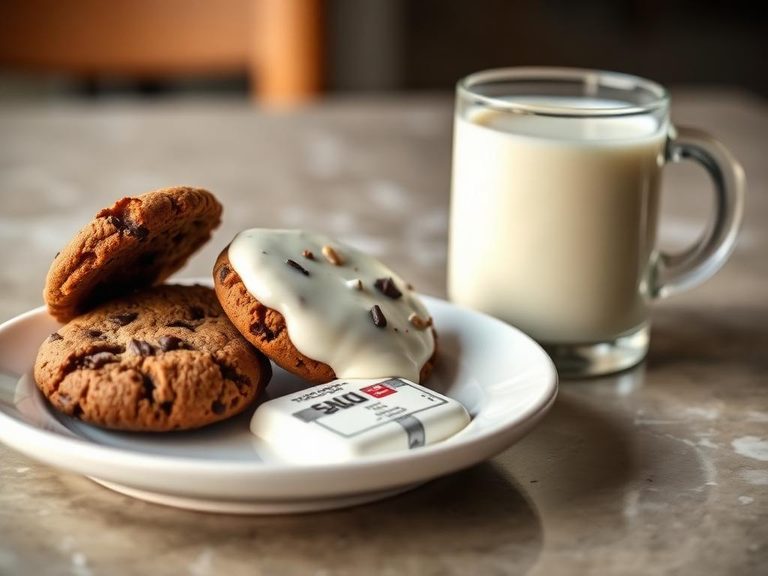
A soft, chewy, commercially baked cookie studded with sweet chocolate chips, offering a classic balance of buttery dough and rich chocolate. Its texture is tender and slightly cakey, designed for a satisfying bite. Nutritionally, it is a dense source of energy, primarily from refined carbohydrates and added sugars.
💚 Why it's loved
People adore it for the nostalgic, comforting combination of sweet, vanilla-scented dough and melty chocolate pockets. It's a universally recognized treat, perfect for sharing, dunking in milk, or enjoying as a simple pleasure.
⚠️ Watch-outs & how to enjoy it better
Its high sugar and refined carb content can lead to rapid blood-sugar spikes and subsequent energy crashes. Those monitoring sugar intake, managing diabetes, or with gluten or dairy allergies should exercise caution. To counteract, pair a single cookie with a source of protein or healthy fat (like a handful of nuts or a glass of milk) to slow sugar absorption and enhance satiety.
Key benefits
- Provides quick energy from carbohydrates
- Contains small amounts of iron and magnesium from chocolate
- Offers a convenient, ready-to-eat snack option
- Can serve as a morale-boosting comfort food in moderation
🍽️ Popular dishes
🌍 Where it's eaten
💡 Did you know?
The chocolate chip cookie was accidentally invented in the 1930s by Ruth Wakefield at the Toll House Inn, who expected the chocolate pieces to melt completely into the dough.
Full nutrition (scales with serving)
| Water | 9.9 g |
| Energy | 444 kcal |
| Energy | 1858 kj |
| Protein | 3.6 g |
| Total lipid (fat) | 19.8 g |
| Ash | 0.97 g |
| Carbohydrate, by difference | 65.8 g |
| Fiber, total dietary | 1.8 g |
| Total Sugars | 37.1 g |
| Sucrose | 22.1 g |
| Glucose | 8.3 g |
| Fructose | 6.3 g |
| Lactose | 0.00 g |
| Maltose | 0.31 g |
| Galactose | 0.00 g |
| Starch | 24.0 g |
| Calcium, Ca | 17.0 mg |
| Iron, Fe | 4.1 mg |
| Magnesium, Mg | 29.0 mg |
| Phosphorus, P | 61.0 mg |
| Potassium, K | 130 mg |
| Sodium, Na | 276 mg |
| Zinc, Zn | 0.54 mg |
| Copper, Cu | 0.23 mg |
| Manganese, Mn | 0.42 mg |
| Selenium, Se | 3.1 ug |
| Thiamin | 0.14 mg |
| Riboflavin | 0.28 mg |
| Niacin | 2.1 mg |
| Pantothenic acid | 0.36 mg |
| Vitamin B-6 | 0.05 mg |
| Folate, total | 27.0 ug |
| Folic acid | 25.0 ug |
| Folate, food | 2.0 ug |
| Folate, DFE | 45.0 ug |
| Vitamin B-12 | 0.00 ug |
| Vitamin A, RAE | 0.00 ug |
| Retinol | 0.00 ug |
| Vitamin A, IU | 0.00 iu |
| Vitamin E (alpha-tocopherol) | 1.6 mg |
| Tocopherol, beta | 0.10 mg |
| Tocopherol, gamma | 0.81 mg |
| Tocopherol, delta | 0.04 mg |
| Tocotrienol, alpha | 1.6 mg |
| Tocotrienol, beta | 0.61 mg |
| Tocotrienol, gamma | 2.3 mg |
| Tocotrienol, delta | 0.69 mg |
| Vitamin K (phylloquinone) | 2.4 ug |
| Vitamin K (Dihydrophylloquinone) | 0.00 ug |
| Vitamin K (Menaquinone-4) | 0.00 ug |
Fat & fatty acid profile (per 100g)
| Fatty acids, total saturated | 9.8 g |
| SFA 4:0 | 0.00 g |
| SFA 6:0 | 0.00 g |
| SFA 8:0 | 0.00 g |
| SFA 10:0 | 0.01 g |
| SFA 12:0 | 0.03 g |
| SFA 14:0 | 0.14 g |
| SFA 15:0 | 0.01 g |
| SFA 16:0 | 7.3 g |
| SFA 17:0 | 0.02 g |
| SFA 18:0 | 2.1 g |
| SFA 20:0 | 0.10 g |
| SFA 22:0 | 0.02 g |
| SFA 24:0 | 0.02 g |
| Fatty acids, total monounsaturated | 7.0 g |
| MUFA 15:1 | 0.00 g |
| MUFA 16:1 | 0.03 g |
| MUFA 16:1 c | 0.03 g |
| MUFA 17:1 | 0.01 g |
| MUFA 18:1 | 6.9 g |
| MUFA 18:1 c | 6.9 g |
| MUFA 20:1 | 0.03 g |
| MUFA 22:1 | 0.00 g |
| MUFA 22:1 c | 0.00 g |
| MUFA 24:1 c | 0.00 g |
| Fatty acids, total polyunsaturated | 1.8 g |
| PUFA 18:2 | 1.7 g |
| PUFA 18:2 n-6 c,c | 1.7 g |
| PUFA 18:2 CLAs | 0.01 g |
| PUFA 18:3 | 0.06 g |
| PUFA 18:3 n-3 c,c,c (ALA) | 0.05 g |
| PUFA 18:3 n-6 c,c,c | 0.01 g |
| PUFA 18:3i | 0.00 g |
| PUFA 18:4 | 0.00 g |
| PUFA 20:2 n-6 c,c | 0.00 g |
| PUFA 20:3 | 0.01 g |
| PUFA 20:3 n-3 | 0.01 g |
| PUFA 20:3 n-6 | 0.00 g |
| PUFA 20:4 | 0.00 g |
| PUFA 20:5 n-3 (EPA) | 0.00 g |
| PUFA 22:4 | 0.00 g |
| PUFA 22:5 n-3 (DPA) | 0.00 g |
| PUFA 22:6 n-3 (DHA) | 0.00 g |
| Fatty acids, total trans | 0.06 g |
| Fatty acids, total trans-monoenoic | 0.01 g |
| TFA 16:1 t | 0.00 g |
| TFA 18:1 t | 0.01 g |
| TFA 22:1 t | 0.00 g |
| TFA 18:2 t not further defined | 0.04 g |
| Fatty acids, total trans-polyenoic | 0.04 g |
Amino acid profile (per 100g)
| Tryptophan | 0.05 g |
| Threonine | 0.12 g |
| Isoleucine | 0.15 g |
| Leucine | 0.27 g |
| Lysine | 0.16 g |
| Methionine | 0.07 g |
| Cystine | 0.07 g |
| Phenylalanine | 0.18 g |
| Tyrosine | 0.12 g |
| Valine | 0.18 g |
| Arginine | 0.14 g |
| Histidine | 0.07 g |
| Alanine | 0.12 g |
| Aspartic acid | 0.20 g |
| Glutamic acid | 1.1 g |
| Glycine | 0.12 g |
| Proline | 0.37 g |
| Serine | 0.19 g |
FAQ
Why are commercially prepared soft cookies softer than homemade ones?
They often use more sugar, fats, and humectants like corn syrup or glycerin, which retain moisture and inhibit gluten development, resulting in a persistently soft, chewy texture.
Is there a significant nutritional difference between 'soft-baked' and 'crisp' chocolate chip cookies?
The primary difference is texture, not nutrition. Both are typically high in sugar, fat, and calories. Soft versions may have slightly more moisture and sugar, while crisp ones may have a bit more fat.
How can I make a store-bought cookie feel more like a complete snack?
Pair it with a protein source (like Greek yogurt or cheese) and a fiber-rich food (like an apple or berries) to create a more balanced snack that provides sustained energy.