

Turkey, skin, from retail parts, from dark meat, raw
Whole food · Poultry Products

Photo: Wikipedia
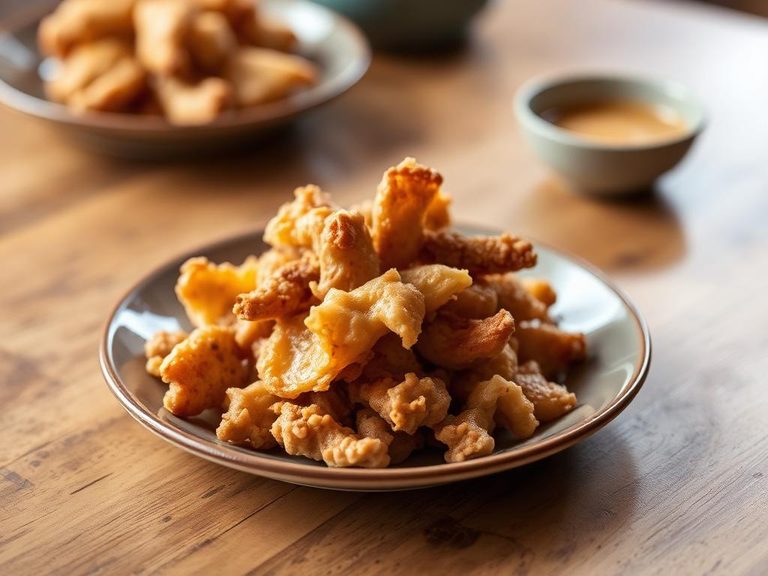
This is the dark meat skin of a raw turkey, prized for its rich, succulent flavor and higher fat content compared to white meat. The skin itself is a concentrated source of fat and calories, providing a crispy, flavorful element when cooked. Nutritionally, it is an extremely high-fat, zero-carb food, offering a significant energy boost but minimal protein relative to the meat beneath.
Calorie split: 15% protein · 0% carbs · 85% fat
↓ Full nutrition💚 Why it's loved
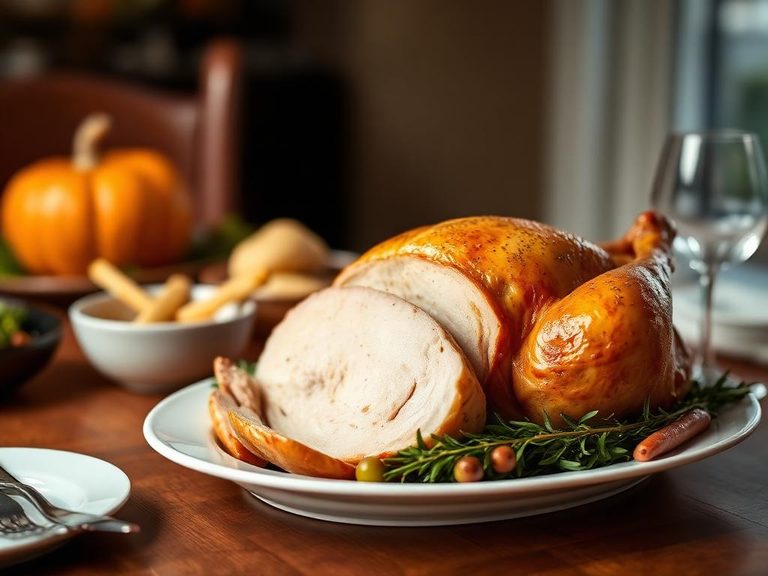
People love turkey skin for its unparalleled ability to become crispy and golden when roasted, delivering a savory, umami-rich crunch. It's a cultural staple at feasts like Thanksgiving, where it's often the most coveted part of the bird, symbolizing indulgence and celebration.
⚠️ Watch-outs & how to enjoy it better
The primary downside is its very high fat and calorie density, which can contribute to weight gain if consumed in excess. To mitigate this, practice strict portion control, render the fat to use sparingly in cooking, or pair it with high-fiber vegetables to increase satiety without overeating.
Key benefits
- Provides a dense source of dietary fat for energy and satiety.
- Contains zero carbohydrates, making it suitable for ketogenic or low-carb diets.
- Rich in fat-soluble vitamins like Vitamin A and Vitamin D.
- Adds significant flavor and moisture to dishes when rendered or cooked.
- A traditional component of holiday meals in many cultures.
🍽️ Popular dishes
🌍 Where it's eaten
💡 Did you know?
The fat in turkey skin is primarily monounsaturated, similar to olive oil, but it solidifies into a firm, white fat when chilled, which was historically used as a substitute for lard in baking.
Full nutrition (USDA data · scales with serving)
| Water | 50.1 g |
| Energy | 380 kcal |
| Energy | 1589 kj |
| Protein | 14.3 g |
| Total lipid (fat) | 35.8 g |
| Ash | 0.49 g |
| Carbohydrate, by difference | 0.00 g |
| Fiber, total dietary | 0.00 g |
| Total Sugars | 0.00 g |
| Calcium, Ca | 4.0 mg |
| Iron, Fe | 0.76 mg |
| Magnesium, Mg | 7.0 mg |
| Phosphorus, P | 80.0 mg |
| Potassium, K | 93.0 mg |
| Sodium, Na | 78.0 mg |
| Zinc, Zn | 0.88 mg |
| Copper, Cu | 0.04 mg |
| Manganese, Mn | 0.00 mg |
| Selenium, Se | 11.2 ug |
| Vitamin C, total ascorbic acid | 0.00 mg |
| Thiamin | 0.03 mg |
| Riboflavin | 0.08 mg |
| Niacin | 2.7 mg |
| Pantothenic acid | 0.59 mg |
| Vitamin B-6 | 0.11 mg |
| Folate, total | 5.0 ug |
| Folate, food | 5.0 ug |
| Choline, total | 40.7 mg |
| Betaine | 2.5 mg |
| Vitamin B-12 | 1.9 ug |
| Vitamin B-12, added | 0.00 ug |
| Vitamin A, RAE | 79.0 ug |
| Retinol | 79.0 ug |
| Carotene, beta | 0.00 ug |
| Carotene, alpha | 0.00 ug |
| Cryptoxanthin, beta | 0.00 ug |
| Vitamin A, IU | 263 iu |
| Lycopene | 0.00 ug |
| Lutein + zeaxanthin | 9.0 ug |
| Vitamin E (alpha-tocopherol) | 0.08 mg |
| Vitamin E, added | 0.00 mg |
| Vitamin D (D2 + D3), International Units | 30.0 iu |
| Vitamin D (D2 + D3) | 0.70 ug |
| Vitamin D3 (cholecalciferol) | 0.70 ug |
| Vitamin K (phylloquinone) | 0.00 ug |
| Alcohol, ethyl | 0.00 g |
| Caffeine | 0.00 mg |
| Theobromine | 0.00 mg |
Fat & fatty acid profile (per 100g)
| Fatty acids, total saturated | 10.2 g |
| SFA 4:0 | 0.00 g |
| SFA 6:0 | 0.00 g |
| SFA 8:0 | 0.00 g |
| SFA 10:0 | 0.01 g |
| SFA 12:0 | 0.10 g |
| SFA 14:0 | 0.36 g |
| SFA 15:0 | 0.05 g |
| SFA 16:0 | 7.3 g |
| SFA 17:0 | 0.09 g |
| SFA 18:0 | 2.3 g |
| SFA 20:0 | 0.04 g |
| SFA 22:0 | 0.02 g |
| SFA 24:0 | 0.01 g |
| Fatty acids, total monounsaturated | 14.0 g |
| MUFA 14:1 | 0.08 g |
| MUFA 15:1 | 0.00 g |
| MUFA 16:1 | 1.6 g |
| MUFA 16:1 c | 1.5 g |
| MUFA 17:1 | 0.06 g |
| MUFA 18:1 | 12.1 g |
| MUFA 18:1 c | 11.7 g |
| MUFA 20:1 | 0.18 g |
| MUFA 22:1 | 0.02 g |
| MUFA 22:1 c | 0.00 g |
| MUFA 24:1 c | 0.01 g |
| Fatty acids, total polyunsaturated | 10.9 g |
| PUFA 18:2 | 9.9 g |
| PUFA 18:2 n-6 c,c | 9.7 g |
| PUFA 18:2 CLAs | 0.08 g |
| PUFA 18:3 | 0.70 g |
| PUFA 18:3 n-3 c,c,c (ALA) | 0.68 g |
| PUFA 18:3 n-6 c,c,c | 0.02 g |
| PUFA 18:4 | 0.00 g |
| PUFA 20:2 n-6 c,c | 0.05 g |
| PUFA 20:3 | 0.03 g |
| PUFA 20:3 n-3 | 0.01 g |
| PUFA 20:3 n-6 | 0.02 g |
| PUFA 20:4 | 0.15 g |
| PUFA 20:5 n-3 (EPA) | 0.01 g |
| PUFA 22:4 | 0.03 g |
| PUFA 22:5 n-3 (DPA) | 0.02 g |
| PUFA 22:6 n-3 (DHA) | 0.01 g |
| Fatty acids, total trans | 0.47 g |
| Fatty acids, total trans-monoenoic | 0.36 g |
| TFA 16:1 t | 0.03 g |
| TFA 18:1 t | 0.32 g |
| TFA 22:1 t | 0.02 g |
| TFA 18:2 t not further defined | 0.11 g |
| Fatty acids, total trans-polyenoic | 0.11 g |
| Cholesterol | 111 mg |
Amino acid profile (per 100g)
| Tryptophan | 0.06 g |
| Threonine | 0.34 g |
| Isoleucine | 0.26 g |
| Leucine | 0.61 g |
| Lysine | 0.75 g |
| Methionine | 0.20 g |
| Cystine | 0.09 g |
| Phenylalanine | 0.34 g |
| Tyrosine | 0.22 g |
| Valine | 0.35 g |
| Arginine | 0.90 g |
| Histidine | 0.19 g |
| Alanine | 0.96 g |
| Aspartic acid | 0.81 g |
| Glutamic acid | 1.4 g |
| Glycine | 2.0 g |
| Proline | 1.3 g |
| Serine | 0.41 g |
| Hydroxyproline | 1.1 g |
FAQ
Is turkey skin healthy to eat?
It is very high in fat and calories, so it should be eaten in moderation. However, it does contain some beneficial nutrients like vitamin A and monounsaturated fats.
How can I make turkey skin crispy?
Pat the skin completely dry before cooking, season it well, and roast it at a high temperature (around 400°F/200°C) or under a broiler for the last few minutes.
What is the difference between dark and white turkey meat skin?
Dark meat skin, from the legs and thighs, tends to be slightly fattier and more flavorful than skin from the breast (white meat).
Nutrient density (calculated · NRF9.3)
Nutrient Rich Foods index: beneficial nutrients (protein, fiber, vitamins, minerals) minus saturated fat, added sugar & sodium, per 100 kcal.
NRF9.3 index — Fulgoni, Keast & Drewnowski, 2009. Computed from USDA nutrients.
Weight-loss friendliness (composite index)
Energy density 3.80 kcal/g · 15% calories from protein · 0.0 g fiber · 0.0 g sugar per 100 g.
Composite of energy density (Rolls et al., 1999), protein & fiber satiety, minus sugar. A calculated heuristic — ranks satiety-per-calorie, not a clinical measure.
Dietary load (calculated from USDA values)
Potential renal acid load. Positive = acid-forming, negative = alkaline-forming.
Sodium-to-potassium ratio: 0.84 (lower is better — aim for ≤ 1)
Sodium:potassium per WHO potassium guidance. Computed from USDA nutrients.