

Sweet potato, raw, unprepared (Includes foods for USDA's Food Distribution Program)
Whole food · Vegetables and Vegetable Products
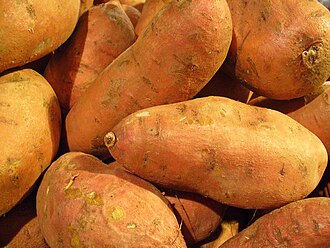
Photo: Wikipedia
A raw sweet potato is a starchy, tuberous root with a crisp, dense texture and a mildly sweet, earthy flavor before cooking. Nutritionally, it's a powerhouse of complex carbohydrates and fiber, providing a steady source of energy with very little fat. Its vibrant orange flesh is a telltale sign of its high beta-carotene content, a precursor to vitamin A.
Calorie split: 7% protein · 92% carbs · 1% fat
↓ Full nutrition💚 Why it's loved
People love its natural, earthy sweetness that intensifies with cooking, making it a comforting and versatile ingredient. It's a culinary chameleon, equally at home in savory stews, spicy curries, or sweet pies and fries across countless global cuisines.
⚠️ Watch-outs & how to enjoy it better
Raw sweet potato contains resistant starch and lectins that can cause digestive discomfort (gas, bloating) for some. To counteract this, always cook it thoroughly. Its high carbohydrate content can also impact blood sugar, so pairing it with protein (like beans or chicken) or healthy fats (like avocado or olive oil) can help moderate the glycemic response.
Key benefits
- Excellent source of beta-carotene, which the body converts to vitamin A.
- High in dietary fiber, supporting digestive health and satiety.
- Provides a good amount of complex carbohydrates for sustained energy.
- Naturally low in fat and contains no cholesterol.
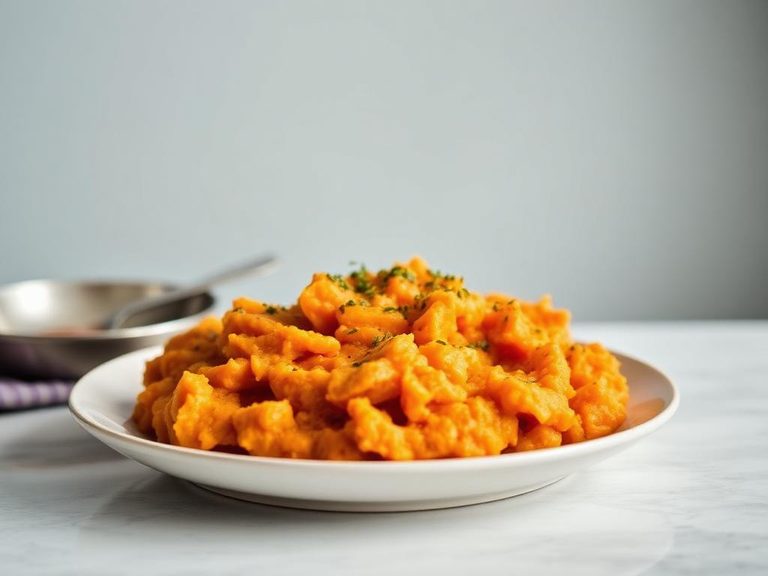
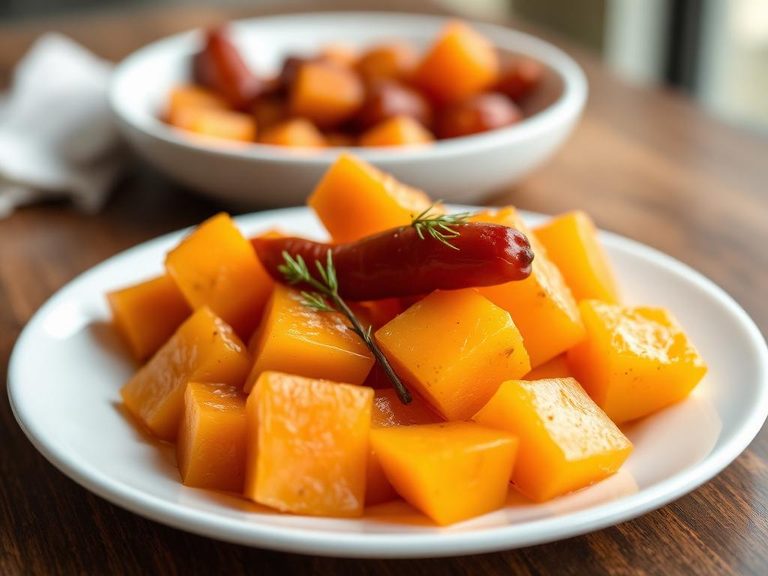
🍽️ Popular dishes




🌍 Where it's eaten
💡 Did you know?
Sweet potatoes are not botanically related to regular potatoes (which are nightshades); they are members of the morning glory family.
Full nutrition (USDA data · scales with serving)
| Water | 77.3 g |
| Energy | 86.0 kcal |
| Energy | 359 kj |
| Protein | 1.6 g |
| Total lipid (fat) | 0.05 g |
| Ash | 0.99 g |
| Carbohydrate, by difference | 20.1 g |
| Fiber, total dietary | 3.0 g |
| Total Sugars | 4.2 g |
| Sucrose | 2.5 g |
| Glucose | 0.96 g |
| Fructose | 0.70 g |
| Lactose | 0.00 g |
| Maltose | 0.00 g |
| Galactose | 0.00 g |
| Starch | 12.7 g |
| Calcium, Ca | 30.0 mg |
| Iron, Fe | 0.61 mg |
| Magnesium, Mg | 25.0 mg |
| Phosphorus, P | 47.0 mg |
| Potassium, K | 337 mg |
| Sodium, Na | 55.0 mg |
| Zinc, Zn | 0.30 mg |
| Copper, Cu | 0.15 mg |
| Manganese, Mn | 0.26 mg |
| Selenium, Se | 0.60 ug |
| Vitamin C, total ascorbic acid | 2.4 mg |
| Thiamin | 0.08 mg |
| Riboflavin | 0.06 mg |
| Niacin | 0.56 mg |
| Pantothenic acid | 0.80 mg |
| Vitamin B-6 | 0.21 mg |
| Folate, total | 11.0 ug |
| Folic acid | 0.00 ug |
| Folate, food | 11.0 ug |
| Folate, DFE | 11.0 ug |
| Choline, total | 12.3 mg |
| Vitamin B-12 | 0.00 ug |
| Vitamin B-12, added | 0.00 ug |
| Vitamin A, RAE | 709 ug |
| Retinol | 0.00 ug |
| Carotene, beta | 8509 ug |
| Carotene, alpha | 7.0 ug |
| Cryptoxanthin, beta | 0.00 ug |
| Vitamin A, IU | 14187 iu |
| Lycopene | 0.00 ug |
| Lutein + zeaxanthin | 0.00 ug |
| Vitamin E (alpha-tocopherol) | 0.26 mg |
| Vitamin E, added | 0.00 mg |
| Tocopherol, beta | 0.01 mg |
| Tocopherol, gamma | 0.00 mg |
| Tocopherol, delta | 0.00 mg |
| Tocotrienol, alpha | 0.01 mg |
| Tocotrienol, beta | 0.00 mg |
| Tocotrienol, gamma | 0.00 mg |
| Tocotrienol, delta | 0.00 mg |
| Vitamin D (D2 + D3), International Units | 0.00 iu |
| Vitamin D (D2 + D3) | 0.00 ug |
| Vitamin K (phylloquinone) | 1.8 ug |
| Vitamin K (Dihydrophylloquinone) | 0.00 ug |
| Alcohol, ethyl | 0.00 g |
| Caffeine | 0.00 mg |
| Theobromine | 0.00 mg |
Fat & fatty acid profile (per 100g)
| Fatty acids, total saturated | 0.02 g |
| SFA 4:0 | 0.00 g |
| SFA 6:0 | 0.00 g |
| SFA 8:0 | 0.00 g |
| SFA 10:0 | 0.00 g |
| SFA 12:0 | 0.00 g |
| SFA 14:0 | 0.00 g |
| SFA 15:0 | 0.00 g |
| SFA 16:0 | 0.02 g |
| SFA 17:0 | 0.00 g |
| SFA 18:0 | 0.00 g |
| SFA 20:0 | 0.00 g |
| SFA 22:0 | 0.00 g |
| SFA 24:0 | 0.00 g |
| Fatty acids, total monounsaturated | 0.00 g |
| MUFA 14:1 | 0.00 g |
| MUFA 15:1 | 0.00 g |
| MUFA 16:1 | 0.00 g |
| MUFA 17:1 | 0.00 g |
| MUFA 18:1 | 0.00 g |
| MUFA 20:1 | 0.00 g |
| MUFA 22:1 | 0.00 g |
| Fatty acids, total polyunsaturated | 0.01 g |
| PUFA 18:2 | 0.01 g |
| PUFA 18:3 | 0.00 g |
| PUFA 18:4 | 0.00 g |
| PUFA 20:2 n-6 c,c | 0.00 g |
| PUFA 20:3 | 0.00 g |
| PUFA 20:4 | 0.00 g |
| PUFA 20:5 n-3 (EPA) | 0.00 g |
| PUFA 22:5 n-3 (DPA) | 0.00 g |
| PUFA 22:6 n-3 (DHA) | 0.00 g |
| Fatty acids, total trans | 0.00 g |
| Cholesterol | 0.00 mg |
| Phytosterols | 12.0 mg |
Amino acid profile (per 100g)
| Tryptophan | 0.03 g |
| Threonine | 0.08 g |
| Isoleucine | 0.06 g |
| Leucine | 0.09 g |
| Lysine | 0.07 g |
| Methionine | 0.03 g |
| Cystine | 0.02 g |
| Phenylalanine | 0.09 g |
| Tyrosine | 0.03 g |
| Valine | 0.09 g |
| Arginine | 0.06 g |
| Histidine | 0.03 g |
| Alanine | 0.08 g |
| Aspartic acid | 0.38 g |
| Glutamic acid | 0.15 g |
| Glycine | 0.06 g |
| Proline | 0.05 g |
| Serine | 0.09 g |
FAQ
What's the difference between a sweet potato and a yam?
In the U.S., the orange-fleshed, moist sweet potatoes are often mislabeled as 'yams.' True yams are a different, starchier tuber with rough, bark-like skin, primarily found in African and Asian markets.
Is it okay to eat the skin?
Yes, the skin of a sweet potato is edible and nutritious, containing fiber and potassium. Just scrub it thoroughly before cooking. The skin becomes tender when baked or boiled.
Why does my sweet potato have a blue or purple tint inside?
This is a harmless natural phenomenon. It's caused by a reaction between phenolic compounds in the sweet potato and iron from the soil or your knife. It's safe to eat.
Nutrient density (calculated · NRF9.3)
Nutrient Rich Foods index: beneficial nutrients (protein, fiber, vitamins, minerals) minus saturated fat, added sugar & sodium, per 100 kcal.
NRF9.3 index — Fulgoni, Keast & Drewnowski, 2009. Computed from USDA nutrients.
Weight-loss friendliness (composite index)
Energy density 0.86 kcal/g · 7% calories from protein · 3.0 g fiber · 4.2 g sugar per 100 g.
Composite of energy density (Rolls et al., 1999), protein & fiber satiety, minus sugar. A calculated heuristic — ranks satiety-per-calorie, not a clinical measure.
Dietary load (calculated from USDA values)
Potential renal acid load. Positive = acid-forming, negative = alkaline-forming.
Sodium-to-potassium ratio: 0.16 (lower is better — aim for ≤ 1)
Sodium:potassium per WHO potassium guidance. Computed from USDA nutrients.