

SUBWAY, meatball marinara sub on white bread (no toppings)
Whole food · Fast Foods

Photo: Wikipedia
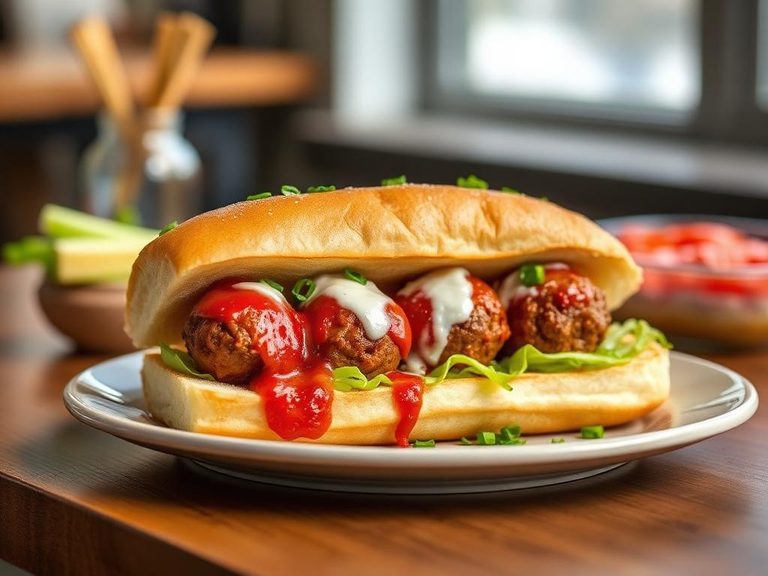
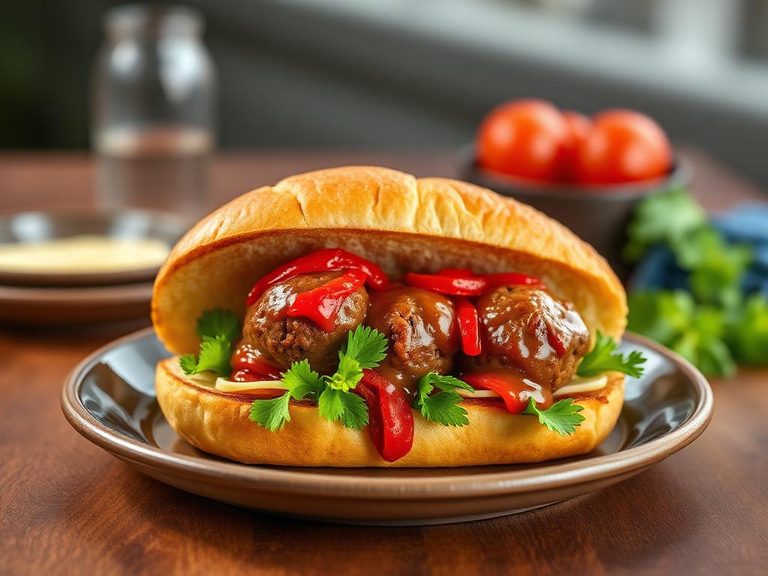
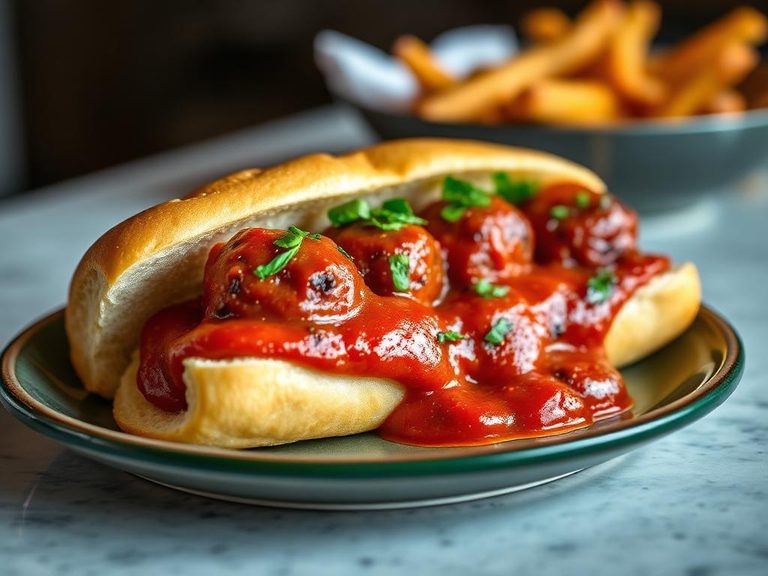
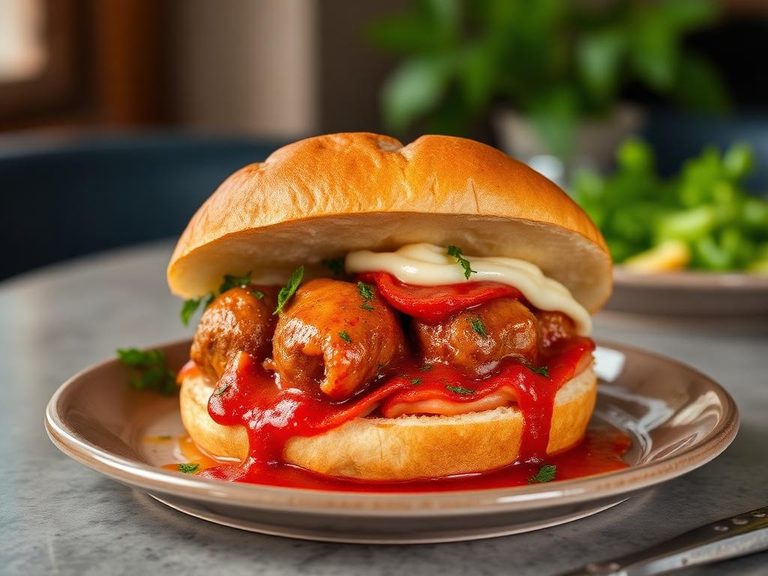
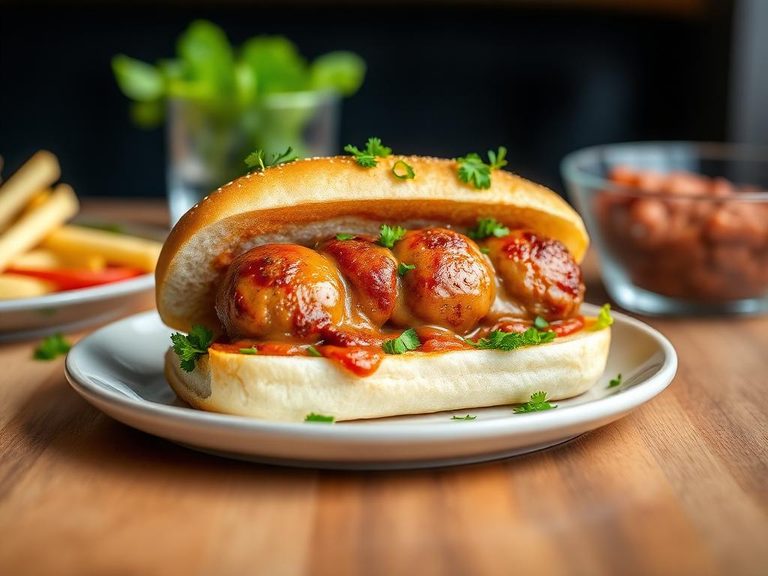
A classic Subway meatball marinara sub on white bread is a warm, savory sandwich featuring seasoned meatballs smothered in a tangy tomato sauce, served on soft, slightly sweet white bread. The texture is a comforting mix of tender meatballs, chewy bread, and smooth sauce, with a mild, familiar flavor profile. Nutritionally, it offers a moderate protein source (9.77g per 100g) with a higher carbohydrate content (26.01g per 100g) from the bread and sauce, making it a quick, energy-dense meal.
Calorie split: 18% protein · 47% carbs · 35% fat
↓ Full nutrition💚 Why it's loved
People love this sub for its comforting, nostalgic flavor—a simple, satisfying combination of savory meatballs, tangy marinara, and soft bread that feels like a warm hug. It's also incredibly versatile, easily customized with different breads or toppings, and fits into a quick, casual meal culture.
⚠️ Watch-outs & how to enjoy it better
The sub can be high in sodium and refined carbohydrates, which may cause blood-sugar spikes, especially for those with diabetes or insulin resistance. To counteract, pair it with a side salad or vegetables for fiber, choose a whole-grain bread option if available, and practice portion control by opting for a smaller sub size.
Key benefits
- Provides a convenient source of protein from meatballs.
- Offers quick energy from carbohydrates in the bread and sauce.
- Contains some dietary fiber (2.1g per 100g) from the tomato sauce and meat.
- Relatively low in fat (8.45g per 100g) compared to many fast-food sandwiches.
- A familiar, comforting meal option for many.
🍽️ Popular dishes
🌍 Where it's eaten
💡 Did you know?
The meatball marinara sub at Subway is often served with a side of marinara sauce for dipping, which can add extra flavor and moisture to the sandwich.
Full nutrition (USDA data · scales with serving)
| Water | 53.6 g |
| Energy | 219 kcal |
| Energy | 917 kj |
| Protein | 9.8 g |
| Total lipid (fat) | 8.4 g |
| Ash | 2.2 g |
| Carbohydrate, by difference | 26.0 g |
| Fiber, total dietary | 2.1 g |
| Total Sugars | 5.0 g |
| Sucrose | 0.00 g |
| Glucose | 1.9 g |
| Fructose | 2.1 g |
| Lactose | 0.00 g |
| Maltose | 0.96 g |
| Galactose | 0.00 g |
| Starch | 16.4 g |
| Calcium, Ca | 176 mg |
| Iron, Fe | 2.3 mg |
| Magnesium, Mg | 29.0 mg |
| Phosphorus, P | 97.0 mg |
| Potassium, K | 275 mg |
| Sodium, Na | 437 mg |
| Zinc, Zn | 1.2 mg |
| Copper, Cu | 0.13 mg |
| Manganese, Mn | 0.43 mg |
| Selenium, Se | 13.8 ug |
| Vitamin C, total ascorbic acid | 0.40 mg |
| Thiamin | 0.25 mg |
| Riboflavin | 0.25 mg |
| Niacin | 3.5 mg |
| Pantothenic acid | 0.42 mg |
| Vitamin B-6 | 0.13 mg |
| Folate, total | 79.0 ug |
| Vitamin B-12 | 0.55 ug |
| Vitamin A, RAE | 15.0 ug |
| Retinol | 0.00 ug |
| Carotene, beta | 175 ug |
| Carotene, alpha | 0.00 ug |
| Cryptoxanthin, beta | 0.00 ug |
| Vitamin A, IU | 292 iu |
| Lycopene | 3152 ug |
| Lutein + zeaxanthin | 95.0 ug |
| Vitamin E (alpha-tocopherol) | 0.79 mg |
| Tocopherol, beta | 0.08 mg |
| Tocopherol, gamma | 0.66 mg |
| Tocopherol, delta | 0.24 mg |
| Tocotrienol, alpha | 0.04 mg |
| Tocotrienol, beta | 0.31 mg |
| Tocotrienol, gamma | 0.00 mg |
| Tocotrienol, delta | 0.00 mg |
Fat & fatty acid profile (per 100g)
| Fatty acids, total saturated | 3.1 g |
| SFA 4:0 | 0.00 g |
| SFA 6:0 | 0.00 g |
| SFA 8:0 | 0.00 g |
| SFA 10:0 | 0.00 g |
| SFA 12:0 | 0.01 g |
| SFA 14:0 | 0.21 g |
| SFA 15:0 | 0.04 g |
| SFA 16:0 | 1.8 g |
| SFA 17:0 | 0.09 g |
| SFA 18:0 | 0.98 g |
| SFA 20:0 | 0.01 g |
| SFA 22:0 | 0.01 g |
| SFA 24:0 | 0.00 g |
| Fatty acids, total monounsaturated | 3.6 g |
| MUFA 14:1 | 0.06 g |
| MUFA 15:1 | 0.00 g |
| MUFA 16:1 | 0.28 g |
| MUFA 16:1 c | 0.26 g |
| MUFA 17:1 | 0.06 g |
| MUFA 18:1 | 3.1 g |
| MUFA 18:1 c | 2.8 g |
| MUFA 20:1 | 0.03 g |
| MUFA 22:1 | 0.00 g |
| MUFA 22:1 c | 0.00 g |
| MUFA 24:1 c | 0.00 g |
| Fatty acids, total polyunsaturated | 1.1 g |
| PUFA 18:2 | 1.00 g |
| PUFA 18:2 n-6 c,c | 0.92 g |
| PUFA 18:2 CLAs | 0.04 g |
| PUFA 18:3 | 0.10 g |
| PUFA 18:3 n-3 c,c,c (ALA) | 0.10 g |
| PUFA 18:3 n-6 c,c,c | 0.00 g |
| PUFA 18:3i | 0.00 g |
| PUFA 18:4 | 0.00 g |
| PUFA 20:2 n-6 c,c | 0.00 g |
| PUFA 20:3 | 0.01 g |
| PUFA 20:3 n-3 | 0.00 g |
| PUFA 20:3 n-6 | 0.01 g |
| PUFA 20:4 | 0.01 g |
| PUFA 20:5 n-3 (EPA) | 0.00 g |
| PUFA 22:4 | 0.01 g |
| PUFA 22:5 n-3 (DPA) | 0.00 g |
| PUFA 22:6 n-3 (DHA) | 0.00 g |
| Fatty acids, total trans | 0.42 g |
| Fatty acids, total trans-monoenoic | 0.38 g |
| TFA 16:1 t | 0.02 g |
| TFA 18:1 t | 0.36 g |
| TFA 22:1 t | 0.00 g |
| TFA 18:2 t not further defined | 0.04 g |
| Fatty acids, total trans-polyenoic | 0.04 g |
| Cholesterol | 15.0 mg |
Amino acid profile (per 100g)
Estimated from SUBWAY, cold cut sub on white bread with lettuce and tomato — USDA does not publish this profile for SUBWAY.
| Tryptophan | 0.10 g |
| Threonine | 0.33 g |
| Isoleucine | 0.43 g |
| Leucine | 0.75 g |
| Lysine | 0.49 g |
| Methionine | 0.21 g |
| Phenylalanine | 0.43 g |
| Tyrosine | 0.26 g |
| Valine | 0.50 g |
| Arginine | 0.50 g |
| Histidine | 0.30 g |
| Alanine | 0.48 g |
| Aspartic acid | 0.74 g |
| Glutamic acid | 2.5 g |
| Glycine | 0.45 g |
| Proline | 1.0 g |
| Serine | 0.41 g |
| Hydroxyproline | 0.07 g |
FAQ
Is the Subway meatball marinara sub on white bread healthy?
It provides protein and energy but is high in refined carbs and sodium. It can be part of a balanced diet when paired with vegetables and eaten in moderation.
How many calories are in a Subway meatball marinara sub?
A 100g serving has about 219 kcal. A typical 6-inch sub (around 170g) would be approximately 372 kcal.
What are the main allergens in a Subway meatball marinara sub?
Common allergens include wheat (from the bread), soy, and possibly milk or eggs in the meatballs or sauce. Always check with the restaurant for specific allergen information.
Nutrient density (calculated · NRF9.3)
Nutrient Rich Foods index: beneficial nutrients (protein, fiber, vitamins, minerals) minus saturated fat, added sugar & sodium, per 100 kcal.
NRF9.3 index — Fulgoni, Keast & Drewnowski, 2009. Computed from USDA nutrients.
Weight-loss friendliness (composite index)
Energy density 2.19 kcal/g · 18% calories from protein · 2.1 g fiber · 5.0 g sugar per 100 g.
Composite of energy density (Rolls et al., 1999), protein & fiber satiety, minus sugar. A calculated heuristic — ranks satiety-per-calorie, not a clinical measure.
Dietary load (calculated from USDA values)
Potential renal acid load. Positive = acid-forming, negative = alkaline-forming.
Sodium-to-potassium ratio: 1.59 (lower is better — aim for ≤ 1)
Sodium:potassium per WHO potassium guidance. Computed from USDA nutrients.