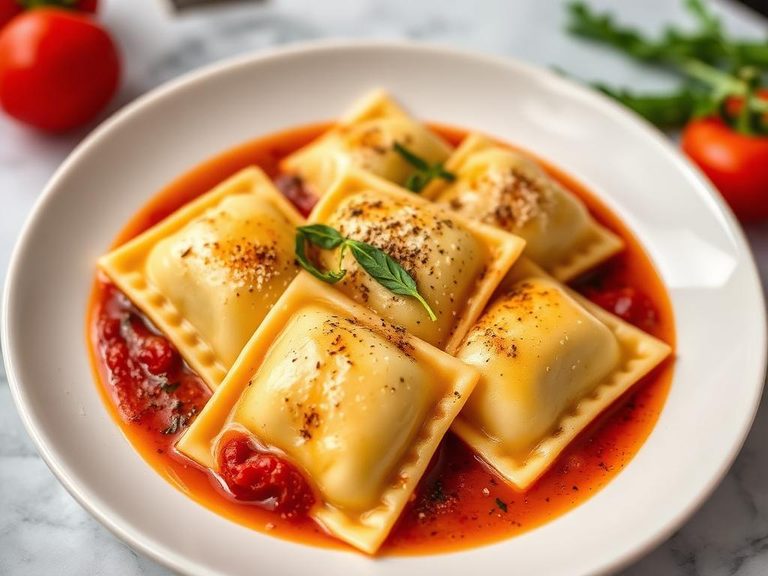
CARRABBA'S ITALIAN GRILL, cheese ravioli with marinara sauce
Whole food · Restaurant Foods

Photo: Wikipedia
Carrabba's cheese ravioli with marinara is a comforting plate of tender pasta pillows filled with a creamy, savory cheese blend, bathed in a bright, herb-infused tomato sauce. Each bite offers a satisfying contrast between the soft, yielding pasta and the smooth, rich filling. Nutritionally, it's a moderate-calorie entrée that provides a solid protein boost from the cheese filling.
💚 Why it's loved
People adore this dish for its classic, comforting Italian-American flavors—the perfect balance of rich, cheesy filling and tangy, savory sauce. It's a beloved staple that evokes a sense of warmth and familiarity.
⚠️ Watch-outs & how to enjoy it better
The combination of refined pasta and tomato sauce can lead to a rapid blood-sugar spike, making it less ideal for those managing diabetes. It may also be high in sodium and is a common allergen due to wheat (gluten) and dairy. To counteract this, pair it with a side of fibrous vegetables like roasted broccoli or a leafy green salad to slow digestion, and consider a smaller portion of the pasta itself.
Key benefits
- Good source of protein from cheese filling
- Provides calcium and phosphorus from dairy
- Contains lycopene from cooked tomato sauce
- Moderate calorie density for a main dish
- Offers quick energy from pasta carbohydrates
🍽️ Popular dishes
🌍 Where it's eaten
💡 Did you know?
The word 'ravioli' likely derives from the Italian verb 'riavvolgere,' meaning 'to wrap' or 'to fold back,' perfectly describing the action of sealing the filling inside the pasta dough.
Full nutrition (scales with serving)
| Water | 66.8 g |
| Energy | 156 kcal |
| Energy | 654 kj |
| Protein | 8.0 g |
| Total lipid (fat) | 6.0 g |
| Ash | 1.6 g |
| Carbohydrate, by difference | 17.6 g |
| Fiber, total dietary | 1.4 g |
| Total Sugars | 4.2 g |
| Sucrose | 0.00 g |
| Glucose | 1.2 g |
| Fructose | 1.1 g |
| Lactose | 1.9 g |
| Maltose | 0.00 g |
| Galactose | 0.00 g |
| Starch | 11.3 g |
| Calcium, Ca | 135 mg |
| Iron, Fe | 0.52 mg |
| Magnesium, Mg | 21.0 mg |
| Phosphorus, P | 126 mg |
| Potassium, K | 195 mg |
| Sodium, Na | 371 mg |
| Zinc, Zn | 0.81 mg |
| Copper, Cu | 0.09 mg |
| Manganese, Mn | 0.18 mg |
| Selenium, Se | 22.0 ug |
| Thiamin | 0.05 mg |
| Riboflavin | 0.17 mg |
| Niacin | 0.90 mg |
| Pantothenic acid | 0.46 mg |
| Vitamin B-6 | 0.09 mg |
| Folate, total | 11.0 ug |
| Vitamin B-12 | 0.40 ug |
| Vitamin A, RAE | 58.0 ug |
| Retinol | 40.0 ug |
| Carotene, beta | 218 ug |
| Carotene, alpha | 0.00 ug |
| Cryptoxanthin, beta | 0.00 ug |
| Vitamin A, IU | 496 iu |
| Lycopene | 2401 ug |
| Lutein + zeaxanthin | 98.0 ug |
| Vitamin E (alpha-tocopherol) | 0.49 mg |
| Tocopherol, beta | 0.00 mg |
| Tocopherol, gamma | 0.11 mg |
| Tocopherol, delta | 0.00 mg |
| Tocotrienol, alpha | 0.00 mg |
| Tocotrienol, beta | 0.10 mg |
| Tocotrienol, gamma | 0.00 mg |
| Tocotrienol, delta | 0.00 mg |
Fat & fatty acid profile (per 100g)
| Fatty acids, total saturated | 2.8 g |
| SFA 4:0 | 0.09 g |
| SFA 6:0 | 0.07 g |
| SFA 8:0 | 0.05 g |
| SFA 10:0 | 0.13 g |
| SFA 12:0 | 0.13 g |
| SFA 14:0 | 0.42 g |
| SFA 15:0 | 0.05 g |
| SFA 16:0 | 1.4 g |
| SFA 17:0 | 0.03 g |
| SFA 18:0 | 0.47 g |
| SFA 20:0 | 0.01 g |
| SFA 22:0 | 0.01 g |
| SFA 24:0 | 0.00 g |
| Fatty acids, total monounsaturated | 1.9 g |
| MUFA 14:1 | 0.04 g |
| MUFA 15:1 | 0.00 g |
| MUFA 16:1 | 0.09 g |
| MUFA 16:1 c | 0.07 g |
| MUFA 17:1 | 0.01 g |
| MUFA 18:1 | 1.8 g |
| MUFA 18:1 c | 1.7 g |
| MUFA 20:1 | 0.01 g |
| MUFA 22:1 | 0.00 g |
| MUFA 22:1 c | 0.00 g |
| MUFA 24:1 c | 0.00 g |
| Fatty acids, total polyunsaturated | 0.47 g |
| PUFA 18:2 | 0.40 g |
| PUFA 18:2 n-6 c,c | 0.34 g |
| PUFA 18:2 CLAs | 0.03 g |
| PUFA 18:3 | 0.04 g |
| PUFA 18:3 n-3 c,c,c (ALA) | 0.04 g |
| PUFA 18:3 n-6 c,c,c | 0.00 g |
| PUFA 18:3i | 0.00 g |
| PUFA 18:4 | 0.00 g |
| PUFA 20:2 n-6 c,c | 0.00 g |
| PUFA 20:3 | 0.01 g |
| PUFA 20:3 n-3 | 0.01 g |
| PUFA 20:3 n-6 | 0.01 g |
| PUFA 20:4 | 0.01 g |
| PUFA 20:5 n-3 (EPA) | 0.00 g |
| PUFA 22:4 | 0.00 g |
| PUFA 22:5 n-3 (DPA) | 0.00 g |
| PUFA 22:6 n-3 (DHA) | 0.00 g |
| Fatty acids, total trans | 0.14 g |
| Fatty acids, total trans-monoenoic | 0.11 g |
| TFA 16:1 t | 0.02 g |
| TFA 18:1 t | 0.10 g |
| TFA 22:1 t | 0.00 g |
| TFA 18:2 t not further defined | 0.03 g |
| Fatty acids, total trans-polyenoic | 0.03 g |
| Cholesterol | 30.0 mg |
Amino acid profile (per 100g)
| Tryptophan | 0.12 g |
| Threonine | 0.33 g |
| Isoleucine | 0.38 g |
| Leucine | 0.78 g |
| Lysine | 0.60 g |
| Methionine | 0.19 g |
| Cystine | 0.14 g |
| Phenylalanine | 0.41 g |
| Tyrosine | 0.26 g |
| Valine | 0.45 g |
| Arginine | 0.32 g |
| Histidine | 0.19 g |
| Alanine | 0.31 g |
| Aspartic acid | 0.67 g |
| Glutamic acid | 2.2 g |
| Glycine | 0.21 g |
| Proline | 1.6 g |
| Serine | 0.46 g |
| Hydroxyproline | 0.00 g |
FAQ
What is the cheese filling typically made of?
A classic filling is a blend of ricotta cheese (for creaminess), often combined with Parmesan or Pecorino Romano (for sharpness), and sometimes a touch of mozzarella. It's seasoned with salt, pepper, and herbs like parsley or nutmeg.
Is the marinara sauce at Carrabba's meat-based?
No, a traditional marinara is a simple, quick-cooked tomato sauce. Carrabba's version is typically made with San Marzano tomatoes, garlic, onions, and Italian herbs like basil and oregano, simmered to a bright, smooth consistency.
How does this dish fit into a balanced diet?
It can be a balanced meal when portion-controlled and paired with non-starchy vegetables. The pasta provides energy, the cheese filling offers protein and fat, and the tomato sauce contributes vitamins. Adding a large side salad or steamed vegetables increases fiber and nutrient density.