APPLEBEE'S, fish, hand battered
Whole food · Restaurant Foods

Photo: Wikipedia
Applebee's hand-battered fish is a classic pub-style fillet, likely cod or haddock, coated in a seasoned flour batter and deep-fried to a golden, crispy crunch that shatters into a tender, flaky interior. It delivers a satisfying, savory flavor with a notable protein punch of 13.23g per 100g, making it a hearty, comforting option. The dish balances a rich, oily mouthfeel with a mild, clean fish taste, often served with tartar sauce or fries for a complete meal.
💚 Why it's loved
People love it for the irresistible contrast between the crunchy, seasoned batter and the soft, flaky fish inside, which delivers a comforting, nostalgic taste of casual dining. Its versatility shines when paired with sides like coleslaw, fries, or a simple salad, making it a crowd-pleaser in American pub culture.
⚠️ Watch-outs & how to enjoy it better
The deep-frying process adds significant fat (9.14g per 100g) and can make it heavy for those watching calorie intake or managing blood-sugar spikes, especially when paired with starchy sides. To counteract, opt for a side salad or steamed vegetables instead of fries, and consider a smaller portion (e.g., 100g) to keep the meal balanced. Also, be mindful of potential allergens like wheat in the batter or fish allergies, and choose a sauce like lemon juice or vinegar to cut the richness without adding sugar.
Key benefits
- High-quality protein source (13.23g per 100g) for muscle maintenance
- Provides essential omega-3 fatty acids from the fish
- Quick energy from moderate carbohydrates (16.65g per 100g)
- Low in sugar (0.51g per 100g) for minimal blood-sugar impact
- Satisfying texture and flavor for a fulfilling meal
🍽️ Popular dishes
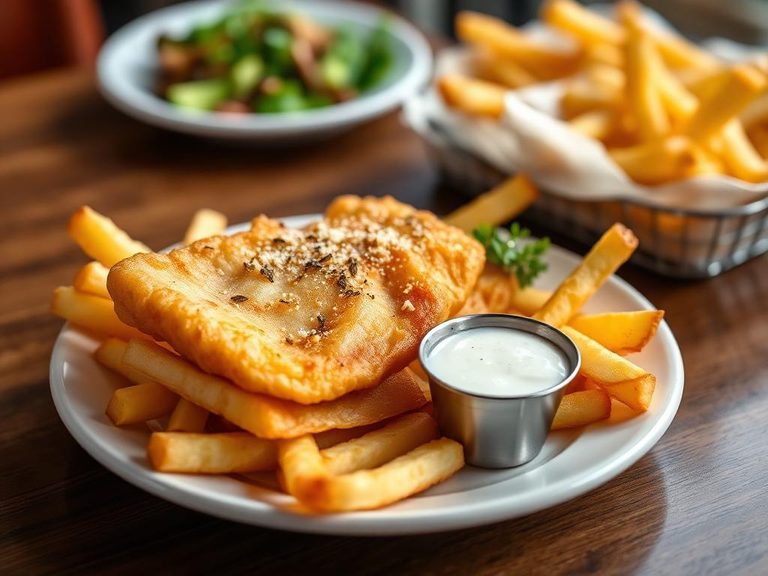
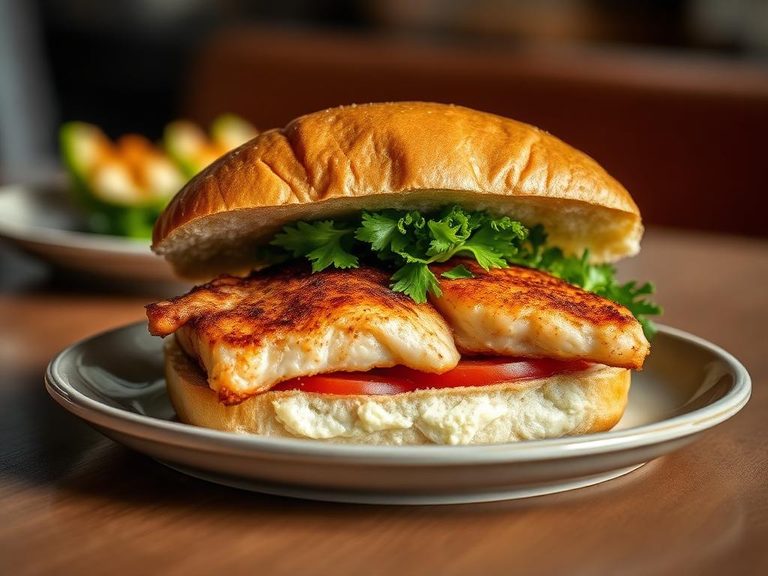
🌍 Where it's eaten
💡 Did you know?
The hand-battered fish at Applebee's is often made using a secret blend of spices and a batter that includes beer or carbonated water, which creates tiny air bubbles for an extra-light, crispy texture that stays crunchy longer than traditional flour coatings.
Full nutrition (scales with serving)
| Water | 58.8 g |
| Energy | 202 kcal |
| Energy | 844 kj |
| Protein | 13.2 g |
| Total lipid (fat) | 9.1 g |
| Ash | 2.2 g |
| Carbohydrate, by difference | 16.6 g |
| Fiber, total dietary | 0.90 g |
| Total Sugars | 0.51 g |
| Sucrose | 0.00 g |
| Glucose | 0.51 g |
| Fructose | 0.00 g |
| Lactose | 0.00 g |
| Maltose | 0.00 g |
| Galactose | 0.00 g |
| Starch | 15.8 g |
| Calcium, Ca | 13.0 mg |
| Iron, Fe | 0.35 mg |
| Magnesium, Mg | 20.0 mg |
| Phosphorus, P | 234 mg |
| Potassium, K | 241 mg |
| Sodium, Na | 607 mg |
| Zinc, Zn | 0.34 mg |
| Copper, Cu | 0.04 mg |
| Manganese, Mn | 0.10 mg |
| Selenium, Se | 17.8 ug |
| Thiamin | 0.05 mg |
| Riboflavin | 0.09 mg |
| Niacin | 2.3 mg |
| Pantothenic acid | 0.40 mg |
| Vitamin B-6 | 0.20 mg |
| Vitamin B-12 | 1.2 ug |
| Vitamin A, RAE | 3.0 ug |
| Retinol | 2.0 ug |
| Carotene, beta | 5.0 ug |
| Carotene, alpha | 1.0 ug |
| Cryptoxanthin, beta | 5.0 ug |
| Vitamin A, IU | 22.0 iu |
| Lycopene | 0.00 ug |
| Lutein + zeaxanthin | 100 ug |
| Vitamin E (alpha-tocopherol) | 0.88 mg |
| Tocopherol, beta | 0.09 mg |
| Tocopherol, gamma | 3.7 mg |
| Tocopherol, delta | 1.5 mg |
| Tocotrienol, alpha | 0.01 mg |
| Tocotrienol, beta | 0.11 mg |
| Tocotrienol, gamma | 0.05 mg |
| Tocotrienol, delta | 0.00 mg |
Fat & fatty acid profile (per 100g)
| Fatty acids, total saturated | 1.6 g |
| SFA 4:0 | 0.00 g |
| SFA 6:0 | 0.00 g |
| SFA 8:0 | 0.01 g |
| SFA 10:0 | 0.01 g |
| SFA 12:0 | 0.00 g |
| SFA 14:0 | 0.01 g |
| SFA 15:0 | 0.00 g |
| SFA 16:0 | 1.0 g |
| SFA 17:0 | 0.01 g |
| SFA 18:0 | 0.48 g |
| SFA 20:0 | 0.03 g |
| SFA 22:0 | 0.03 g |
| SFA 24:0 | 0.01 g |
| Fatty acids, total monounsaturated | 2.0 g |
| MUFA 14:1 | 0.00 g |
| MUFA 15:1 | 0.00 g |
| MUFA 16:1 | 0.03 g |
| MUFA 16:1 c | 0.03 g |
| MUFA 17:1 | 0.01 g |
| MUFA 18:1 | 1.9 g |
| MUFA 18:1 c | 1.9 g |
| MUFA 20:1 | 0.06 g |
| MUFA 22:1 | 0.00 g |
| MUFA 22:1 c | 0.00 g |
| MUFA 24:1 c | 0.00 g |
| Fatty acids, total polyunsaturated | 4.6 g |
| PUFA 18:2 | 3.9 g |
| PUFA 18:2 n-6 c,c | 3.8 g |
| PUFA 18:2 CLAs | 0.01 g |
| PUFA 18:3 | 0.52 g |
| PUFA 18:3 n-3 c,c,c (ALA) | 0.48 g |
| PUFA 18:3 n-6 c,c,c | 0.04 g |
| PUFA 18:3i | 0.00 g |
| PUFA 18:4 | 0.00 g |
| PUFA 20:2 n-6 c,c | 0.01 g |
| PUFA 20:3 | 0.00 g |
| PUFA 20:3 n-3 | 0.00 g |
| PUFA 20:3 n-6 | 0.00 g |
| PUFA 20:4 | 0.01 g |
| PUFA 20:5 n-3 (EPA) | 0.05 g |
| PUFA 22:4 | 0.00 g |
| PUFA 22:5 n-3 (DPA) | 0.01 g |
| PUFA 22:6 n-3 (DHA) | 0.11 g |
| Fatty acids, total trans | 0.08 g |
| Fatty acids, total trans-monoenoic | 0.02 g |
| TFA 16:1 t | 0.00 g |
| TFA 18:1 t | 0.02 g |
| TFA 22:1 t | 0.00 g |
| TFA 18:2 t not further defined | 0.05 g |
| Fatty acids, total trans-polyenoic | 0.05 g |
| Cholesterol | 34.0 mg |
Amino acid profile (per 100g)
| Tryptophan | 0.14 g |
| Threonine | 0.43 g |
| Isoleucine | 0.69 g |
| Leucine | 1.2 g |
| Lysine | 1.2 g |
| Methionine | 0.41 g |
| Cystine | 0.16 g |
| Phenylalanine | 0.54 g |
| Tyrosine | 0.41 g |
| Valine | 0.77 g |
| Arginine | 0.85 g |
| Histidine | 0.33 g |
| Alanine | 0.81 g |
| Aspartic acid | 1.3 g |
| Glutamic acid | 2.2 g |
| Glycine | 0.67 g |
| Proline | 0.69 g |
| Serine | 0.43 g |
| Hydroxyproline | 0.01 g |
FAQ
What type of fish is used in Applebee's hand-battered fish?
Applebee's typically uses white fish like cod or haddock for their hand-battered fish, which has a mild flavor and flaky texture that holds up well to frying.
Is Applebee's hand-battered fish gluten-free?
No, the batter contains wheat flour, making it unsuitable for those with gluten intolerance or celiac disease. For a gluten-free option, consider grilled fish instead.
How can I make a healthier version of hand-battered fish at home?
Use a light batter with whole-grain flour or cornmeal, bake or air-fry instead of deep-frying, and pair with vegetables to reduce overall fat and calories while maintaining the crispy texture.
What are the best sides to pair with hand-battered fish?
Classic sides include French fries, coleslaw, tartar sauce, and lemon wedges. For a healthier twist, try steamed broccoli, a green salad, or roasted potatoes.
Does hand-battered fish contain any common allergens?
Yes, it typically contains wheat (from the batter) and fish, which are common allergens. Always check with the restaurant for specific allergen information if you have dietary restrictions.