

Pork, fresh, loin, sirloin (chops), bone-in, separable lean only, cooked, braised
Whole food · Pork Products

Photo: Wikipedia
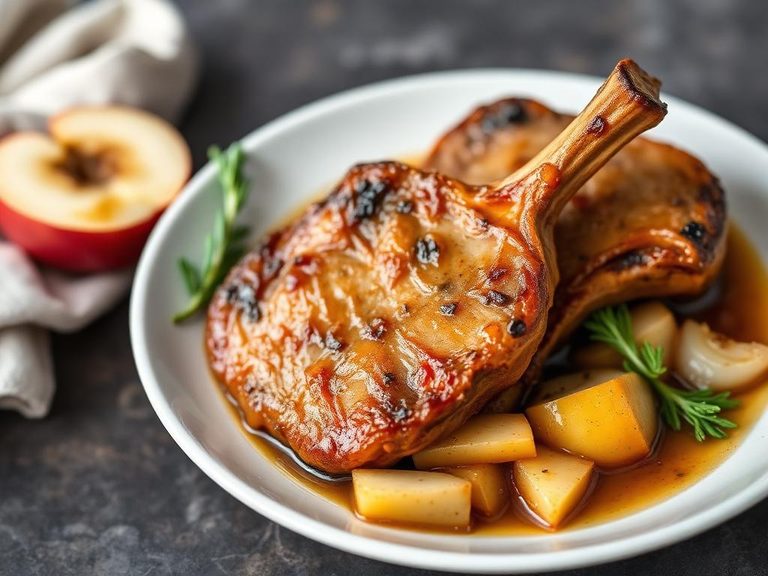
This is a lean, bone-in pork chop cut from the sirloin loin, braised to tender perfection. The meat becomes succulent and flavorful, with the bone adding depth to the cooking liquid. With an impressive 31 grams of protein per 100 grams and virtually no carbohydrates, it's a powerhouse for muscle maintenance and satiety.
Calorie split: 67% protein · 0% carbs · 33% fat
↓ Full nutrition💚 Why it's loved
People love it for its rich, savory flavor that develops beautifully through braising, which breaks down connective tissue into a melt-in-your-mouth texture. It's a versatile centerpiece that can be braised in a variety of liquids—from beer to broth—making it a adaptable comfort food in many home kitchens.
⚠️ Watch-outs & how to enjoy it better
While lean, the fat content (6.9g) and potential for added sodium in braising liquids or marinades require consideration for those managing fat or sodium intake. To counteract, use low-sodium broths, trim any visible external fat before cooking, and pair with fiber-rich vegetables like roasted Brussels sprouts or a fresh salad to balance the meal.
Key benefits
- Excellent source of complete, high-quality protein
- Very low in carbohydrates and sugars
- Provides essential B vitamins, especially thiamine (B1) and niacin (B3)
- Contains minerals like selenium and phosphorus
- Bone-in cut adds flavor and may contribute minerals to the braising liquid
🍽️ Popular dishes

🌍 Where it's eaten
💡 Did you know?
Braising is a form of stewing that uses both dry and wet heat; the pork chop is first seared to create a flavorful crust (the Maillard reaction) and then simmered gently in liquid, which is the key to transforming a potentially tough cut into a tender dish.
Full nutrition (USDA data · scales with serving)
| Water | 62.2 g |
| Energy | 195 kcal |
| Energy | 814 kj |
| Protein | 31.0 g |
| Total lipid (fat) | 6.9 g |
| Ash | 1.3 g |
| Carbohydrate, by difference | 0.00 g |
| Fiber, total dietary | 0.00 g |
| Total Sugars | 0.00 g |
| Calcium, Ca | 11.0 mg |
| Iron, Fe | 0.73 mg |
| Magnesium, Mg | 26.0 mg |
| Phosphorus, P | 303 mg |
| Potassium, K | 428 mg |
| Sodium, Na | 58.0 mg |
| Zinc, Zn | 2.1 mg |
| Copper, Cu | 0.09 mg |
| Manganese, Mn | 0.01 mg |
| Selenium, Se | 47.4 ug |
| Vitamin C, total ascorbic acid | 0.00 mg |
| Thiamin | 0.68 mg |
| Riboflavin | 0.27 mg |
| Niacin | 8.0 mg |
| Pantothenic acid | 1.0 mg |
| Vitamin B-6 | 0.54 mg |
| Folate, total | 0.00 ug |
| Folic acid | 0.00 ug |
| Folate, food | 0.00 ug |
| Folate, DFE | 0.00 ug |
| Choline, total | 89.9 mg |
| Betaine | 3.5 mg |
| Vitamin B-12 | 0.64 ug |
| Vitamin B-12, added | 0.00 ug |
| Vitamin A, RAE | 2.0 ug |
| Retinol | 2.0 ug |
| Carotene, beta | 0.00 ug |
| Carotene, alpha | 0.00 ug |
| Cryptoxanthin, beta | 0.00 ug |
| Vitamin A, IU | 6.0 iu |
| Lycopene | 0.00 ug |
| Lutein + zeaxanthin | 0.00 ug |
| Vitamin E (alpha-tocopherol) | 0.25 mg |
| Vitamin E, added | 0.00 mg |
| Vitamin D (D2 + D3), International Units | 17.0 iu |
| Vitamin D (D2 + D3) | 0.40 ug |
| Vitamin D3 (cholecalciferol) | 0.40 ug |
| Vitamin K (phylloquinone) | 0.00 ug |
| Vitamin K (Dihydrophylloquinone) | 0.00 ug |
| Alcohol, ethyl | 0.00 g |
| Caffeine | 0.00 mg |
| Theobromine | 0.00 mg |
Fat & fatty acid profile (per 100g)
| Fatty acids, total saturated | 2.3 g |
| SFA 4:0 | 0.00 g |
| SFA 6:0 | 0.00 g |
| SFA 8:0 | 0.00 g |
| SFA 10:0 | 0.01 g |
| SFA 12:0 | 0.00 g |
| SFA 14:0 | 0.09 g |
| SFA 15:0 | 0.00 g |
| SFA 16:0 | 1.4 g |
| SFA 17:0 | 0.02 g |
| SFA 18:0 | 0.76 g |
| SFA 20:0 | 0.01 g |
| SFA 22:0 | 0.00 g |
| SFA 24:0 | 0.00 g |
| Fatty acids, total monounsaturated | 2.8 g |
| MUFA 14:1 | 0.00 g |
| MUFA 15:1 | 0.00 g |
| MUFA 16:1 | 0.16 g |
| MUFA 17:1 | 0.00 g |
| MUFA 18:1 | 2.6 g |
| MUFA 18:1 c | 2.5 g |
| MUFA 20:1 | 0.04 g |
| MUFA 22:1 | 0.00 g |
| MUFA 22:1 c | 0.00 g |
| Fatty acids, total polyunsaturated | 1.2 g |
| PUFA 18:2 | 1.0 g |
| PUFA 18:2 n-6 c,c | 1.0 g |
| PUFA 18:3 | 0.04 g |
| PUFA 18:3 n-3 c,c,c (ALA) | 0.04 g |
| PUFA 18:3 n-6 c,c,c | 0.00 g |
| PUFA 18:3i | 0.00 g |
| PUFA 18:4 | 0.00 g |
| PUFA 20:2 n-6 c,c | 0.04 g |
| PUFA 20:3 | 0.00 g |
| PUFA 20:4 | 0.09 g |
| PUFA 20:5 n-3 (EPA) | 0.00 g |
| PUFA 22:5 n-3 (DPA) | 0.01 g |
| PUFA 22:6 n-3 (DHA) | 0.00 g |
| Fatty acids, total trans | 0.04 g |
| Fatty acids, total trans-monoenoic | 0.04 g |
| TFA 18:1 t | 0.04 g |
| TFA 18:2 t not further defined | 0.00 g |
| Fatty acids, total trans-polyenoic | 0.00 g |
| Cholesterol | 88.0 mg |
Amino acid profile (per 100g)
| Tryptophan | 0.37 g |
| Threonine | 1.4 g |
| Isoleucine | 1.5 g |
| Leucine | 2.6 g |
| Lysine | 2.8 g |
| Methionine | 0.85 g |
| Cystine | 0.35 g |
| Phenylalanine | 1.3 g |
| Tyrosine | 1.2 g |
| Valine | 1.6 g |
| Arginine | 2.0 g |
| Histidine | 1.3 g |
| Alanine | 1.8 g |
| Aspartic acid | 2.9 g |
| Glutamic acid | 4.7 g |
| Glycine | 1.4 g |
| Proline | 1.3 g |
| Serine | 1.3 g |
| Hydroxyproline | 0.11 g |
FAQ
What's the difference between braising and stewing for this cut?
Braising typically uses larger pieces of meat (like whole chops) partially submerged in liquid, while stewing involves cutting the meat into smaller, bite-sized pieces fully submerged. For sirloin chops, braising keeps the chop intact for presentation.
Can I use a boneless loin chop for braising?
Yes, but the bone-in version is preferred for braising as the bone adds flavor to the dish and helps the meat retain moisture during the long cooking process.
How do I prevent braised pork chops from drying out?
Ensure a tight-fitting lid on your pot to trap steam, maintain a very gentle simmer (not a boil), and don't overcook. The internal temperature should reach 145°F (63°C) followed by a rest period.
Nutrient density (calculated · NRF9.3)
Nutrient Rich Foods index: beneficial nutrients (protein, fiber, vitamins, minerals) minus saturated fat, added sugar & sodium, per 100 kcal.
NRF9.3 index — Fulgoni, Keast & Drewnowski, 2009. Computed from USDA nutrients.
Weight-loss friendliness (composite index)
Energy density 1.95 kcal/g · 64% calories from protein · 0.0 g fiber · 0.0 g sugar per 100 g.
Composite of energy density (Rolls et al., 1999), protein & fiber satiety, minus sugar. A calculated heuristic — ranks satiety-per-calorie, not a clinical measure.
Dietary load (calculated from USDA values)
Potential renal acid load. Positive = acid-forming, negative = alkaline-forming.
Sodium-to-potassium ratio: 0.14 (lower is better — aim for ≤ 1)
Sodium:potassium per WHO potassium guidance. Computed from USDA nutrients.