

Pork, fresh, loin, sirloin (chops), bone-in, separable lean and fat, cooked, braised
Whole food · Pork Products

Photo: Wikipedia
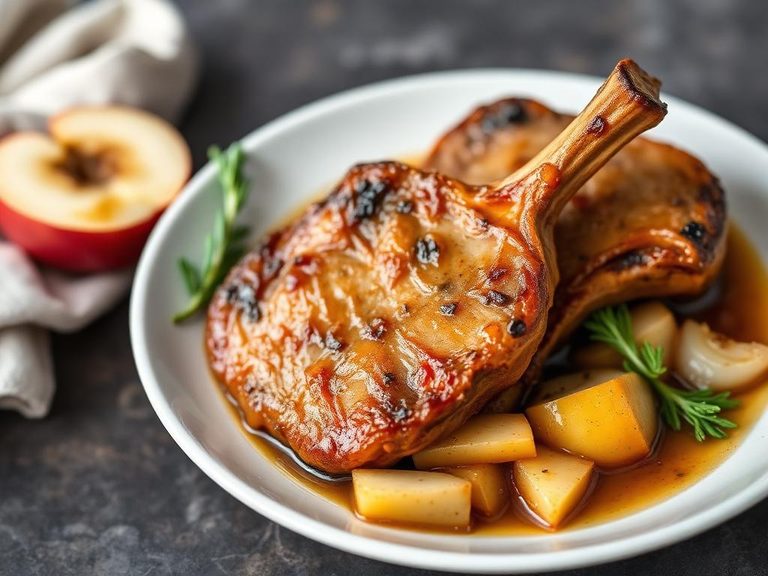
This is a bone-in pork chop cut from the sirloin section, featuring a tender strip of lean meat bordered by a layer of flavorful fat. When braised, it transforms into a succulent, fall-apart tender dish where the meat easily separates from the bone, and the rendered fat creates a rich, savory sauce. It's a high-protein, zero-carb powerhouse, delivering nearly 29 grams of protein per 100g with a moderate calorie count.
Calorie split: 51% protein · 0% carbs · 49% fat
↓ Full nutrition💚 Why it's loved
People adore this cut for its perfect balance of lean meat and flavorful fat, which bastes the chop from the outside in during the slow, moist cooking of braising. It's a beloved comfort food that yields incredibly tender, juicy results with minimal effort, making it a staple for hearty, satisfying meals.
⚠️ Watch-outs & how to enjoy it better
As a red meat, it is higher in saturated fat than poultry or fish, so those monitoring saturated fat intake should practice portion control. To counteract this, pair it with fiber-rich vegetables like roasted Brussels sprouts or a vinegar-based slaw to aid digestion and balance the meal. Braising allows excess fat to render out, which can be skimmed from the sauce before serving.
Key benefits
- Excellent source of complete, high-quality protein for muscle maintenance.
- Naturally zero in carbohydrates and sugars, suitable for low-carb diets.
- Provides essential B vitamins like thiamine (B1) and niacin (B3).
- Contains minerals such as selenium and phosphorus.
- The braising method helps break down connective tissue, making it very tender.
🍽️ Popular dishes

🌍 Where it's eaten
💡 Did you know?
The 'sirloin' in pork doesn't correspond to the same cut as beef sirloin; it's a section of the loin closer to the hip, which gives it a bit more marbling and flavor than the center-cut loin chop.
Full nutrition (USDA data · scales with serving)
| Water | 58.9 g |
| Energy | 234 kcal |
| Energy | 979 kj |
| Protein | 28.8 g |
| Total lipid (fat) | 12.3 g |
| Ash | 1.2 g |
| Carbohydrate, by difference | 0.00 g |
| Fiber, total dietary | 0.00 g |
| Total Sugars | 0.00 g |
| Calcium, Ca | 12.0 mg |
| Iron, Fe | 0.71 mg |
| Magnesium, Mg | 24.0 mg |
| Phosphorus, P | 285 mg |
| Potassium, K | 400 mg |
| Sodium, Na | 58.0 mg |
| Zinc, Zn | 2.0 mg |
| Copper, Cu | 0.09 mg |
| Manganese, Mn | 0.01 mg |
| Selenium, Se | 44.1 ug |
| Vitamin C, total ascorbic acid | 0.00 mg |
| Thiamin | 0.63 mg |
| Riboflavin | 0.26 mg |
| Niacin | 7.5 mg |
| Pantothenic acid | 0.97 mg |
| Vitamin B-6 | 0.51 mg |
| Folate, total | 0.00 ug |
| Folic acid | 0.00 ug |
| Folate, food | 0.00 ug |
| Folate, DFE | 0.00 ug |
| Choline, total | 84.7 mg |
| Betaine | 3.3 mg |
| Vitamin B-12 | 0.63 ug |
| Vitamin B-12, added | 0.00 ug |
| Vitamin A, RAE | 4.0 ug |
| Retinol | 4.0 ug |
| Carotene, beta | 0.00 ug |
| Carotene, alpha | 0.00 ug |
| Cryptoxanthin, beta | 0.00 ug |
| Vitamin A, IU | 13.0 iu |
| Lycopene | 0.00 ug |
| Lutein + zeaxanthin | 0.00 ug |
| Vitamin E (alpha-tocopherol) | 0.22 mg |
| Vitamin E, added | 0.00 mg |
| Vitamin D (D2 + D3), International Units | 22.0 iu |
| Vitamin D (D2 + D3) | 0.60 ug |
| Vitamin D3 (cholecalciferol) | 0.60 ug |
| Vitamin K (phylloquinone) | 0.00 ug |
| Vitamin K (Dihydrophylloquinone) | 0.00 ug |
| Alcohol, ethyl | 0.00 g |
| Caffeine | 0.00 mg |
| Theobromine | 0.00 mg |
Fat & fatty acid profile (per 100g)
| Fatty acids, total saturated | 4.3 g |
| SFA 4:0 | 0.00 g |
| SFA 6:0 | 0.00 g |
| SFA 8:0 | 0.00 g |
| SFA 10:0 | 0.01 g |
| SFA 12:0 | 0.01 g |
| SFA 14:0 | 0.16 g |
| SFA 15:0 | 0.00 g |
| SFA 16:0 | 2.7 g |
| SFA 17:0 | 0.04 g |
| SFA 18:0 | 1.4 g |
| SFA 20:0 | 0.02 g |
| SFA 22:0 | 0.00 g |
| SFA 24:0 | 0.00 g |
| Fatty acids, total monounsaturated | 5.2 g |
| MUFA 14:1 | 0.00 g |
| MUFA 15:1 | 0.00 g |
| MUFA 16:1 | 0.27 g |
| MUFA 17:1 | 0.00 g |
| MUFA 18:1 | 4.8 g |
| MUFA 18:1 c | 4.8 g |
| MUFA 20:1 | 0.08 g |
| MUFA 22:1 | 0.00 g |
| MUFA 22:1 c | 0.00 g |
| Fatty acids, total polyunsaturated | 2.2 g |
| PUFA 18:2 | 1.9 g |
| PUFA 18:2 n-6 c,c | 1.9 g |
| PUFA 18:3 | 0.08 g |
| PUFA 18:3 n-3 c,c,c (ALA) | 0.07 g |
| PUFA 18:3 n-6 c,c,c | 0.00 g |
| PUFA 18:3i | 0.00 g |
| PUFA 18:4 | 0.00 g |
| PUFA 20:2 n-6 c,c | 0.07 g |
| PUFA 20:3 | 0.01 g |
| PUFA 20:4 | 0.10 g |
| PUFA 20:5 n-3 (EPA) | 0.00 g |
| PUFA 22:5 n-3 (DPA) | 0.01 g |
| PUFA 22:6 n-3 (DHA) | 0.00 g |
| Fatty acids, total trans | 0.08 g |
| Fatty acids, total trans-monoenoic | 0.07 g |
| TFA 18:1 t | 0.07 g |
| TFA 18:2 t not further defined | 0.01 g |
| Fatty acids, total trans-polyenoic | 0.01 g |
| Cholesterol | 87.0 mg |
Amino acid profile (per 100g)
| Tryptophan | 0.34 g |
| Threonine | 1.3 g |
| Isoleucine | 1.4 g |
| Leucine | 2.4 g |
| Lysine | 2.6 g |
| Methionine | 0.79 g |
| Cystine | 0.33 g |
| Phenylalanine | 1.2 g |
| Tyrosine | 1.1 g |
| Valine | 1.5 g |
| Arginine | 1.9 g |
| Histidine | 1.2 g |
| Alanine | 1.6 g |
| Aspartic acid | 2.7 g |
| Glutamic acid | 4.4 g |
| Glycine | 1.3 g |
| Proline | 1.2 g |
| Serine | 1.2 g |
| Hydroxyproline | 0.10 g |
FAQ
What's the difference between braising and pan-frying this chop?
Braising involves a quick sear followed by slow cooking in a small amount of liquid, which breaks down collagen and results in extremely tender, juicy meat. Pan-frying cooks it quickly with direct heat, which can yield a crisp exterior but risks drying out the lean part if overcooked.
How can I tell when it's properly braised?
The meat is done when it is fork-tender and easily pulls away from the bone. The internal temperature should reach 145°F (63°C) followed by a 3-minute rest, but the key indicator for braising is tenderness, not just temperature.
Is the bone important for flavor?
Yes, absolutely. The bone and its surrounding connective tissue contribute gelatin and rich flavor to the braising liquid, resulting in a more savory and full-bodied sauce. It also helps the meat cook more evenly and stay moist.
Nutrient density (calculated · NRF9.3)
Nutrient Rich Foods index: beneficial nutrients (protein, fiber, vitamins, minerals) minus saturated fat, added sugar & sodium, per 100 kcal.
NRF9.3 index — Fulgoni, Keast & Drewnowski, 2009. Computed from USDA nutrients.
Weight-loss friendliness (composite index)
Energy density 2.34 kcal/g · 49% calories from protein · 0.0 g fiber · 0.0 g sugar per 100 g.
Composite of energy density (Rolls et al., 1999), protein & fiber satiety, minus sugar. A calculated heuristic — ranks satiety-per-calorie, not a clinical measure.
Dietary load (calculated from USDA values)
Potential renal acid load. Positive = acid-forming, negative = alkaline-forming.
Sodium-to-potassium ratio: 0.14 (lower is better — aim for ≤ 1)
Sodium:potassium per WHO potassium guidance. Computed from USDA nutrients.