

Pork, fresh, loin, blade (chops), bone-in, separable lean and fat, cooked, pan-fried
Whole food · Pork Products

Photo: Wikipedia
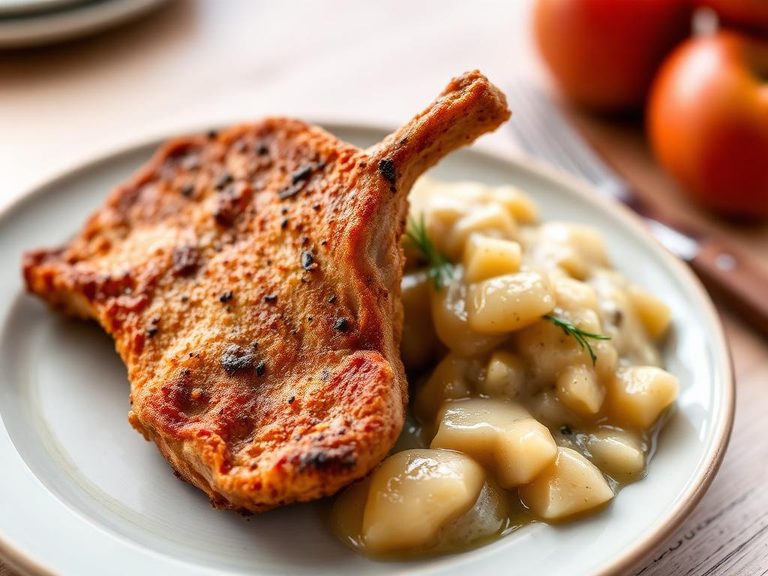
This is a juicy, bone-in pork chop cut from the shoulder area, known as the blade loin. When pan-fried, it develops a beautifully caramelized, savory crust while the interior stays tender with a satisfying balance of lean meat and flavorful marbling. It's a protein-packed powerhouse, delivering over 25 grams of high-quality protein per 100 grams with zero carbohydrates.
Calorie split: 40% protein · 0% carbs · 60% fat
↓ Full nutrition💚 Why it's loved
People adore it for its deep, savory pork flavor and the satisfying contrast between the crispy exterior and juicy interior. It's a versatile staple that can be seasoned simply or dressed up with sauces, making it a comforting weeknight dinner or a centerpiece for weekend meals.
⚠️ Watch-outs & how to enjoy it better
As a red meat, it is higher in saturated fat and calories than lean poultry or fish, so portion control is key for those monitoring intake. The blade cut can have more connective tissue than other chops, which might make it tougher if overcooked. To counteract this, marinate the chops for 30 minutes to tenderize, and use a meat thermometer to pull them from the pan at 145°F (63°C), allowing a 3-minute rest for perfect juiciness.
Key benefits
- Excellent source of complete protein for muscle maintenance.
- Provides essential B vitamins like thiamine and B12 for energy metabolism.
- Rich in minerals such as selenium, zinc, and phosphorus.
- Contains monounsaturated fats, which can be part of a heart-healthy diet when consumed in moderation.
🍽️ Popular dishes

🌍 Where it's eaten
💡 Did you know?
The blade chop comes from the shoulder, which is a hard-working muscle group, so it often has a distinctive 'eye' of fat and connective tissue running through it that melts during cooking, basting the meat from within.
Full nutrition (USDA data · scales with serving)
| Water | 58.0 g |
| Energy | 256 kcal |
| Energy | 1072 kj |
| Protein | 25.0 g |
| Total lipid (fat) | 16.6 g |
| Ash | 1.2 g |
| Carbohydrate, by difference | 0.00 g |
| Fiber, total dietary | 0.00 g |
| Total Sugars | 0.00 g |
| Calcium, Ca | 48.0 mg |
| Iron, Fe | 0.84 mg |
| Magnesium, Mg | 20.0 mg |
| Phosphorus, P | 226 mg |
| Potassium, K | 318 mg |
| Sodium, Na | 85.0 mg |
| Zinc, Zn | 2.9 mg |
| Copper, Cu | 0.10 mg |
| Manganese, Mn | 0.01 mg |
| Selenium, Se | 36.7 ug |
| Vitamin C, total ascorbic acid | 0.00 mg |
| Thiamin | 0.48 mg |
| Riboflavin | 0.34 mg |
| Niacin | 8.3 mg |
| Pantothenic acid | 1.2 mg |
| Vitamin B-6 | 0.48 mg |
| Folate, total | 0.00 ug |
| Folic acid | 0.00 ug |
| Folate, food | 0.00 ug |
| Folate, DFE | 0.00 ug |
| Choline, total | 80.4 mg |
| Betaine | 3.2 mg |
| Vitamin B-12 | 0.72 ug |
| Vitamin B-12, added | 0.00 ug |
| Vitamin A, RAE | 5.0 ug |
| Retinol | 5.0 ug |
| Carotene, beta | 0.00 ug |
| Carotene, alpha | 0.00 ug |
| Cryptoxanthin, beta | 0.00 ug |
| Vitamin A, IU | 17.0 iu |
| Lycopene | 0.00 ug |
| Lutein + zeaxanthin | 0.00 ug |
| Vitamin E (alpha-tocopherol) | 0.20 mg |
| Vitamin E, added | 0.00 mg |
| Vitamin D (D2 + D3), International Units | 27.0 iu |
| Vitamin D (D2 + D3) | 0.70 ug |
| Vitamin D3 (cholecalciferol) | 0.70 ug |
| Vitamin K (phylloquinone) | 0.00 ug |
| Vitamin K (Dihydrophylloquinone) | 0.00 ug |
| Alcohol, ethyl | 0.00 g |
| Caffeine | 0.00 mg |
| Theobromine | 0.00 mg |
Fat & fatty acid profile (per 100g)
| Fatty acids, total saturated | 4.3 g |
| SFA 4:0 | 0.00 g |
| SFA 6:0 | 0.00 g |
| SFA 8:0 | 0.00 g |
| SFA 10:0 | 0.01 g |
| SFA 12:0 | 0.01 g |
| SFA 14:0 | 0.15 g |
| SFA 15:0 | 0.01 g |
| SFA 16:0 | 2.6 g |
| SFA 17:0 | 0.04 g |
| SFA 18:0 | 1.4 g |
| SFA 20:0 | 0.02 g |
| SFA 22:0 | 0.00 g |
| SFA 24:0 | 0.00 g |
| Fatty acids, total monounsaturated | 9.5 g |
| MUFA 14:1 | 0.00 g |
| MUFA 15:1 | 0.00 g |
| MUFA 16:1 | 0.48 g |
| MUFA 17:1 | 0.00 g |
| MUFA 18:1 | 8.8 g |
| MUFA 18:1 c | 8.7 g |
| MUFA 20:1 | 0.15 g |
| MUFA 22:1 | 0.00 g |
| MUFA 22:1 c | 0.00 g |
| Fatty acids, total polyunsaturated | 2.8 g |
| PUFA 18:2 | 2.5 g |
| PUFA 18:2 n-6 c,c | 1.3 g |
| PUFA 18:3 | 0.11 g |
| PUFA 18:3 n-3 c,c,c (ALA) | 0.10 g |
| PUFA 18:3 n-6 c,c,c | 0.00 g |
| PUFA 18:3i | 0.01 g |
| PUFA 18:4 | 0.00 g |
| PUFA 20:2 n-6 c,c | 0.10 g |
| PUFA 20:3 | 0.01 g |
| PUFA 20:4 | 0.14 g |
| PUFA 20:5 n-3 (EPA) | 0.00 g |
| PUFA 22:5 n-3 (DPA) | 0.02 g |
| PUFA 22:6 n-3 (DHA) | 0.00 g |
| Fatty acids, total trans | 0.12 g |
| Fatty acids, total trans-monoenoic | 0.10 g |
| TFA 18:1 t | 0.10 g |
| TFA 18:2 t not further defined | 0.01 g |
| Fatty acids, total trans-polyenoic | 0.02 g |
| Cholesterol | 82.0 mg |
Amino acid profile (per 100g)
| Tryptophan | 0.29 g |
| Threonine | 1.1 g |
| Isoleucine | 1.2 g |
| Leucine | 2.0 g |
| Lysine | 2.2 g |
| Methionine | 0.67 g |
| Cystine | 0.28 g |
| Phenylalanine | 1.0 g |
| Tyrosine | 0.97 g |
| Valine | 1.2 g |
| Arginine | 1.6 g |
| Histidine | 0.99 g |
| Alanine | 1.4 g |
| Aspartic acid | 2.3 g |
| Glutamic acid | 3.7 g |
| Glycine | 1.1 g |
| Proline | 0.99 g |
| Serine | 1.0 g |
| Hydroxyproline | 0.09 g |
FAQ
What's the difference between a blade chop and a rib chop?
A blade chop comes from the shoulder (front) and has more marbling and connective tissue, making it flavorful but potentially tougher. A rib chop comes from the loin (back) and is leaner, more tender, and typically more expensive.
How do I prevent my pork chops from drying out?
The key is to not overcook them. Use a meat thermometer and remove the chops from the heat when the internal temperature reaches 145°F (63°C). Let them rest on a cutting board for 3-5 minutes before serving; the residual heat will finish cooking them while the juices redistribute.
Can I use this cut for slow cooking?
Yes, absolutely. Because it has more connective tissue than leaner chops, it becomes incredibly tender and flavorful when braised or slow-cooked in a liquid like broth, cider, or barbecue sauce.
Nutrient density (calculated · NRF9.3)
Nutrient Rich Foods index: beneficial nutrients (protein, fiber, vitamins, minerals) minus saturated fat, added sugar & sodium, per 100 kcal.
NRF9.3 index — Fulgoni, Keast & Drewnowski, 2009. Computed from USDA nutrients.
Weight-loss friendliness (composite index)
Energy density 2.56 kcal/g · 39% calories from protein · 0.0 g fiber · 0.0 g sugar per 100 g.
Composite of energy density (Rolls et al., 1999), protein & fiber satiety, minus sugar. A calculated heuristic — ranks satiety-per-calorie, not a clinical measure.
Dietary load (calculated from USDA values)
Potential renal acid load. Positive = acid-forming, negative = alkaline-forming.
Sodium-to-potassium ratio: 0.27 (lower is better — aim for ≤ 1)
Sodium:potassium per WHO potassium guidance. Computed from USDA nutrients.