

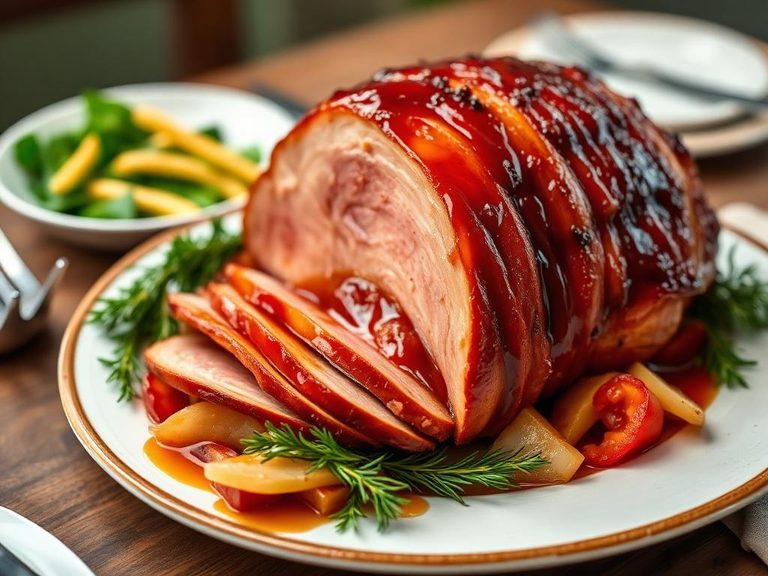
Pork, cured, ham -- water added, shank, bone-in, separable lean and fat, heated, roasted
Whole food · Pork Products

Photo: Wikipedia
This is a moist, savory cut of ham from the pig's leg, specifically the shank portion, that has been cured, water-injected, and roasted to a tender finish. Its texture is a satisfying balance of lean, fibrous meat and a thin, flavorful layer of fat, offering a classic salty, smoky, and subtly sweet taste. Nutritionally, it's a strong protein source with a moderate calorie count, though its fat content comes primarily from the added water and curing process.
Calorie split: 37% protein · 3% carbs · 60% fat
↓ Full nutrition💚 Why it's loved
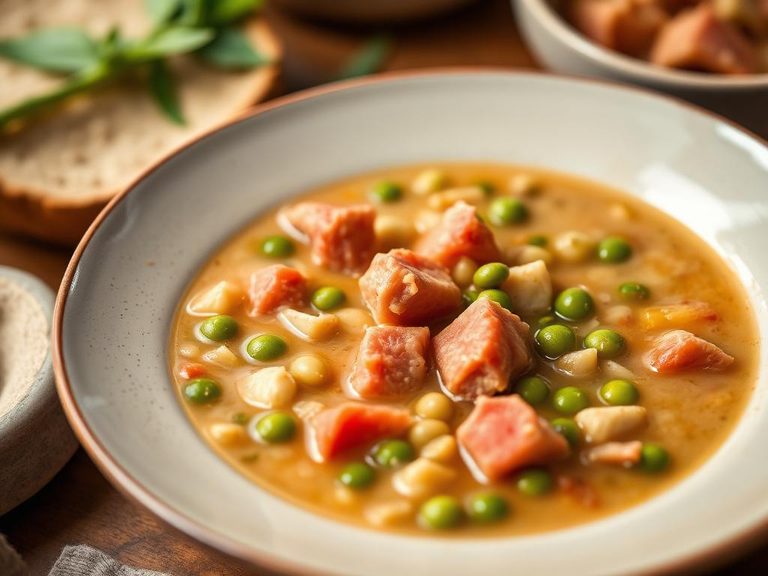
People love its deeply savory, salty flavor and tender, juicy texture that makes it a centerpiece for holiday meals and everyday sandwiches alike. Its versatility allows it to be served hot, cold, or incorporated into a wide range of dishes, from classic breakfasts to hearty dinners.
⚠️ Watch-outs & how to enjoy it better
The primary downside is its high sodium content from the curing process, which can be a concern for those monitoring blood pressure. To counteract this, pair it with potassium-rich foods like leafy greens or sweet potatoes, and practice portion control. Additionally, the added water and fat can make it less lean than fresh pork, so choosing leaner cuts or trimming visible fat is advisable.
Key benefits
- Excellent source of high-quality protein for muscle maintenance.
- Rich in essential minerals like selenium and phosphorus.
- Provides B vitamins, particularly B1 (thiamine) and B6, for energy metabolism.
- Convenient, pre-cooked protein that requires minimal preparation.
🍽️ Popular dishes



🌍 Where it's eaten
💡 Did you know?
The 'water added' in the description refers to a common processing technique called 'pumping' where a brine solution is injected into the meat to increase its weight and moisture, a practice regulated by the USDA.
Full nutrition (USDA data · scales with serving)
| Water | 63.4 g |
| Energy | 200 kcal |
| Energy | 838 kj |
| Protein | 18.6 g |
| Total lipid (fat) | 13.4 g |
| Ash | 3.2 g |
| Carbohydrate, by difference | 1.4 g |
| Fiber, total dietary | 0.00 g |
| Total Sugars | 0.79 g |
| Sucrose | 0.57 g |
| Glucose | 0.17 g |
| Fructose | 0.05 g |
| Lactose | 0.00 g |
| Maltose | 0.00 g |
| Galactose | 0.00 g |
| Calcium, Ca | 9.0 mg |
| Iron, Fe | 1.4 mg |
| Magnesium, Mg | 17.0 mg |
| Phosphorus, P | 207 mg |
| Potassium, K | 232 mg |
| Sodium, Na | 988 mg |
| Zinc, Zn | 2.7 mg |
| Copper, Cu | 0.16 mg |
| Manganese, Mn | 0.02 mg |
| Selenium, Se | 24.2 ug |
| Vitamin C, total ascorbic acid | 0.00 mg |
| Thiamin | 0.26 mg |
| Riboflavin | 0.17 mg |
| Niacin | 4.7 mg |
| Pantothenic acid | 0.52 mg |
| Vitamin B-6 | 0.32 mg |
| Folate, total | 1.0 ug |
| Folic acid | 0.00 ug |
| Folate, food | 1.0 ug |
| Folate, DFE | 1.0 ug |
| Choline, total | 73.9 mg |
| Betaine | 2.3 mg |
| Vitamin B-12 | 0.55 ug |
| Vitamin B-12, added | 0.00 ug |
| Vitamin A, RAE | 11.0 ug |
| Retinol | 11.0 ug |
| Carotene, beta | 0.00 ug |
| Carotene, alpha | 0.00 ug |
| Cryptoxanthin, beta | 0.00 ug |
| Vitamin A, IU | 38.0 iu |
| Lycopene | 0.00 ug |
| Lutein + zeaxanthin | 0.00 ug |
| Vitamin E (alpha-tocopherol) | 0.29 mg |
| Vitamin E, added | 0.00 mg |
| Tocopherol, beta | 0.01 mg |
| Tocopherol, gamma | 0.08 mg |
| Tocopherol, delta | 0.01 mg |
| Tocotrienol, alpha | 0.03 mg |
| Tocotrienol, beta | 0.00 mg |
| Tocotrienol, gamma | 0.03 mg |
| Tocotrienol, delta | 0.00 mg |
| Vitamin K (phylloquinone) | 0.00 ug |
| Vitamin K (Dihydrophylloquinone) | 0.00 ug |
| Vitamin K (Menaquinone-4) | 4.5 ug |
| Alcohol, ethyl | 0.00 g |
| Caffeine | 0.00 mg |
| Theobromine | 0.00 mg |
Fat & fatty acid profile (per 100g)
| Fatty acids, total saturated | 4.4 g |
| SFA 4:0 | 0.00 g |
| SFA 6:0 | 0.00 g |
| SFA 8:0 | 0.00 g |
| SFA 10:0 | 0.01 g |
| SFA 12:0 | 0.01 g |
| SFA 14:0 | 0.16 g |
| SFA 15:0 | 0.00 g |
| SFA 16:0 | 2.8 g |
| SFA 17:0 | 0.03 g |
| SFA 18:0 | 1.3 g |
| SFA 20:0 | 0.02 g |
| SFA 22:0 | 0.02 g |
| Fatty acids, total monounsaturated | 6.1 g |
| MUFA 14:1 | 0.00 g |
| MUFA 15:1 | 0.00 g |
| MUFA 16:1 | 0.32 g |
| MUFA 17:1 | 0.00 g |
| MUFA 18:1 | 5.7 g |
| MUFA 20:1 | 0.10 g |
| MUFA 22:1 | 0.00 g |
| Fatty acids, total polyunsaturated | 1.7 g |
| PUFA 18:2 | 1.5 g |
| PUFA 18:3 | 0.06 g |
| PUFA 18:4 | 0.00 g |
| PUFA 20:2 n-6 c,c | 0.07 g |
| PUFA 20:3 | 0.00 g |
| PUFA 20:4 | 0.08 g |
| PUFA 20:5 n-3 (EPA) | 0.00 g |
| PUFA 22:5 n-3 (DPA) | 0.00 g |
| PUFA 22:6 n-3 (DHA) | 0.00 g |
| Fatty acids, total trans | 0.09 g |
| Cholesterol | 66.0 mg |
Amino acid profile (per 100g)
| Tryptophan | 0.17 g |
| Threonine | 0.82 g |
| Isoleucine | 0.83 g |
| Leucine | 1.5 g |
| Lysine | 1.6 g |
| Methionine | 0.44 g |
| Cystine | 0.21 g |
| Phenylalanine | 0.74 g |
| Tyrosine | 0.59 g |
| Valine | 0.94 g |
| Arginine | 1.2 g |
| Histidine | 0.81 g |
| Alanine | 1.1 g |
| Aspartic acid | 1.6 g |
| Glutamic acid | 2.6 g |
| Glycine | 1.0 g |
| Proline | 0.81 g |
| Serine | 0.73 g |
| Hydroxyproline | 0.12 g |
FAQ
What is the difference between 'water added' and 'water added, bone-in' ham?
'Water added' means the ham has been injected with a brine solution to increase moisture and weight. 'Bone-in' means the shank bone is still present during cooking, which can add flavor and help keep the meat moist.
Is this a healthy choice for a low-fat diet?
While it provides good protein, the fat content (13.37g per 100g) is moderate. For a lower-fat option, you could trim visible fat or choose a leaner cut like the 'separable lean only' version.
How should I store leftover roasted ham?
Store leftovers in an airtight container in the refrigerator for 3-4 days. For longer storage, freeze for up to 1-2 months. Always reheat to an internal temperature of 165°F (74°C).
Nutrient density (calculated · NRF9.3)
Nutrient Rich Foods index: beneficial nutrients (protein, fiber, vitamins, minerals) minus saturated fat, added sugar & sodium, per 100 kcal.
NRF9.3 index — Fulgoni, Keast & Drewnowski, 2009. Computed from USDA nutrients.
Weight-loss friendliness (composite index)
Energy density 2.00 kcal/g · 37% calories from protein · 0.0 g fiber · 0.8 g sugar per 100 g.
Composite of energy density (Rolls et al., 1999), protein & fiber satiety, minus sugar. A calculated heuristic — ranks satiety-per-calorie, not a clinical measure.
Dietary load (calculated from USDA values)
Potential renal acid load. Positive = acid-forming, negative = alkaline-forming.
Sodium-to-potassium ratio: 4.26 (lower is better — aim for ≤ 1)
Sodium:potassium per WHO potassium guidance. Computed from USDA nutrients.