

Chicken, nuggets, white meat, precooked, frozen, not reheated
Whole food · Meals, Entrees, and Side Dishes

Photo: Wikipedia
These are bite-sized pieces of white chicken meat, coated in a seasoned batter or breading and flash-frozen before cooking. In their raw, frozen state, they are pale and firm, with a soft, slightly starchy texture from the coating and a mild, savory chicken flavor. Nutritionally, they offer a moderate protein punch for their calorie count, but their energy comes almost equally from fats and refined carbohydrates.
Calorie split: 22% protein · 25% carbs · 53% fat
↓ Full nutrition💚 Why it's loved
People love them for their ultimate convenience and crowd-pleasing, mild flavor that's a staple for quick family meals and kid-friendly snacks. Their crispy potential and ability to be paired with countless sauces make them a versatile comfort food.
⚠️ Watch-outs & how to enjoy it better
The high fat and refined carb content from the breading can lead to blood-sugar spikes and empty calories, and they often contain significant sodium. To counteract, bake or air-fry instead of deep-frying, control portions, and pair with a fiber-rich vegetable or a simple side salad to slow digestion.
Key benefits
- Convenient source of quick protein
- Long shelf life reduces food waste
- Versatile base for many meals
- Consistent portion and nutrient profile
- Familiar, mild flavor appeals to many palates
🍽️ Popular dishes
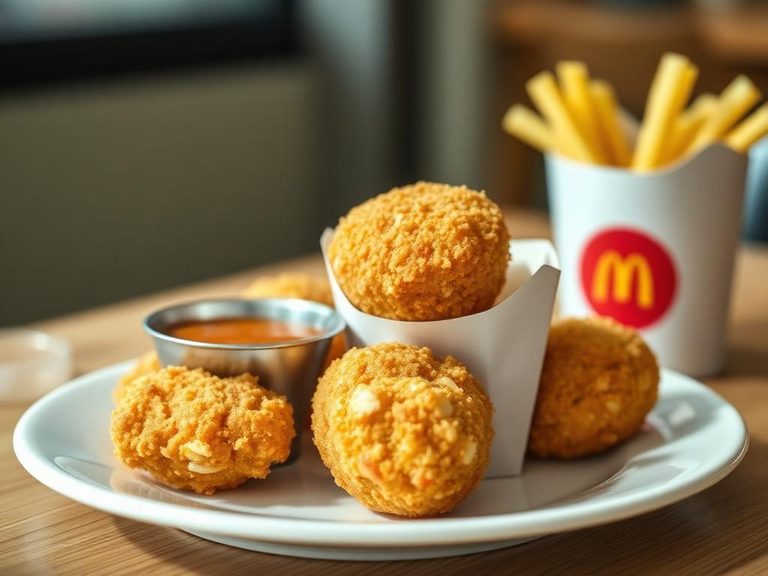
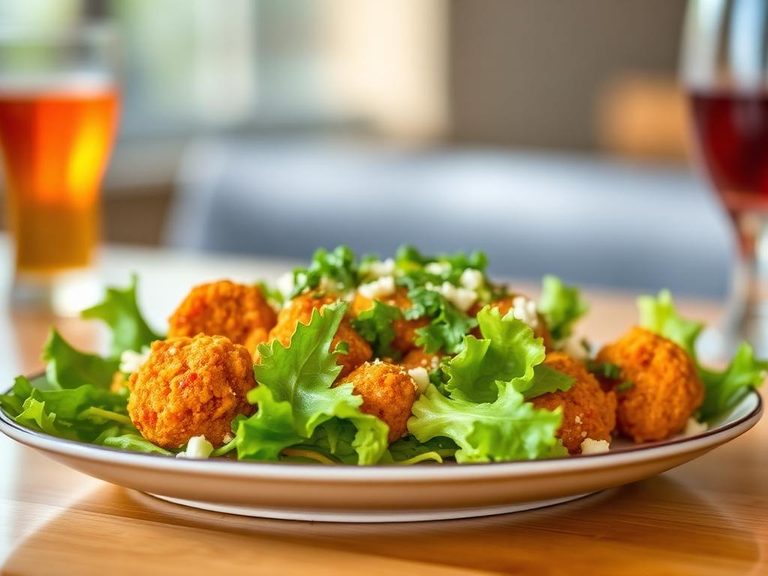
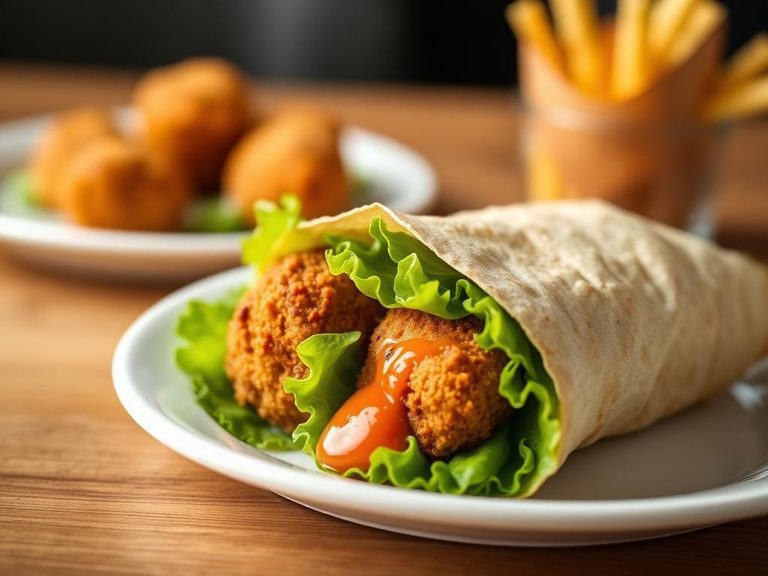
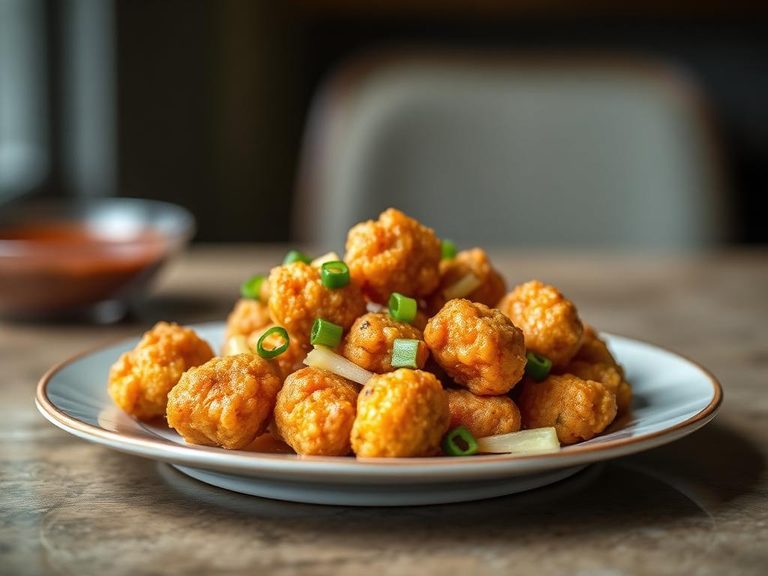

🌍 Where it's eaten
💡 Did you know?
The modern chicken nugget was invented in 1963 by Robert C. Baker, a food science professor at Cornell University, who created a way to bind ground chicken meat to its breading so it wouldn't fall apart during cooking.
Full nutrition (USDA data · scales with serving)
| Water | 51.9 g |
| Energy | 261 kcal |
| Energy | 1093 kj |
| Protein | 14.4 g |
| Total lipid (fat) | 15.4 g |
| Ash | 2.1 g |
| Carbohydrate, by difference | 16.2 g |
| Fiber, total dietary | 0.70 g |
| Total Sugars | 1.3 g |
| Sucrose | 0.00 g |
| Glucose | 0.56 g |
| Fructose | 0.28 g |
| Lactose | 0.00 g |
| Maltose | 0.42 g |
| Galactose | 0.00 g |
| Starch | 13.3 g |
| Calcium, Ca | 38.0 mg |
| Iron, Fe | 1.4 mg |
| Magnesium, Mg | 35.0 mg |
| Phosphorus, P | 213 mg |
| Potassium, K | 281 mg |
| Sodium, Na | 538 mg |
| Zinc, Zn | 0.75 mg |
| Copper, Cu | 0.14 mg |
| Manganese, Mn | 0.46 mg |
| Selenium, Se | 17.0 ug |
| Vitamin C, total ascorbic acid | 0.00 mg |
| Thiamin | 0.11 mg |
| Riboflavin | 0.06 mg |
| Niacin | 6.7 mg |
| Vitamin B-6 | 0.33 mg |
| Folate, total | 5.0 ug |
| Folic acid | 0.00 ug |
| Folate, food | 5.0 ug |
| Folate, DFE | 5.0 ug |
| Choline, total | 45.5 mg |
| Vitamin B-12 | 0.23 ug |
| Vitamin B-12, added | 0.00 ug |
| Vitamin A, RAE | 16.0 ug |
| Retinol | 16.0 ug |
| Carotene, beta | 0.00 ug |
| Carotene, alpha | 0.00 ug |
| Cryptoxanthin, beta | 0.00 ug |
| Vitamin A, IU | 53.0 iu |
| Lycopene | 0.00 ug |
| Lutein + zeaxanthin | 0.00 ug |
| Vitamin E (alpha-tocopherol) | 1.2 mg |
| Vitamin E, added | 0.00 mg |
| Vitamin K (phylloquinone) | 10.0 ug |
| Alcohol, ethyl | 0.00 g |
| Caffeine | 0.00 mg |
| Theobromine | 0.00 mg |
Fat & fatty acid profile (per 100g)
| Fatty acids, total saturated | 3.4 g |
| SFA 4:0 | 0.00 g |
| SFA 6:0 | 0.00 g |
| SFA 8:0 | 0.00 g |
| SFA 10:0 | 0.00 g |
| SFA 12:0 | 0.01 g |
| SFA 14:0 | 0.05 g |
| SFA 15:0 | 0.01 g |
| SFA 16:0 | 2.5 g |
| SFA 17:0 | 0.02 g |
| SFA 18:0 | 0.68 g |
| SFA 20:0 | 0.03 g |
| SFA 22:0 | 0.03 g |
| SFA 24:0 | 0.01 g |
| Fatty acids, total monounsaturated | 4.7 g |
| MUFA 14:1 | 0.01 g |
| MUFA 15:1 | 0.00 g |
| MUFA 16:1 | 0.41 g |
| MUFA 16:1 c | 0.40 g |
| MUFA 17:1 | 0.01 g |
| MUFA 18:1 | 4.2 g |
| MUFA 18:1 c | 4.1 g |
| MUFA 20:1 | 0.07 g |
| MUFA 22:1 | 0.01 g |
| MUFA 22:1 c | 0.00 g |
| MUFA 24:1 c | 0.00 g |
| Fatty acids, total polyunsaturated | 6.2 g |
| PUFA 18:2 | 5.5 g |
| PUFA 18:2 n-6 c,c | 5.5 g |
| PUFA 18:2 CLAs | 0.02 g |
| PUFA 18:3 | 0.56 g |
| PUFA 18:3 n-3 c,c,c (ALA) | 0.55 g |
| PUFA 18:3 n-6 c,c,c | 0.01 g |
| PUFA 18:4 | 0.00 g |
| PUFA 20:2 n-6 c,c | 0.01 g |
| PUFA 20:3 | 0.01 g |
| PUFA 20:3 n-3 | 0.00 g |
| PUFA 20:3 n-6 | 0.01 g |
| PUFA 20:4 | 0.04 g |
| PUFA 20:5 n-3 (EPA) | 0.00 g |
| PUFA 22:4 | 0.01 g |
| PUFA 22:5 n-3 (DPA) | 0.00 g |
| PUFA 22:6 n-3 (DHA) | 0.00 g |
| Fatty acids, total trans | 0.08 g |
| Fatty acids, total trans-monoenoic | 0.03 g |
| TFA 16:1 t | 0.00 g |
| TFA 18:1 t | 0.03 g |
| TFA 22:1 t | 0.00 g |
| TFA 18:2 t not further defined | 0.05 g |
| Fatty acids, total trans-polyenoic | 0.05 g |
| Cholesterol | 34.0 mg |
Amino acid profile (per 100g)
Estimated from Taquitos, frozen, chicken and cheese, oven-heated — USDA does not publish this profile for Chicken.
| Tryptophan | 0.10 g |
| Threonine | 0.27 g |
| Isoleucine | 0.36 g |
| Leucine | 0.72 g |
| Lysine | 0.47 g |
| Methionine | 0.19 g |
| Cystine | 0.20 g |
| Phenylalanine | 0.42 g |
| Tyrosine | 0.25 g |
| Valine | 0.43 g |
| Arginine | 0.48 g |
| Histidine | 0.25 g |
| Alanine | 0.37 g |
| Aspartic acid | 0.63 g |
| Glutamic acid | 2.5 g |
| Glycine | 0.41 g |
| Proline | 1.1 g |
| Serine | 0.47 g |
| Hydroxyproline | 0.00 g |
FAQ
Are these nuggets made from whole chicken breast?
They are labeled 'white meat,' which typically means they are made from chicken breast muscle, but the meat is often ground or minced before being formed into the nugget shape.
Why are they precooked but not reheated?
This describes their state in the package: they are fully cooked for safety and convenience, but are sold frozen and require the consumer to reheat (bake, fry, etc.) to achieve the desired hot, crispy texture.
Is the nutritional info for the raw, frozen nugget or after cooking?
The data provided (261 kcal per 100g) is for the product as purchased, in its raw, frozen state. Cooking methods will add or remove fat and moisture, slightly altering the final nutrition.
Nutrient density (calculated · NRF9.3)
Nutrient Rich Foods index: beneficial nutrients (protein, fiber, vitamins, minerals) minus saturated fat, added sugar & sodium, per 100 kcal.
NRF9.3 index — Fulgoni, Keast & Drewnowski, 2009. Computed from USDA nutrients.
Weight-loss friendliness (composite index)
Energy density 2.61 kcal/g · 22% calories from protein · 0.7 g fiber · 1.3 g sugar per 100 g.
Composite of energy density (Rolls et al., 1999), protein & fiber satiety, minus sugar. A calculated heuristic — ranks satiety-per-calorie, not a clinical measure.
Dietary load (calculated from USDA values)
Potential renal acid load. Positive = acid-forming, negative = alkaline-forming.
Sodium-to-potassium ratio: 1.91 (lower is better — aim for ≤ 1)
Sodium:potassium per WHO potassium guidance. Computed from USDA nutrients.