

Bread, chapati or roti, plain, commercially prepared
Whole food · Baked Products
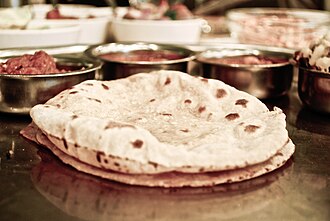
Photo: Wikipedia
A staple unleavened flatbread made from whole wheat flour, chapati is a soft, slightly chewy disc with a subtle, nutty sweetness and a lightly charred, smoky aroma from the hot griddle. It's a nutritionally dense source of complex carbohydrates and plant-based protein, providing a steady release of energy. Its high fiber content supports digestion and helps maintain a feeling of fullness.
Calorie split: 15% protein · 62% carbs · 23% fat
↓ Full nutrition💚 Why it's loved
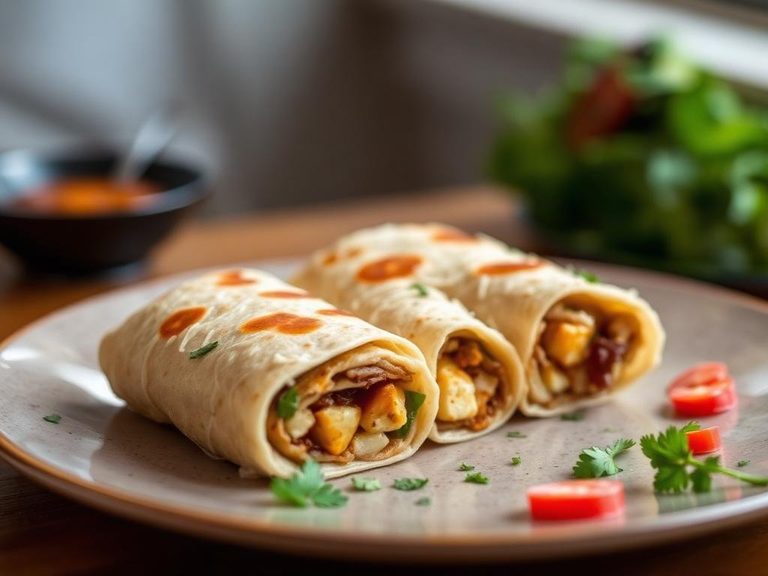
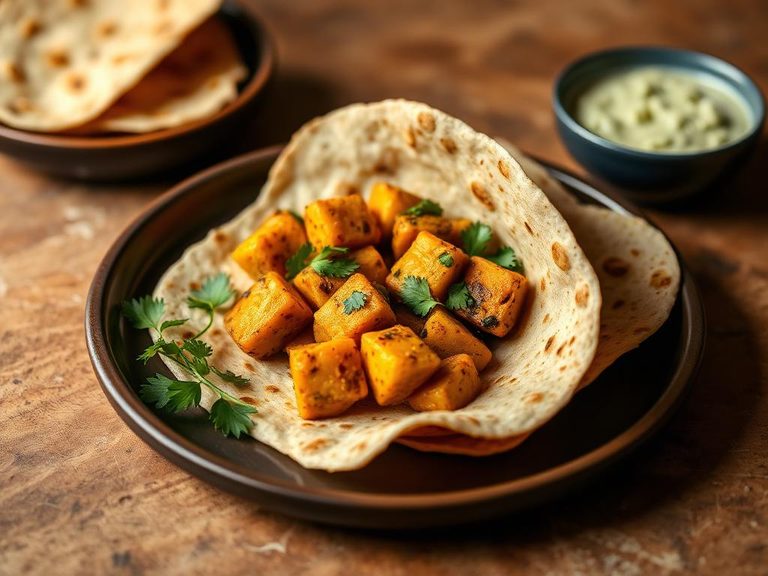
People love chapati for its comforting, mild flavor that perfectly complements and soaks up rich curries, dals, and stews. Its incredible versatility allows it to be a simple wrap, a scoop for dips, or a base for more elaborate dishes, deeply woven into daily meals across South Asia.
⚠️ Watch-outs & how to enjoy it better
As a carbohydrate-rich food, it can cause blood sugar spikes if eaten alone or in large portions, especially for those with insulin sensitivity. To counteract this, pair it with protein and healthy fats like dal, yogurt, or a vegetable curry to slow digestion. Those with gluten intolerance or celiac disease must avoid it, as it is made from wheat.
Key benefits
- Excellent source of dietary fiber for digestive health.
- Provides sustained energy from complex carbohydrates.
- Good plant-based source of protein.
- Low in sugar, making it a better choice than many refined breads.
- Whole wheat flour retains essential B vitamins and minerals.
🍽️ Popular dishes



🌍 Where it's eaten
💡 Did you know?
The word 'chapati' is derived from the Hindi/Hindustani word 'chapat', meaning 'to slap' or 'to flatten with hands', referring to the traditional method of shaping the dough between the palms.
Full nutrition (USDA data · scales with serving)
| Water | 33.0 g |
| Energy | 297 kcal |
| Energy | 1245 kj |
| Protein | 11.3 g |
| Total lipid (fat) | 7.5 g |
| Ash | 1.9 g |
| Carbohydrate, by difference | 46.4 g |
| Fiber, total dietary | 4.9 g |
| Total Sugars | 2.7 g |
| Sucrose | 0.29 g |
| Glucose | 0.25 g |
| Fructose | 0.54 g |
| Lactose | 0.00 g |
| Maltose | 1.6 g |
| Galactose | 0.00 g |
| Starch | 37.8 g |
| Calcium, Ca | 93.0 mg |
| Iron, Fe | 3.0 mg |
| Magnesium, Mg | 62.0 mg |
| Phosphorus, P | 184 mg |
| Potassium, K | 266 mg |
| Sodium, Na | 409 mg |
| Zinc, Zn | 1.6 mg |
| Copper, Cu | 0.25 mg |
| Manganese, Mn | 1.3 mg |
| Selenium, Se | 53.7 ug |
| Thiamin | 0.55 mg |
| Riboflavin | 0.20 mg |
| Niacin | 6.8 mg |
| Pantothenic acid | 0.58 mg |
| Vitamin B-6 | 0.27 mg |
| Folate, total | 61.0 ug |
| Folate, food | 61.0 ug |
| Vitamin E (alpha-tocopherol) | 0.88 mg |
| Tocopherol, beta | 0.22 mg |
| Tocopherol, gamma | 0.89 mg |
| Tocopherol, delta | 0.10 mg |
| Tocotrienol, alpha | 0.48 mg |
| Tocotrienol, beta | 2.1 mg |
| Tocotrienol, gamma | 0.68 mg |
| Tocotrienol, delta | 0.32 mg |
Fat & fatty acid profile (per 100g)
| Fatty acids, total saturated | 2.0 g |
| SFA 4:0 | 0.00 g |
| SFA 6:0 | 0.00 g |
| SFA 8:0 | 0.00 g |
| SFA 10:0 | 0.01 g |
| SFA 12:0 | 0.01 g |
| SFA 14:0 | 0.04 g |
| SFA 15:0 | 0.01 g |
| SFA 16:0 | 1.6 g |
| SFA 17:0 | 0.01 g |
| SFA 18:0 | 0.21 g |
| SFA 20:0 | 0.02 g |
| SFA 22:0 | 0.01 g |
| SFA 24:0 | 0.01 g |
| Fatty acids, total monounsaturated | 1.9 g |
| MUFA 14:1 | 0.00 g |
| MUFA 15:1 | 0.00 g |
| MUFA 16:1 | 0.01 g |
| MUFA 16:1 c | 0.01 g |
| MUFA 17:1 | 0.00 g |
| MUFA 18:1 | 1.9 g |
| MUFA 18:1 c | 1.8 g |
| MUFA 20:1 | 0.03 g |
| MUFA 22:1 | 0.00 g |
| MUFA 22:1 c | 0.00 g |
| MUFA 24:1 c | 0.00 g |
| Fatty acids, total polyunsaturated | 1.1 g |
| PUFA 18:2 | 1.0 g |
| PUFA 18:2 n-6 c,c | 1.0 g |
| PUFA 18:2 CLAs | 0.00 g |
| PUFA 18:3 | 0.13 g |
| PUFA 18:3 n-3 c,c,c (ALA) | 0.13 g |
| PUFA 18:3 n-6 c,c,c | 0.00 g |
| PUFA 18:3i | 0.00 g |
| PUFA 18:4 | 0.00 g |
| PUFA 20:2 n-6 c,c | 0.00 g |
| PUFA 20:3 | 0.00 g |
| PUFA 20:3 n-3 | 0.00 g |
| PUFA 20:3 n-6 | 0.00 g |
| PUFA 20:4 | 0.00 g |
| PUFA 20:5 n-3 (EPA) | 0.00 g |
| PUFA 22:4 | 0.00 g |
| PUFA 22:5 n-3 (DPA) | 0.00 g |
| PUFA 22:6 n-3 (DHA) | 0.00 g |
| Fatty acids, total trans | 0.03 g |
| Fatty acids, total trans-monoenoic | 0.03 g |
| TFA 16:1 t | 0.00 g |
| TFA 18:1 t | 0.03 g |
| TFA 22:1 t | 0.00 g |
| TFA 18:2 t not further defined | 0.01 g |
| Fatty acids, total trans-polyenoic | 0.01 g |
Amino acid profile (per 100g)
Estimated from Bread, salvadoran sweet cheese (quesadilla salvadorena) — USDA does not publish this profile for Bread.
| Tryptophan | 0.07 g |
| Threonine | 0.21 g |
| Isoleucine | 0.30 g |
| Leucine | 0.65 g |
| Lysine | 0.50 g |
| Methionine | 0.28 g |
| Cystine | 0.06 g |
| Phenylalanine | 0.37 g |
| Tyrosine | 0.23 g |
| Valine | 0.43 g |
| Arginine | 0.25 g |
| Histidine | 0.15 g |
| Alanine | 0.36 g |
| Aspartic acid | 0.59 g |
| Glutamic acid | 1.3 g |
| Glycine | 0.20 g |
| Proline | 0.83 g |
| Serine | 0.45 g |
| Hydroxyproline | 0.00 g |
FAQ
What is the difference between chapati and roti?
In many contexts, the terms are used interchangeably. Technically, 'roti' is a generic term for any unleavened flatbread, while 'chapati' often specifically refers to a roti made from whole wheat flour (atta) and cooked on a tava (griddle).
Can chapati be part of a weight-loss diet?
Yes, due to its high fiber and protein content which promotes satiety. The key is portion control (1-2 per meal) and pairing it with high-volume, low-calorie vegetables and lean protein rather than rich, oily gravies.
How do you keep chapati soft?
Store them in an insulated container (like a roti basket) lined with a clean kitchen towel or paper towel to absorb excess moisture. This prevents them from drying out and becoming brittle.
Nutrient density (calculated · NRF9.3)
Nutrient Rich Foods index: beneficial nutrients (protein, fiber, vitamins, minerals) minus saturated fat, added sugar & sodium, per 100 kcal.
NRF9.3 index — Fulgoni, Keast & Drewnowski, 2009. Computed from USDA nutrients.
Weight-loss friendliness (composite index)
Energy density 2.97 kcal/g · 15% calories from protein · 4.9 g fiber · 2.7 g sugar per 100 g.
Composite of energy density (Rolls et al., 1999), protein & fiber satiety, minus sugar. A calculated heuristic — ranks satiety-per-calorie, not a clinical measure.
Dietary load (calculated from USDA values)
Potential renal acid load. Positive = acid-forming, negative = alkaline-forming.
Sodium-to-potassium ratio: 1.54 (lower is better — aim for ≤ 1)
Sodium:potassium per WHO potassium guidance. Computed from USDA nutrients.