

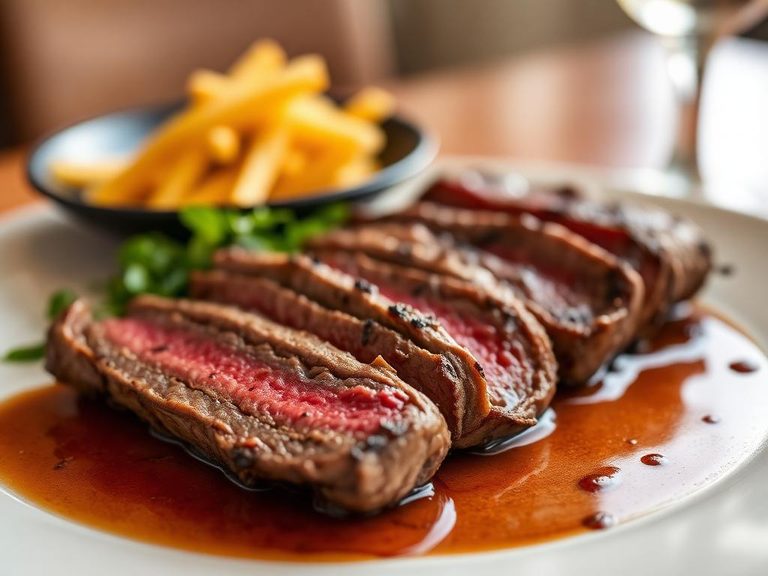
Beef, rib eye steak, boneless, lip-on, separable lean only, trimmed to 1/8" fat, all grades, cooked, grilled
Whole food · Beef Products

Photo: Wikipedia
This is a premium cut of beef, the boneless ribeye steak with the flavorful 'lip' fat left on, then meticulously trimmed to a thin 1/8-inch fat cap and grilled. The result is a supremely juicy, richly marbled steak with a deep, beefy flavor and a tender, melt-in-your-mouth texture. Nutritionally, it's a powerhouse of complete protein with zero carbs, making it a staple for high-protein, low-carb diets.
Calorie split: 54% protein · 0% carbs · 46% fat
↓ Full nutrition💚 Why it's loved
People adore it for the perfect balance of intense, savory beef flavor and luxurious, buttery tenderness from its intramuscular fat (marbling). It's the quintessential celebratory steak, equally at home in a classic steakhouse dinner or a backyard barbecue.
⚠️ Watch-outs & how to enjoy it better
As a red meat, it's high in saturated fat and cholesterol, which some individuals may need to limit for heart health. To mitigate, enjoy it in moderate portions (e.g., 4-6 oz) and balance your meal with fiber-rich vegetables like roasted asparagus or a leafy salad. It's also a common food for those following strict low-cholesterol diets.
Key benefits
- Excellent source of high-quality, complete protein for muscle maintenance.
- Rich in bioavailable iron (heme iron) and zinc for immune function.
- Provides B vitamins, especially B12, crucial for nerve health and energy.
- Contains creatine, which may support muscle performance and cognitive function.
- Zero carbohydrates, making it ideal for ketogenic and low-carb lifestyles.
🍽️ Popular dishes

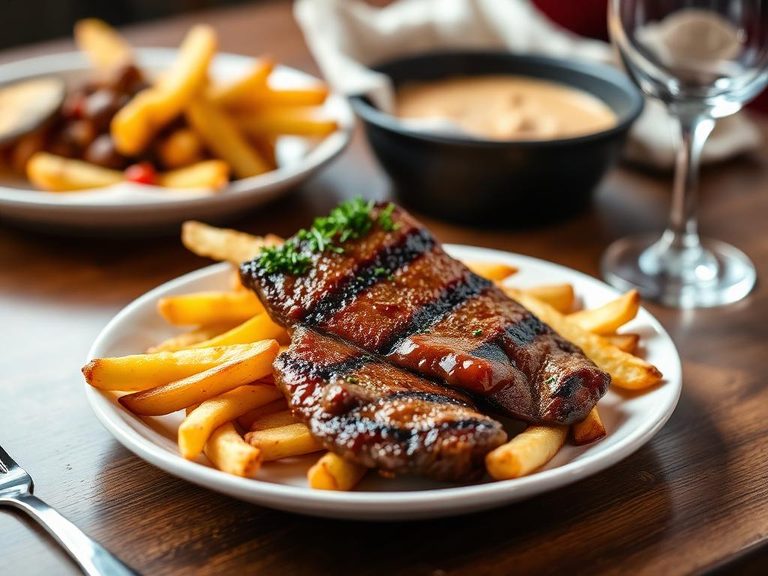
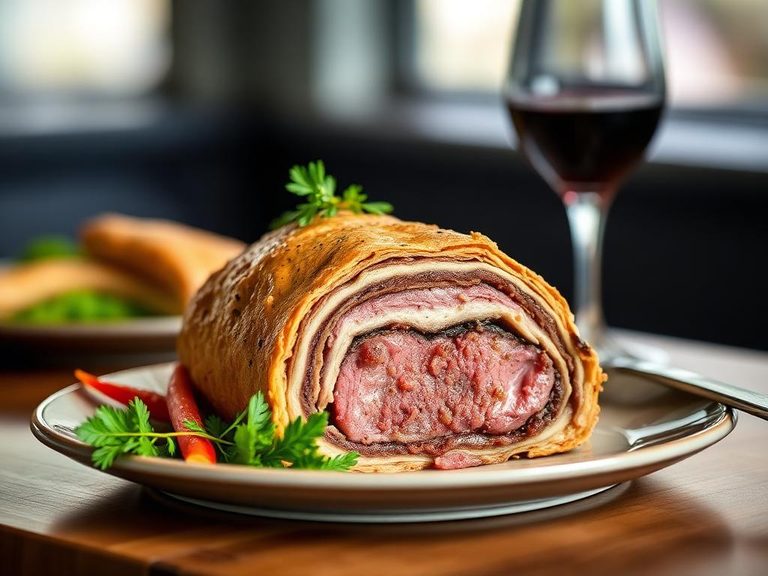
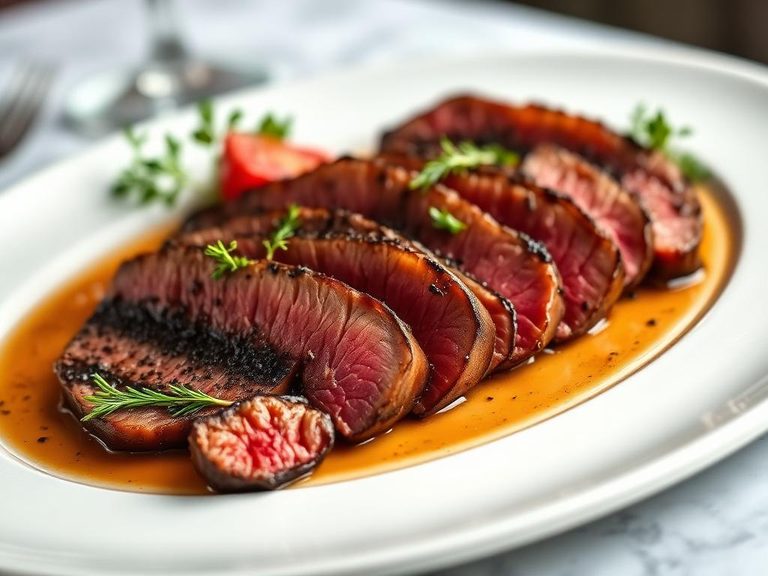
🌍 Where it's eaten
💡 Did you know?
The 'lip-on' designation refers to the *m. caput costae* muscle, a small, incredibly tender and flavorful piece of meat attached to the ribeye that is often considered a chef's secret favorite bite.
Full nutrition (USDA data · scales with serving)
| Water | 61.4 g |
| Energy | 207 kcal |
| Energy | 866 kj |
| Protein | 28.0 g |
| Total lipid (fat) | 10.6 g |
| Ash | 1.0 g |
| Carbohydrate, by difference | 0.00 g |
| Fiber, total dietary | 0.00 g |
| Total Sugars | 0.00 g |
| Calcium, Ca | 7.0 mg |
| Iron, Fe | 2.5 mg |
| Magnesium, Mg | 25.0 mg |
| Phosphorus, P | 177 mg |
| Potassium, K | 296 mg |
| Sodium, Na | 59.0 mg |
| Zinc, Zn | 7.0 mg |
| Copper, Cu | 0.09 mg |
| Manganese, Mn | 0.09 mg |
| Selenium, Se | 35.6 ug |
| Vitamin C, total ascorbic acid | 0.00 mg |
| Thiamin | 0.08 mg |
| Riboflavin | 0.32 mg |
| Niacin | 5.8 mg |
| Pantothenic acid | 0.59 mg |
| Vitamin B-6 | 0.56 mg |
| Folate, total | 7.0 ug |
| Folic acid | 0.00 ug |
| Folate, food | 7.0 ug |
| Folate, DFE | 7.0 ug |
| Choline, total | 57.0 mg |
| Betaine | 13.5 mg |
| Vitamin B-12 | 2.3 ug |
| Vitamin B-12, added | 0.00 ug |
| Vitamin A, RAE | 2.0 ug |
| Retinol | 2.0 ug |
| Carotene, beta | 0.00 ug |
| Carotene, alpha | 0.00 ug |
| Cryptoxanthin, beta | 0.00 ug |
| Vitamin A, IU | 6.0 iu |
| Lycopene | 0.00 ug |
| Lutein + zeaxanthin | 0.00 ug |
| Vitamin E (alpha-tocopherol) | 0.10 mg |
| Vitamin E, added | 0.00 mg |
| Vitamin D (D2 + D3), International Units | 4.0 iu |
| Vitamin D (D2 + D3) | 0.10 ug |
| Vitamin D3 (cholecalciferol) | 0.10 ug |
| Vitamin K (phylloquinone) | 1.6 ug |
| Alcohol, ethyl | 0.00 g |
| Caffeine | 0.00 mg |
| Theobromine | 0.00 mg |
Fat & fatty acid profile (per 100g)
| Fatty acids, total saturated | 4.2 g |
| SFA 4:0 | 0.00 g |
| SFA 6:0 | 0.00 g |
| SFA 8:0 | 0.00 g |
| SFA 10:0 | 0.01 g |
| SFA 12:0 | 0.01 g |
| SFA 14:0 | 0.27 g |
| SFA 15:0 | 0.06 g |
| SFA 16:0 | 2.3 g |
| SFA 17:0 | 0.14 g |
| SFA 18:0 | 1.4 g |
| SFA 20:0 | 0.00 g |
| SFA 24:0 | 0.01 g |
| Fatty acids, total monounsaturated | 4.9 g |
| MUFA 14:1 | 0.06 g |
| MUFA 15:1 | 0.05 g |
| MUFA 16:1 | 0.33 g |
| MUFA 16:1 c | 0.32 g |
| MUFA 17:1 | 0.10 g |
| MUFA 18:1 | 4.3 g |
| MUFA 18:1 c | 3.8 g |
| MUFA 20:1 | 0.01 g |
| MUFA 22:1 | 0.00 g |
| Fatty acids, total polyunsaturated | 0.55 g |
| PUFA 18:2 | 0.44 g |
| PUFA 18:2 n-6 c,c | 0.40 g |
| PUFA 18:2 CLAs | 0.03 g |
| PUFA 18:3 | 0.02 g |
| PUFA 18:3 n-3 c,c,c (ALA) | 0.02 g |
| PUFA 18:4 | 0.00 g |
| PUFA 20:2 n-6 c,c | 0.00 g |
| PUFA 20:3 | 0.02 g |
| PUFA 20:3 n-6 | 0.02 g |
| PUFA 20:4 | 0.06 g |
| PUFA 20:5 n-3 (EPA) | 0.00 g |
| PUFA 22:5 n-3 (DPA) | 0.01 g |
| PUFA 22:6 n-3 (DHA) | 0.00 g |
| Fatty acids, total trans | 0.52 g |
| Fatty acids, total trans-monoenoic | 0.51 g |
| TFA 16:1 t | 0.01 g |
| TFA 18:1 t | 0.50 g |
| TFA 18:2 t not further defined | 0.01 g |
| Fatty acids, total trans-polyenoic | 0.01 g |
| Cholesterol | 79.0 mg |
Amino acid profile (per 100g)
| Tryptophan | 0.34 g |
| Threonine | 1.4 g |
| Isoleucine | 1.4 g |
| Leucine | 2.6 g |
| Lysine | 2.9 g |
| Methionine | 0.81 g |
| Cystine | 0.31 g |
| Phenylalanine | 1.2 g |
| Tyrosine | 1.1 g |
| Valine | 1.5 g |
| Arginine | 2.1 g |
| Histidine | 1.1 g |
| Alanine | 1.8 g |
| Aspartic acid | 3.0 g |
| Glutamic acid | 5.0 g |
| Glycine | 1.3 g |
| Proline | 1.3 g |
| Serine | 1.2 g |
| Hydroxyproline | 0.14 g |
FAQ
What does 'separable lean only' mean in the nutrition data?
It means the nutritional values are calculated for just the lean meat portion, after the large outer fat cap and any significant internal fat have been trimmed away. The 'trimmed to 1/8" fat' part indicates a very lean final product.
How does grilling affect the nutrition compared to other methods?
Grilling allows excess fat to drip away from the steak, potentially resulting in a slightly lower final fat content than methods like pan-frying where the steak cooks in its own rendered fat. It also doesn't add any carbohydrates or sugars.
Is this a good cut for a low-sodium diet?
Unseasoned beef is naturally very low in sodium. The sodium content depends entirely on any marinades, rubs, or sauces added during preparation. For a low-sodium meal, season it yourself with herbs, garlic, and pepper instead of pre-made salty blends.
Nutrient density (calculated · NRF9.3)
Nutrient Rich Foods index: beneficial nutrients (protein, fiber, vitamins, minerals) minus saturated fat, added sugar & sodium, per 100 kcal.
NRF9.3 index — Fulgoni, Keast & Drewnowski, 2009. Computed from USDA nutrients.
Weight-loss friendliness (composite index)
Energy density 2.07 kcal/g · 54% calories from protein · 0.0 g fiber · 0.0 g sugar per 100 g.
Composite of energy density (Rolls et al., 1999), protein & fiber satiety, minus sugar. A calculated heuristic — ranks satiety-per-calorie, not a clinical measure.
Dietary load (calculated from USDA values)
Potential renal acid load. Positive = acid-forming, negative = alkaline-forming.
Sodium-to-potassium ratio: 0.20 (lower is better — aim for ≤ 1)
Sodium:potassium per WHO potassium guidance. Computed from USDA nutrients.