

Beef, rib eye steak, boneless, lip-on, separable lean and fat, trimmed to 1/8" fat, select, cooked, grilled
Whole food · Beef Products

Photo: Wikipedia
A boneless, lip-on ribeye steak, trimmed to a thin 1/8-inch fat cap, delivers a deeply beefy, buttery flavor with a rich, marbled texture that melts in the mouth. Grilling caramelizes the exterior while keeping the interior juicy and tender. It's a high-protein, zero-carb powerhouse, packing nearly 25 grams of protein and over 19 grams of fat per 100-gram serving.
Calorie split: 36% protein · 0% carbs · 64% fat
↓ Full nutrition💚 Why it's loved
People adore it for the perfect harmony of intense, savory beef flavor and luxurious, melt-in-your-mouth tenderness from its signature marbling. It's a versatile centerpiece for everything from a simple grilled steak to a sliced topping for salads and grain bowls.
⚠️ Watch-outs & how to enjoy it better
The high saturated fat content means it should be enjoyed in moderation, especially by those monitoring cholesterol. To counteract, practice strict portion control (see below) and balance your meal with fiber-rich vegetables like roasted broccoli or a leafy salad to aid digestion and promote satiety.
Key benefits
- Excellent source of complete, high-quality protein for muscle maintenance.
- Rich in bioavailable iron and zinc, essential for immune function.
- Provides B vitamins like B12 and niacin, crucial for energy metabolism.
- Contains conjugated linoleic acid (CLA), a naturally occurring fatty acid.
🍽️ Popular dishes

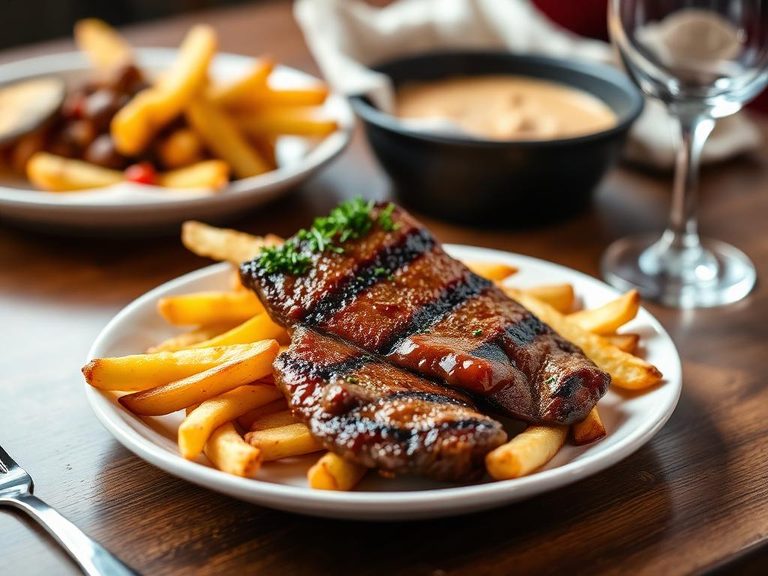
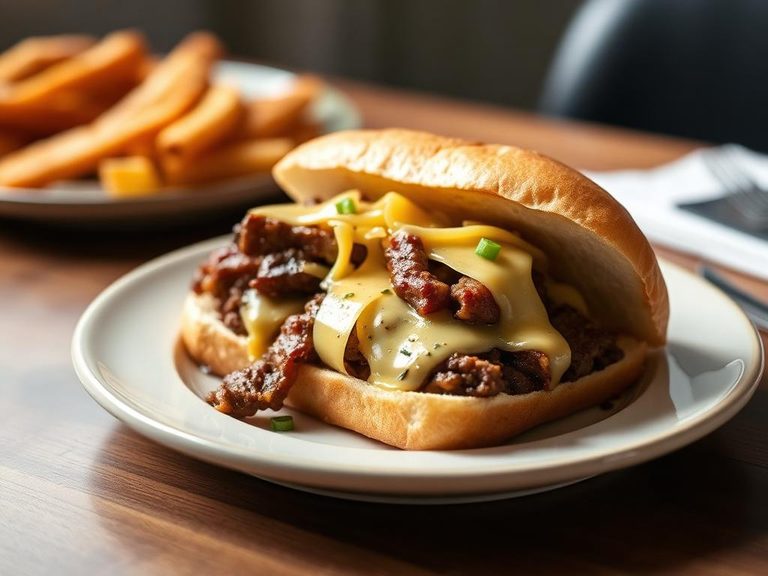
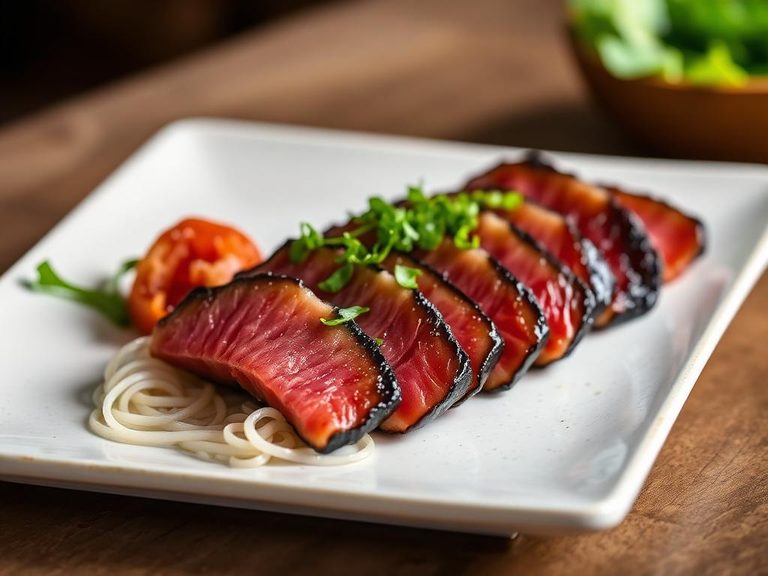
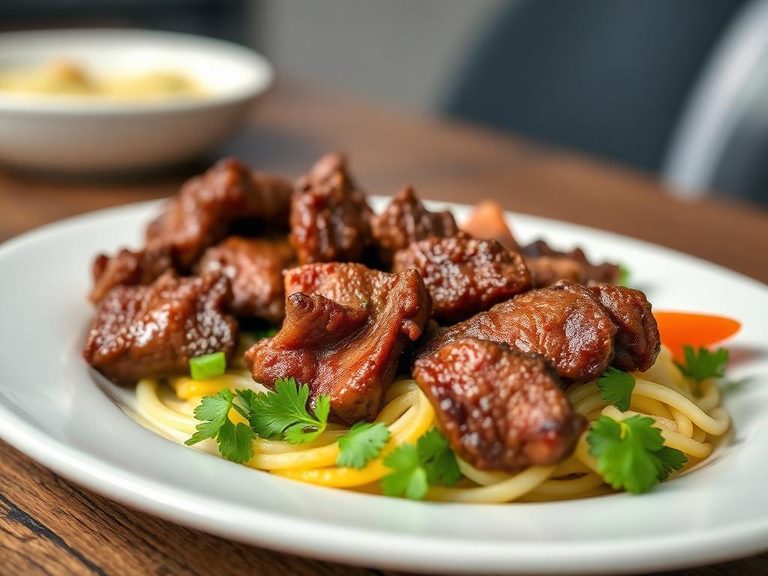
🌍 Where it's eaten
💡 Did you know?
The 'lip-on' refers to the external fat layer left along the edge; when rendered on the grill, it bastes the meat, adding significant flavor and moisture.
Full nutrition (USDA data · scales with serving)
| Water | 56.0 g |
| Energy | 273 kcal |
| Energy | 1140 kj |
| Protein | 24.8 g |
| Total lipid (fat) | 19.3 g |
| Ash | 0.93 g |
| Carbohydrate, by difference | 0.00 g |
| Fiber, total dietary | 0.00 g |
| Total Sugars | 0.00 g |
| Calcium, Ca | 10.0 mg |
| Iron, Fe | 2.1 mg |
| Magnesium, Mg | 23.0 mg |
| Phosphorus, P | 157 mg |
| Potassium, K | 279 mg |
| Sodium, Na | 54.0 mg |
| Zinc, Zn | 6.0 mg |
| Copper, Cu | 0.09 mg |
| Manganese, Mn | 0.09 mg |
| Selenium, Se | 33.2 ug |
| Vitamin C, total ascorbic acid | 0.00 mg |
| Thiamin | 0.07 mg |
| Riboflavin | 0.28 mg |
| Niacin | 5.3 mg |
| Pantothenic acid | 0.54 mg |
| Vitamin B-6 | 0.53 mg |
| Folate, total | 6.0 ug |
| Folic acid | 0.00 ug |
| Folate, food | 6.0 ug |
| Folate, DFE | 6.0 ug |
| Choline, total | 48.8 mg |
| Betaine | 11.6 mg |
| Vitamin B-12 | 2.1 ug |
| Vitamin B-12, added | 0.00 ug |
| Vitamin A, RAE | 8.0 ug |
| Retinol | 8.0 ug |
| Carotene, beta | 0.00 ug |
| Carotene, alpha | 0.00 ug |
| Cryptoxanthin, beta | 0.00 ug |
| Vitamin A, IU | 26.0 iu |
| Lycopene | 0.00 ug |
| Lutein + zeaxanthin | 0.00 ug |
| Vitamin E (alpha-tocopherol) | 0.08 mg |
| Vitamin E, added | 0.00 mg |
| Vitamin D (D2 + D3), International Units | 6.0 iu |
| Vitamin D (D2 + D3) | 0.10 ug |
| Vitamin D3 (cholecalciferol) | 0.10 ug |
| Vitamin K (phylloquinone) | 1.6 ug |
| Alcohol, ethyl | 0.00 g |
| Caffeine | 0.00 mg |
| Theobromine | 0.00 mg |
Fat & fatty acid profile (per 100g)
| Fatty acids, total saturated | 8.7 g |
| SFA 4:0 | 0.00 g |
| SFA 6:0 | 0.00 g |
| SFA 8:0 | 0.00 g |
| SFA 10:0 | 0.01 g |
| SFA 12:0 | 0.02 g |
| SFA 14:0 | 0.59 g |
| SFA 15:0 | 0.11 g |
| SFA 16:0 | 4.6 g |
| SFA 17:0 | 0.27 g |
| SFA 18:0 | 3.1 g |
| SFA 20:0 | 0.01 g |
| SFA 24:0 | 0.01 g |
| Fatty acids, total monounsaturated | 9.4 g |
| MUFA 14:1 | 0.12 g |
| MUFA 15:1 | 0.04 g |
| MUFA 16:1 | 0.63 g |
| MUFA 16:1 c | 0.58 g |
| MUFA 17:1 | 0.17 g |
| MUFA 18:1 | 8.4 g |
| MUFA 18:1 c | 7.2 g |
| MUFA 20:1 | 0.04 g |
| MUFA 22:1 | 0.00 g |
| Fatty acids, total polyunsaturated | 0.98 g |
| PUFA 18:2 | 0.84 g |
| PUFA 18:2 n-6 c,c | 0.67 g |
| PUFA 18:2 CLAs | 0.09 g |
| PUFA 18:3 | 0.04 g |
| PUFA 18:3 n-3 c,c,c (ALA) | 0.04 g |
| PUFA 18:4 | 0.00 g |
| PUFA 20:2 n-6 c,c | 0.01 g |
| PUFA 20:3 | 0.03 g |
| PUFA 20:3 n-6 | 0.03 g |
| PUFA 20:4 | 0.06 g |
| PUFA 20:5 n-3 (EPA) | 0.00 g |
| PUFA 22:5 n-3 (DPA) | 0.02 g |
| PUFA 22:6 n-3 (DHA) | 0.00 g |
| Fatty acids, total trans | 1.3 g |
| Fatty acids, total trans-monoenoic | 1.3 g |
| TFA 16:1 t | 0.05 g |
| TFA 18:1 t | 1.2 g |
| TFA 18:2 t not further defined | 0.08 g |
| Fatty acids, total trans-polyenoic | 0.08 g |
| Cholesterol | 79.0 mg |
Amino acid profile (per 100g)
| Tryptophan | 0.28 g |
| Threonine | 1.2 g |
| Isoleucine | 1.2 g |
| Leucine | 2.2 g |
| Lysine | 2.5 g |
| Methionine | 0.69 g |
| Cystine | 0.26 g |
| Phenylalanine | 1.0 g |
| Tyrosine | 0.95 g |
| Valine | 1.3 g |
| Arginine | 1.7 g |
| Histidine | 0.97 g |
| Alanine | 1.6 g |
| Aspartic acid | 2.5 g |
| Glutamic acid | 4.1 g |
| Glycine | 1.2 g |
| Proline | 1.1 g |
| Serine | 1.1 g |
| Hydroxyproline | 0.17 g |
FAQ
What does 'lip-on' mean for a ribeye?
It means the external fat layer along the outer edge of the steak has been left intact, rather than being completely trimmed off. This fat renders during cooking, adding flavor and helping to keep the meat moist.
How does trimming to 1/8" fat affect the steak?
It provides a balance: you retain enough fat for flavor and juiciness while removing the thickest, chewier portions that some diners prefer not to eat. It results in a more uniformly tender bite.
Is this a good cut for a low-carb or keto diet?
Yes, it's an excellent choice. With 0g carbs and a high fat and protein content, it aligns perfectly with ketogenic and low-carb dietary frameworks, providing sustained energy without impacting blood sugar.
Nutrient density (calculated · NRF9.3)
Nutrient Rich Foods index: beneficial nutrients (protein, fiber, vitamins, minerals) minus saturated fat, added sugar & sodium, per 100 kcal.
NRF9.3 index — Fulgoni, Keast & Drewnowski, 2009. Computed from USDA nutrients.
Weight-loss friendliness (composite index)
Energy density 2.73 kcal/g · 36% calories from protein · 0.0 g fiber · 0.0 g sugar per 100 g.
Composite of energy density (Rolls et al., 1999), protein & fiber satiety, minus sugar. A calculated heuristic — ranks satiety-per-calorie, not a clinical measure.
Dietary load (calculated from USDA values)
Potential renal acid load. Positive = acid-forming, negative = alkaline-forming.
Sodium-to-potassium ratio: 0.19 (lower is better — aim for ≤ 1)
Sodium:potassium per WHO potassium guidance. Computed from USDA nutrients.