APPLEBEE'S, crunchy onion rings
Whole food · Restaurant Foods

Photo: Wikipedia
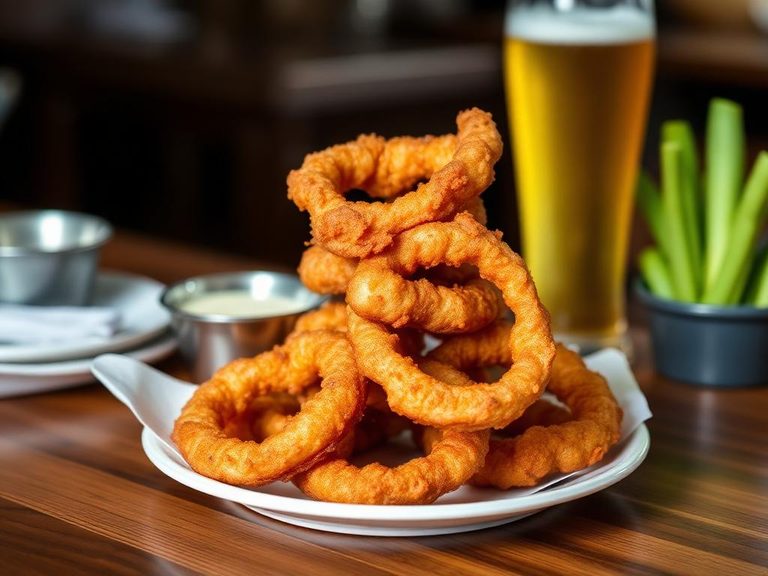
These are thick-cut, golden-brown onion rings coated in a crispy, seasoned batter and deep-fried to a satisfying crunch. Each bite offers a sweet, tender onion interior contrasted by a savory, crunchy exterior. Nutritionally, they are a high-calorie, high-carb side dish with significant fat content from the frying process.
💚 Why it's loved
People love them for the irresistible combination of a shatteringly crisp coating and the sweet, steamy onion inside, making them a classic, shareable appetizer or side that pairs well with burgers and dipping sauces.
⚠️ Watch-outs & how to enjoy it better
The deep-frying process makes them high in calories, fat, and potentially sodium, which can contribute to blood sugar spikes and isn't ideal for those monitoring heart health or calorie intake. To counteract, consider sharing a portion, pairing with a grilled protein to balance the meal, and opting for a vinegar-based dip instead of creamy, high-fat sauces.
Key benefits
- Provides quick energy from carbohydrates
- Contains some dietary fiber from the onion
- Source of vitamin C from the onion
- Offers a satisfying textural contrast
- Common comfort food for social dining
🍽️ Popular dishes
🌍 Where it's eaten
💡 Did you know?
The Blooming Onion, a giant, flower-like fried onion appetizer, was invented in the 1980s and popularized by the restaurant chain Outback Steakhouse.
Full nutrition (scales with serving)
| Water | 33.1 g |
| Energy | 356 kcal |
| Energy | 1487 kj |
| Protein | 4.6 g |
| Total lipid (fat) | 19.6 g |
| Ash | 2.5 g |
| Carbohydrate, by difference | 40.2 g |
| Fiber, total dietary | 3.1 g |
| Total Sugars | 4.5 g |
| Sucrose | 1.1 g |
| Glucose | 1.2 g |
| Fructose | 1.1 g |
| Lactose | 0.00 g |
| Maltose | 1.2 g |
| Galactose | 0.00 g |
| Starch | 32.5 g |
| Calcium, Ca | 22.0 mg |
| Iron, Fe | 0.67 mg |
| Magnesium, Mg | 17.0 mg |
| Phosphorus, P | 90.0 mg |
| Potassium, K | 135 mg |
| Sodium, Na | 833 mg |
| Zinc, Zn | 0.43 mg |
| Copper, Cu | 0.09 mg |
| Manganese, Mn | 0.49 mg |
| Selenium, Se | 6.0 ug |
| Thiamin | 0.11 mg |
| Riboflavin | 0.09 mg |
| Niacin | 0.73 mg |
| Pantothenic acid | 0.41 mg |
| Vitamin B-6 | 0.08 mg |
| Vitamin A, RAE | 0.00 ug |
| Retinol | 0.00 ug |
| Carotene, beta | 2.0 ug |
| Carotene, alpha | 0.00 ug |
| Cryptoxanthin, beta | 1.0 ug |
| Vitamin A, IU | 4.0 iu |
| Lycopene | 0.00 ug |
| Lutein + zeaxanthin | 13.0 ug |
| Vitamin E (alpha-tocopherol) | 1.3 mg |
| Tocopherol, beta | 0.21 mg |
| Tocopherol, gamma | 8.8 mg |
| Tocopherol, delta | 3.9 mg |
| Tocotrienol, alpha | 0.04 mg |
| Tocotrienol, beta | 0.08 mg |
| Tocotrienol, gamma | 0.08 mg |
| Tocotrienol, delta | 0.00 mg |
| Vitamin K (phylloquinone) | 41.1 ug |
| Vitamin K (Dihydrophylloquinone) | 0.00 ug |
| Vitamin K (Menaquinone-4) | 0.00 ug |
Fat & fatty acid profile (per 100g)
| Fatty acids, total saturated | 3.6 g |
| SFA 4:0 | 0.00 g |
| SFA 6:0 | 0.00 g |
| SFA 8:0 | 0.01 g |
| SFA 10:0 | 0.01 g |
| SFA 12:0 | 0.00 g |
| SFA 14:0 | 0.02 g |
| SFA 15:0 | 0.01 g |
| SFA 16:0 | 2.2 g |
| SFA 17:0 | 0.02 g |
| SFA 18:0 | 1.1 g |
| SFA 20:0 | 0.06 g |
| SFA 22:0 | 0.06 g |
| SFA 24:0 | 0.02 g |
| Fatty acids, total monounsaturated | 4.4 g |
| MUFA 14:1 | 0.00 g |
| MUFA 15:1 | 0.00 g |
| MUFA 16:1 | 0.04 g |
| MUFA 16:1 c | 0.04 g |
| MUFA 17:1 | 0.01 g |
| MUFA 18:1 | 4.3 g |
| MUFA 18:1 c | 4.3 g |
| MUFA 20:1 | 0.06 g |
| MUFA 22:1 | 0.00 g |
| MUFA 22:1 c | 0.00 g |
| MUFA 24:1 c | 0.00 g |
| Fatty acids, total polyunsaturated | 10.3 g |
| PUFA 18:2 | 9.0 g |
| PUFA 18:2 n-6 c,c | 8.9 g |
| PUFA 18:2 CLAs | 0.03 g |
| PUFA 18:3 | 1.3 g |
| PUFA 18:3 n-3 c,c,c (ALA) | 1.2 g |
| PUFA 18:3 n-6 c,c,c | 0.07 g |
| PUFA 18:3i | 0.00 g |
| PUFA 18:4 | 0.00 g |
| PUFA 20:2 n-6 c,c | 0.01 g |
| PUFA 20:3 | 0.00 g |
| PUFA 20:3 n-3 | 0.00 g |
| PUFA 20:3 n-6 | 0.00 g |
| PUFA 20:4 | 0.01 g |
| PUFA 20:5 n-3 (EPA) | 0.00 g |
| PUFA 22:4 | 0.00 g |
| PUFA 22:5 n-3 (DPA) | 0.00 g |
| PUFA 22:6 n-3 (DHA) | 0.00 g |
| Fatty acids, total trans | 0.14 g |
| Fatty acids, total trans-monoenoic | 0.04 g |
| TFA 16:1 t | 0.00 g |
| TFA 18:1 t | 0.04 g |
| TFA 22:1 t | 0.00 g |
| TFA 18:2 t not further defined | 0.10 g |
| Fatty acids, total trans-polyenoic | 0.10 g |
Amino acid profile (per 100g)
| Tryptophan | 0.04 g |
| Threonine | 0.08 g |
| Isoleucine | 0.16 g |
| Leucine | 0.29 g |
| Lysine | 0.06 g |
| Methionine | 0.06 g |
| Cystine | 0.12 g |
| Phenylalanine | 0.20 g |
| Tyrosine | 0.09 g |
| Valine | 0.19 g |
| Arginine | 0.21 g |
| Histidine | 0.09 g |
| Alanine | 0.14 g |
| Aspartic acid | 0.22 g |
| Glutamic acid | 1.4 g |
| Glycine | 0.16 g |
| Proline | 0.58 g |
| Serine | 0.14 g |
| Hydroxyproline | 0.00 g |
FAQ
Are onion rings a good source of protein?
No, they are not. With only about 4.58g of protein per 100g, they are primarily a source of carbohydrates and fat.
What is the main nutritional concern with restaurant-style onion rings?
The main concerns are the high calorie density, high fat content from deep-frying, and often high sodium levels in the batter and seasoning.
Can I make a healthier version at home?
Yes. You can use an air fryer with a light spray of oil, or bake them in the oven. Using whole-wheat flour or panko breadcrumbs in the batter can also increase fiber content.