

Sauce, pesto, MEZZETTA, NAPA VALLEY BISTRO, basil pesto, ready-to-serve
Whole food · Soups, Sauces, and Gravies

Photo: Wikipedia
Mezzetta Napa Valley Bistro Basil Pesto is a rich, ready-to-serve sauce that delivers a vibrant, aromatic punch of fresh basil, garlic, and sharp Parmesan cheese. Its texture is luxuriously thick and slightly grainy, coating pasta and proteins with a glossy, herbaceous layer. Nutritionally, it is a calorie-dense, high-fat condiment, providing nearly 50 grams of fat per 100g, making it a source of energy and flavor rather than a light addition.
Calorie split: 5% protein · 4% carbs · 90% fat
↓ Full nutrition💚 Why it's loved
People adore it for its authentic, bold Italian flavor that transforms simple pasta, sandwiches, and vegetables into a gourmet experience. Its convenience as a ready-to-serve sauce makes it a beloved staple for quick, impressive meals.
⚠️ Watch-outs & how to enjoy it better
Due to its very high fat and calorie content, it should be used in moderation, especially for those monitoring caloric intake or fat consumption. To counteract this, pair it with a large volume of vegetables or lean protein (like grilled chicken or white beans) and use it as a flavor accent rather than the main sauce, or dilute it with a splash of pasta water or a dollop of Greek yogurt.
Key benefits
- Provides a concentrated source of monounsaturated fats from olive oil.
- Offers a quick, flavorful base for meals without cooking from scratch.
- Contains antioxidants from fresh basil and garlic.
- Adds significant flavor to dishes, reducing the need for other high-sodium seasonings.
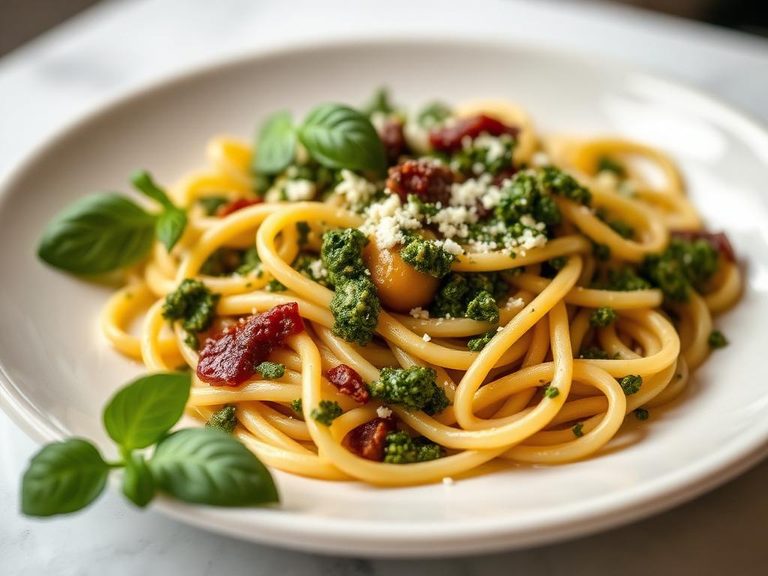
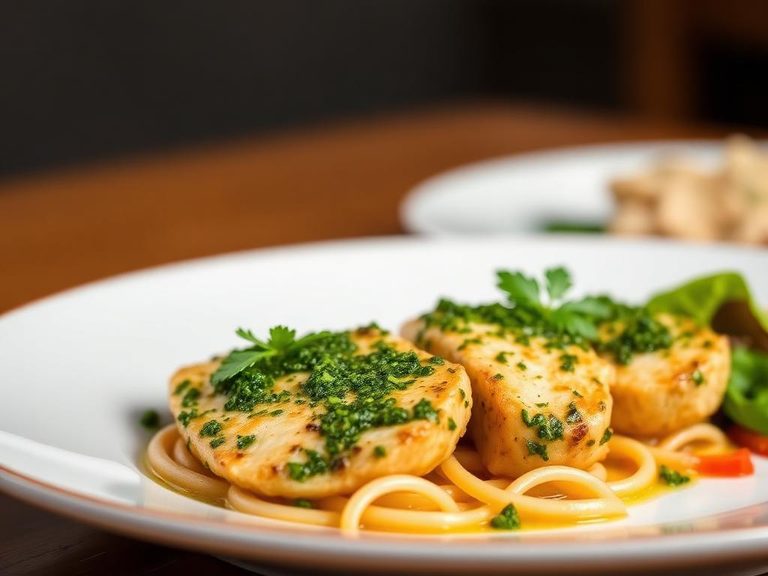
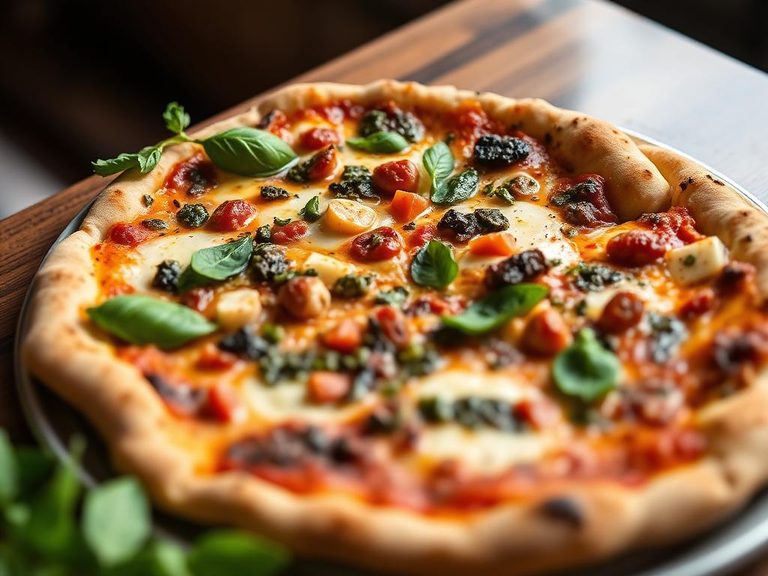
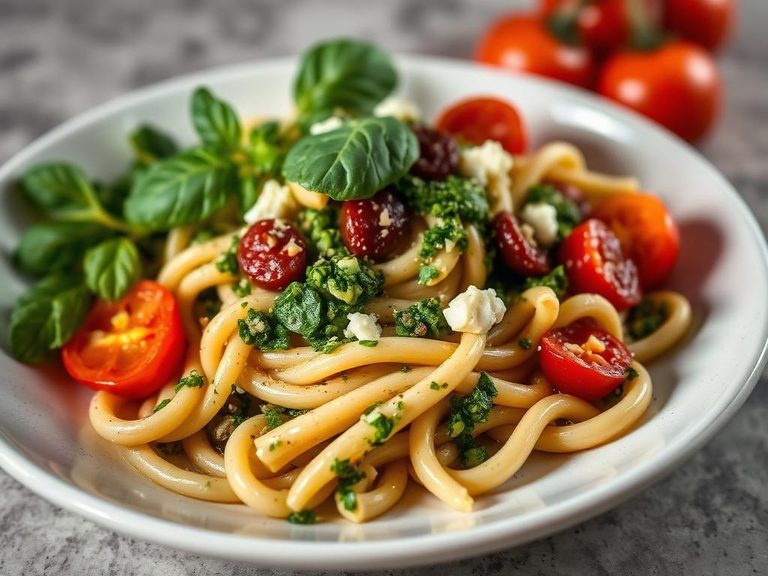
🍽️ Popular dishes
🌍 Where it's eaten
💡 Did you know?
Traditional Genovese pesto is made with a mortar and pestle (pesto comes from 'pestare,' meaning to pound), which bruises the basil leaves to release essential oils without generating heat, preserving its bright green color and flavor.
Full nutrition (USDA data · scales with serving)
| Water | 35.1 g |
| Energy | 496 kcal |
| Energy | 2076 kj |
| Protein | 6.7 g |
| Total lipid (fat) | 49.9 g |
| Ash | 3.3 g |
| Carbohydrate, by difference | 5.1 g |
| Fiber, total dietary | 1.3 g |
| Total Sugars | 1.3 g |
| Sucrose | 0.00 g |
| Glucose | 0.55 g |
| Fructose | 0.70 g |
| Lactose | 0.00 g |
| Maltose | 0.00 g |
| Galactose | 0.00 g |
| Starch | 0.40 g |
| Calcium, Ca | 202 mg |
| Iron, Fe | 0.99 mg |
| Magnesium, Mg | 43.0 mg |
| Phosphorus, P | 149 mg |
| Potassium, K | 205 mg |
| Sodium, Na | 897 mg |
| Zinc, Zn | 1.0 mg |
| Copper, Cu | 0.12 mg |
| Manganese, Mn | 0.77 mg |
| Vitamin C, total ascorbic acid | 0.20 mg |
| Thiamin | 0.09 mg |
| Riboflavin | 0.34 mg |
| Niacin | 0.60 mg |
| Pantothenic acid | 0.21 mg |
| Vitamin B-6 | 0.09 mg |
| Folate, total | 26.0 ug |
| Folate, food | 26.0 ug |
| Vitamin A, RAE | 84.0 ug |
| Carotene, beta | 999 ug |
| Carotene, alpha | 0.00 ug |
| Cryptoxanthin, beta | 11.0 ug |
| Vitamin A, IU | 1674 iu |
| Lycopene | 0.00 ug |
| Lutein + zeaxanthin | 848 ug |
| Vitamin E (alpha-tocopherol) | 13.1 mg |
| Tocopherol, beta | 0.00 mg |
| Tocopherol, gamma | 5.3 mg |
| Tocopherol, delta | 0.14 mg |
| Tocotrienol, alpha | 0.00 mg |
| Tocotrienol, beta | 0.00 mg |
| Tocotrienol, gamma | 0.00 mg |
| Tocotrienol, delta | 0.00 mg |
Fat & fatty acid profile (per 100g)
| Fatty acids, total saturated | 8.0 g |
| SFA 4:0 | 0.06 g |
| SFA 6:0 | 0.05 g |
| SFA 8:0 | 0.03 g |
| SFA 10:0 | 0.07 g |
| SFA 12:0 | 0.09 g |
| SFA 14:0 | 0.30 g |
| SFA 15:0 | 0.04 g |
| SFA 16:0 | 5.7 g |
| SFA 17:0 | 0.04 g |
| SFA 18:0 | 1.3 g |
| SFA 20:0 | 0.20 g |
| SFA 22:0 | 0.07 g |
| SFA 24:0 | 0.04 g |
| Fatty acids, total monounsaturated | 28.7 g |
| MUFA 14:1 | 0.03 g |
| MUFA 15:1 | 0.00 g |
| MUFA 16:1 | 0.51 g |
| MUFA 16:1 c | 0.51 g |
| MUFA 17:1 | 0.05 g |
| MUFA 18:1 | 27.8 g |
| MUFA 18:1 c | 27.7 g |
| MUFA 20:1 | 0.25 g |
| MUFA 22:1 | 0.01 g |
| MUFA 22:1 c | 0.01 g |
| MUFA 24:1 c | 0.02 g |
| Fatty acids, total polyunsaturated | 9.1 g |
| PUFA 18:2 | 7.6 g |
| PUFA 18:2 n-6 c,c | 7.5 g |
| PUFA 18:2 CLAs | 0.03 g |
| PUFA 18:3 | 1.3 g |
| PUFA 18:3 n-3 c,c,c (ALA) | 1.2 g |
| PUFA 18:3 n-6 c,c,c | 0.03 g |
| PUFA 18:3i | 0.11 g |
| PUFA 18:4 | 0.00 g |
| PUFA 20:2 n-6 c,c | 0.02 g |
| PUFA 20:3 | 0.00 g |
| PUFA 20:3 n-3 | 0.00 g |
| PUFA 20:3 n-6 | 0.00 g |
| PUFA 20:4 | 0.10 g |
| PUFA 20:5 n-3 (EPA) | 0.00 g |
| PUFA 22:4 | 0.00 g |
| PUFA 22:5 n-3 (DPA) | 0.00 g |
| PUFA 22:6 n-3 (DHA) | 0.00 g |
| Fatty acids, total trans | 0.23 g |
| Fatty acids, total trans-monoenoic | 0.09 g |
| TFA 16:1 t | 0.01 g |
| TFA 18:1 t | 0.08 g |
| TFA 22:1 t | 0.00 g |
| TFA 18:2 t not further defined | 0.04 g |
| Fatty acids, total trans-polyenoic | 0.14 g |
Amino acid profile (per 100g)
Estimated from Sauce, homemade, white, medium — USDA does not publish this profile for Sauce.
| Tryptophan | 0.04 g |
| Threonine | 0.14 g |
| Isoleucine | 0.19 g |
| Leucine | 0.30 g |
| Lysine | 0.24 g |
| Methionine | 0.08 g |
| Cystine | 0.03 g |
| Phenylalanine | 0.15 g |
| Tyrosine | 0.15 g |
| Valine | 0.20 g |
| Arginine | 0.11 g |
| Histidine | 0.08 g |
| Alanine | 0.10 g |
| Aspartic acid | 0.23 g |
| Glutamic acid | 0.64 g |
| Glycine | 0.07 g |
| Proline | 0.30 g |
| Serine | 0.17 g |
FAQ
Is this pesto gluten-free?
Typically, yes. Traditional pesto recipes like this one do not contain gluten. However, always check the specific product label for any additives or cross-contamination warnings.
How should I store opened pesto?
Once opened, store it in the refrigerator in its original jar, ensuring the surface is covered with a thin layer of olive oil to prevent oxidation and browning. Use within 1-2 weeks.
Can I use this pesto as a marinade?
Absolutely. Its oil and herb base makes it an excellent marinade for chicken, fish, or tofu. For best results, marinate for at least 30 minutes before cooking.
Nutrient density (calculated · NRF9.3)
Nutrient Rich Foods index: beneficial nutrients (protein, fiber, vitamins, minerals) minus saturated fat, added sugar & sodium, per 100 kcal.
NRF9.3 index — Fulgoni, Keast & Drewnowski, 2009. Computed from USDA nutrients.
Weight-loss friendliness (composite index)
Energy density 4.96 kcal/g · 5% calories from protein · 1.3 g fiber · 1.3 g sugar per 100 g.
Composite of energy density (Rolls et al., 1999), protein & fiber satiety, minus sugar. A calculated heuristic — ranks satiety-per-calorie, not a clinical measure.
Dietary load (calculated from USDA values)
Potential renal acid load. Positive = acid-forming, negative = alkaline-forming.
Sodium-to-potassium ratio: 4.38 (lower is better — aim for ≤ 1)
Sodium:potassium per WHO potassium guidance. Computed from USDA nutrients.