

Pork, fresh, loin, center loin (chops), bone-in, separable lean and fat, cooked, braised
Whole food · Pork Products

Photo: Wikipedia
This cut is a succulent, bone-in pork loin chop, braised to tender perfection. The slow, moist cooking method transforms the lean meat and marbling into a rich, melt-in-your-mouth texture with a deep, savory flavor. It's a protein powerhouse, delivering a substantial 28 grams per 100g serving with zero carbohydrates.
Calorie split: 48% protein · 0% carbs · 52% fat
↓ Full nutrition💚 Why it's loved
People adore this cut for its incredible tenderness and the deep, savory flavor that comes from slow braising. It's a versatile comfort food that can be the star of a hearty, home-cooked meal, often evoking a sense of tradition and family gatherings.
⚠️ Watch-outs & how to enjoy it better
The main downside is its higher fat content (13.51g per 100g), which can be a concern for those monitoring saturated fat intake. To counteract this, choose a well-trimmed chop, serve it with a large portion of non-starchy vegetables (like steamed broccoli or a green salad), and use the braising liquid sparingly. Those on a strict low-fat diet should practice portion control.
Key benefits
- Excellent source of high-quality protein for muscle maintenance.
- Rich in B vitamins, particularly thiamine (B1) and niacin (B3).
- Provides essential minerals like selenium and phosphorus.
- The bone-in cut adds flavor and collagen to the braising liquid.
- A zero-carb option suitable for low-carb and ketogenic diets.
🍽️ Popular dishes
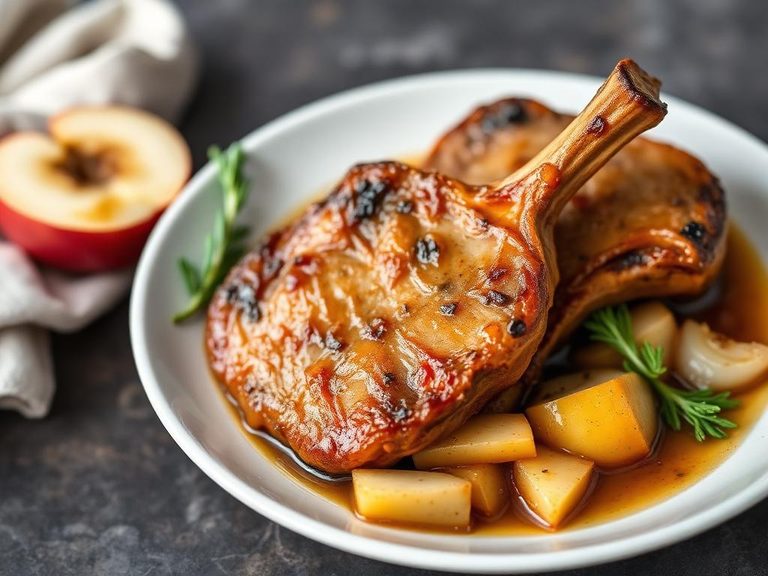
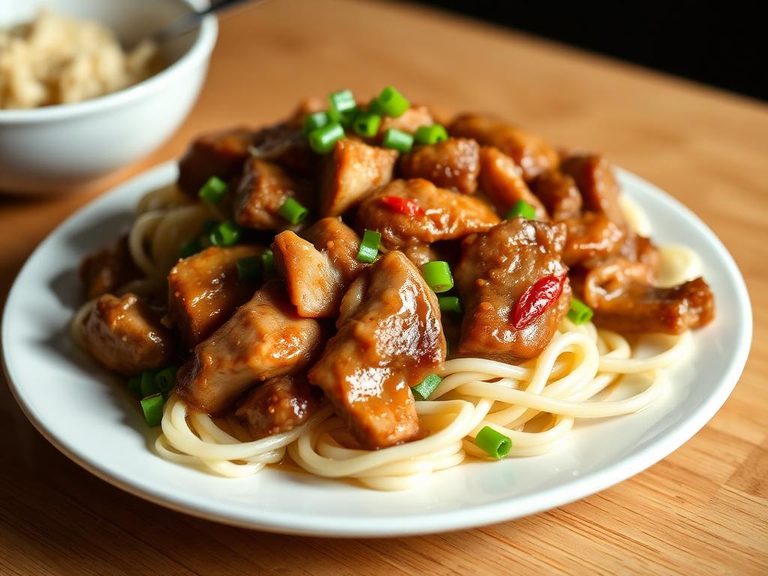
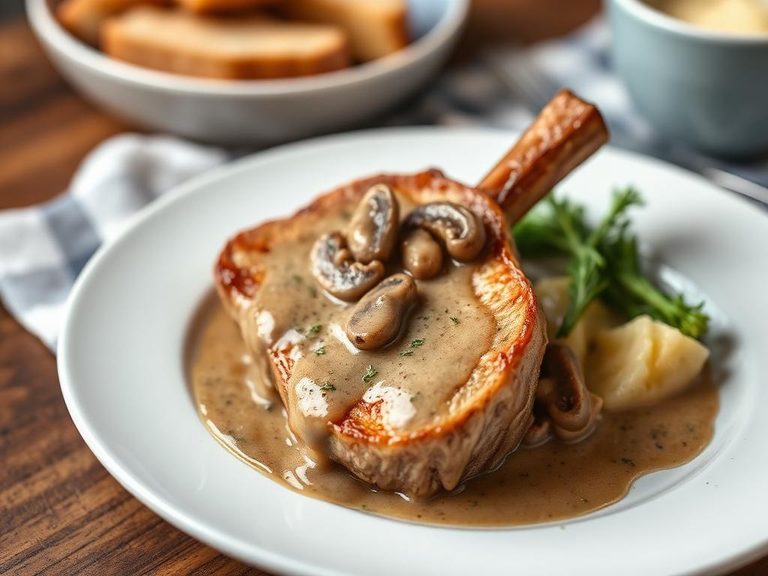

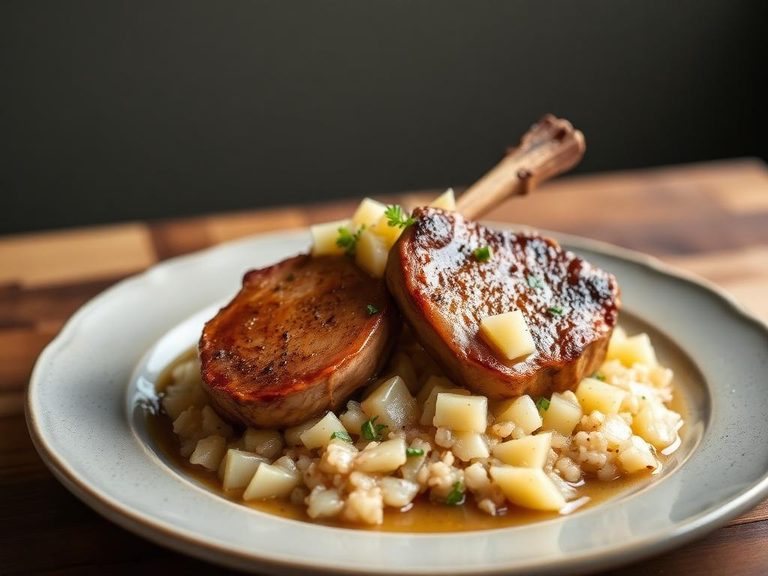
🌍 Where it's eaten
💡 Did you know?
The center loin chop is often called the "pork tenderloin chop" because it contains a portion of the tenderloin muscle, making it one of the most tender chops on the animal.
Full nutrition (USDA data · scales with serving)
| Water | 58.0 g |
| Energy | 242 kcal |
| Energy | 1014 kj |
| Protein | 28.2 g |
| Total lipid (fat) | 13.5 g |
| Ash | 1.2 g |
| Carbohydrate, by difference | 0.00 g |
| Fiber, total dietary | 0.00 g |
| Total Sugars | 0.00 g |
| Calcium, Ca | 55.0 mg |
| Iron, Fe | 0.86 mg |
| Magnesium, Mg | 20.0 mg |
| Phosphorus, P | 225 mg |
| Potassium, K | 273 mg |
| Sodium, Na | 73.0 mg |
| Zinc, Zn | 3.3 mg |
| Copper, Cu | 0.10 mg |
| Manganese, Mn | 0.01 mg |
| Selenium, Se | 44.1 ug |
| Vitamin C, total ascorbic acid | 0.00 mg |
| Thiamin | 0.52 mg |
| Riboflavin | 0.34 mg |
| Niacin | 7.9 mg |
| Pantothenic acid | 1.0 mg |
| Vitamin B-6 | 0.52 mg |
| Folate, total | 0.00 ug |
| Folic acid | 0.00 ug |
| Folate, food | 0.00 ug |
| Folate, DFE | 0.00 ug |
| Choline, total | 95.1 mg |
| Betaine | 3.7 mg |
| Vitamin B-12 | 0.66 ug |
| Vitamin B-12, added | 0.00 ug |
| Vitamin A, RAE | 4.0 ug |
| Retinol | 4.0 ug |
| Carotene, beta | 0.00 ug |
| Carotene, alpha | 0.00 ug |
| Cryptoxanthin, beta | 0.00 ug |
| Vitamin A, IU | 14.0 iu |
| Lycopene | 0.00 ug |
| Lutein + zeaxanthin | 0.00 ug |
| Vitamin E (alpha-tocopherol) | 0.19 mg |
| Vitamin E, added | 0.00 mg |
| Vitamin D (D2 + D3), International Units | 33.0 iu |
| Vitamin D (D2 + D3) | 0.80 ug |
| Vitamin D3 (cholecalciferol) | 0.80 ug |
| Vitamin K (phylloquinone) | 0.00 ug |
| Vitamin K (Dihydrophylloquinone) | 0.00 ug |
| Alcohol, ethyl | 0.00 g |
| Caffeine | 0.00 mg |
| Theobromine | 0.00 mg |
Fat & fatty acid profile (per 100g)
| Fatty acids, total saturated | 4.9 g |
| SFA 4:0 | 0.00 g |
| SFA 6:0 | 0.00 g |
| SFA 8:0 | 0.00 g |
| SFA 10:0 | 0.01 g |
| SFA 12:0 | 0.01 g |
| SFA 14:0 | 0.17 g |
| SFA 15:0 | 0.01 g |
| SFA 16:0 | 3.0 g |
| SFA 17:0 | 0.04 g |
| SFA 18:0 | 1.7 g |
| SFA 20:0 | 0.02 g |
| SFA 22:0 | 0.00 g |
| SFA 24:0 | 0.00 g |
| Fatty acids, total monounsaturated | 5.6 g |
| MUFA 14:1 | 0.00 g |
| MUFA 15:1 | 0.00 g |
| MUFA 16:1 | 0.28 g |
| MUFA 17:1 | 0.00 g |
| MUFA 18:1 | 5.2 g |
| MUFA 18:1 c | 5.1 g |
| MUFA 20:1 | 0.09 g |
| MUFA 22:1 | 0.00 g |
| Fatty acids, total polyunsaturated | 2.2 g |
| PUFA 18:2 | 1.9 g |
| PUFA 18:2 n-6 c,c | 1.1 g |
| PUFA 18:3 | 0.08 g |
| PUFA 18:3 n-3 c,c,c (ALA) | 0.07 g |
| PUFA 18:3 n-6 c,c,c | 0.00 g |
| PUFA 18:3i | 0.01 g |
| PUFA 18:4 | 0.00 g |
| PUFA 20:2 n-6 c,c | 0.07 g |
| PUFA 20:3 | 0.01 g |
| PUFA 20:4 | 0.10 g |
| PUFA 20:5 n-3 (EPA) | 0.00 g |
| PUFA 22:5 n-3 (DPA) | 0.01 g |
| PUFA 22:6 n-3 (DHA) | 0.00 g |
| Fatty acids, total trans | 0.08 g |
| Fatty acids, total trans-monoenoic | 0.06 g |
| TFA 18:1 t | 0.06 g |
| TFA 18:2 t not further defined | 0.01 g |
| Fatty acids, total trans-polyenoic | 0.02 g |
| Cholesterol | 81.0 mg |
Amino acid profile (per 100g)
| Tryptophan | 0.34 g |
| Threonine | 1.2 g |
| Isoleucine | 1.3 g |
| Leucine | 2.3 g |
| Lysine | 2.5 g |
| Methionine | 0.77 g |
| Cystine | 0.32 g |
| Phenylalanine | 1.2 g |
| Tyrosine | 1.1 g |
| Valine | 1.4 g |
| Arginine | 1.8 g |
| Histidine | 1.1 g |
| Alanine | 1.6 g |
| Aspartic acid | 2.6 g |
| Glutamic acid | 4.3 g |
| Glycine | 1.3 g |
| Proline | 1.1 g |
| Serine | 1.2 g |
| Hydroxyproline | 0.10 g |
FAQ
What is the difference between a center loin chop and a rib chop?
A center loin chop comes from the middle of the loin and often includes a piece of the tenderloin, making it very tender. A rib chop comes from the rib section and has a larger eye of meat with a bone attached, often with more marbling.
Why is braising a good method for this cut?
Braising uses low, slow, moist heat to break down connective tissue and fat, making the lean meat exceptionally tender and infusing it with flavor from the cooking liquid.
Is this cut suitable for a low-carb diet?
Yes, it is an excellent low-carb option as it contains 0g of carbohydrates, making it ideal for keto and other low-carb eating plans.
Nutrient density (calculated · NRF9.3)
Nutrient Rich Foods index: beneficial nutrients (protein, fiber, vitamins, minerals) minus saturated fat, added sugar & sodium, per 100 kcal.
NRF9.3 index — Fulgoni, Keast & Drewnowski, 2009. Computed from USDA nutrients.
Weight-loss friendliness (composite index)
Energy density 2.42 kcal/g · 47% calories from protein · 0.0 g fiber · 0.0 g sugar per 100 g.
Composite of energy density (Rolls et al., 1999), protein & fiber satiety, minus sugar. A calculated heuristic — ranks satiety-per-calorie, not a clinical measure.
Dietary load (calculated from USDA values)
Potential renal acid load. Positive = acid-forming, negative = alkaline-forming.
Sodium-to-potassium ratio: 0.27 (lower is better — aim for ≤ 1)
Sodium:potassium per WHO potassium guidance. Computed from USDA nutrients.