

Fish, salmon, chum, dried (Alaska Native)
Whole food · American Indian/Alaska Native Foods
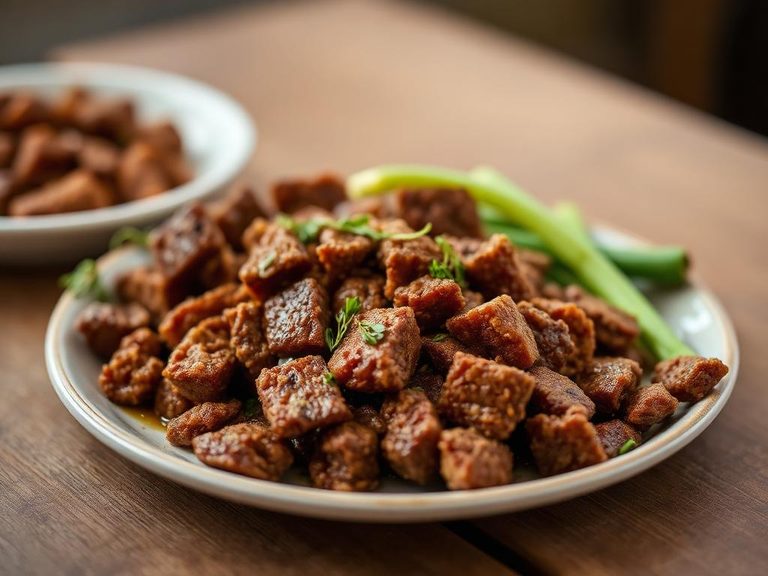
This is a traditional Alaskan Native staple: chum salmon fillets that have been dried, often in the open air or smokehouse, until they become a dense, chewy, and intensely flavored jerky-like product. The taste is a profound, concentrated umami with a deep, savory fishiness and a hint of salt, while the texture is tough and fibrous, meant to be chewed slowly. Nutritionally, it is a powerhouse of pure protein, packing over 62 grams per 100g with virtually no carbohydrates.
Calorie split: 66% protein · 0% carbs · 34% fat
↓ Full nutrition💚 Why it's loved
People love it for its incredible portability and long shelf life, making it the perfect trail food or emergency ration. Its intense, savory flavor is deeply satisfying and culturally significant, representing a connection to traditional subsistence practices and the land.
⚠️ Watch-outs & how to enjoy it better
The primary downside is its extremely tough, jerky-like texture which can be challenging for those unaccustomed to it or with dental issues. It is also very high in sodium from the curing process, which can be a concern for blood pressure. To counteract this, rehydrate it in water or broth before eating to soften it, and consume it in moderation as part of a balanced diet.
Key benefits
- Exceptionally high in complete protein for muscle maintenance.
- Provides a dense source of energy for physical labor or cold climates.
- Rich in omega-3 fatty acids, particularly EPA and DHA.
- A long-lasting, non-perishable food source requiring no refrigeration.
- Contains essential minerals like selenium and phosphorus.
🍽️ Popular dishes
🌍 Where it's eaten
💡 Did you know?
Historically, dried salmon was so durable it was used as a form of currency and trade good among various Indigenous groups of the Pacific Northwest Coast.
Full nutrition (USDA data · scales with serving)
| Water | 22.8 g |
| Energy | 378 kcal |
| Energy | 1581 kj |
| Protein | 62.1 g |
| Total lipid (fat) | 14.4 g |
| Ash | 3.7 g |
| Carbohydrate, by difference | 0.00 g |
| Fiber, total dietary | 0.00 g |
| Total Sugars | 0.00 g |
| Sucrose | 0.00 g |
| Glucose | 0.00 g |
| Fructose | 0.00 g |
| Lactose | 0.00 g |
| Maltose | 0.00 g |
| Galactose | 0.00 g |
| Starch | 0.00 g |
| Calcium, Ca | 155 mg |
| Iron, Fe | 2.2 mg |
| Magnesium, Mg | 68.0 mg |
| Phosphorus, P | 650 mg |
| Potassium, K | 910 mg |
| Sodium, Na | 190 mg |
| Zinc, Zn | 1.4 mg |
| Copper, Cu | 0.25 mg |
| Manganese, Mn | 0.07 mg |
| Selenium, Se | 104 ug |
| Vitamin C, total ascorbic acid | 0.00 mg |
| Thiamin | 0.36 mg |
| Riboflavin | 0.46 mg |
| Niacin | 14.7 mg |
| Pantothenic acid | 2.8 mg |
| Vitamin B-6 | 0.68 mg |
| Folate, total | 12.0 ug |
| Folic acid | 0.00 ug |
| Folate, food | 12.0 ug |
| Folate, DFE | 12.0 ug |
| Choline, total | 231 mg |
| Betaine | 10.6 mg |
| Vitamin B-12 | 28.6 ug |
| Vitamin A, RAE | 16.0 ug |
| Retinol | 16.0 ug |
| Carotene, beta | 0.00 ug |
| Carotene, alpha | 0.00 ug |
| Cryptoxanthin, beta | 0.00 ug |
| Vitamin A, IU | 53.0 iu |
| Lycopene | 0.00 ug |
| Lutein + zeaxanthin | 0.00 ug |
| Vitamin E (alpha-tocopherol) | 0.82 mg |
| Tocopherol, beta | 0.00 mg |
| Tocopherol, gamma | 0.05 mg |
| Tocopherol, delta | 0.00 mg |
| Tocotrienol, alpha | 0.00 mg |
| Tocotrienol, beta | 0.00 mg |
| Tocotrienol, gamma | 0.00 mg |
| Tocotrienol, delta | 0.00 mg |
| Vitamin K (phylloquinone) | 0.00 ug |
| Vitamin K (Dihydrophylloquinone) | 0.00 ug |
| Vitamin K (Menaquinone-4) | 1.0 ug |
| Alcohol, ethyl | 0.00 g |
| Caffeine | 0.00 mg |
| Theobromine | 0.00 mg |
Fat & fatty acid profile (per 100g)
| Fatty acids, total saturated | 2.4 g |
| SFA 8:0 | 0.00 g |
| SFA 10:0 | 0.00 g |
| SFA 12:0 | 0.04 g |
| SFA 14:0 | 0.68 g |
| SFA 15:0 | 0.04 g |
| SFA 16:0 | 1.2 g |
| SFA 17:0 | 0.11 g |
| SFA 18:0 | 0.34 g |
| SFA 20:0 | 0.00 g |
| SFA 22:0 | 0.00 g |
| SFA 24:0 | 0.00 g |
| Fatty acids, total monounsaturated | 5.1 g |
| MUFA 14:1 | 0.00 g |
| MUFA 15:1 | 0.00 g |
| MUFA 16:1 | 0.48 g |
| MUFA 17:1 | 0.00 g |
| MUFA 18:1 | 2.0 g |
| MUFA 20:1 | 1.4 g |
| MUFA 22:1 | 1.2 g |
| MUFA 24:1 c | 0.03 g |
| Fatty acids, total polyunsaturated | 2.3 g |
| PUFA 18:2 | 0.13 g |
| PUFA 18:3 | 0.12 g |
| PUFA 18:4 | 0.14 g |
| PUFA 20:2 n-6 c,c | 0.03 g |
| PUFA 20:3 | 0.01 g |
| PUFA 20:4 | 0.12 g |
| PUFA 20:5 n-3 (EPA) | 0.61 g |
| PUFA 21:5 | 0.02 g |
| PUFA 22:4 | 0.00 g |
| PUFA 22:5 n-3 (DPA) | 0.21 g |
| PUFA 22:6 n-3 (DHA) | 0.95 g |
| Cholesterol | 214 mg |
Amino acid profile (per 100g)
Estimated from Fish, halibut, raw, with skin (Alaska Native) — USDA does not publish this profile for Fish.
| Tryptophan | 0.31 g |
| Threonine | 0.95 g |
| Isoleucine | 0.94 g |
| Leucine | 1.6 g |
| Lysine | 1.8 g |
| Methionine | 0.80 g |
| Cystine | 0.35 g |
| Phenylalanine | 0.82 g |
| Tyrosine | 0.70 g |
| Valine | 1.0 g |
| Arginine | 1.2 g |
| Histidine | 0.50 g |
| Alanine | 1.2 g |
| Aspartic acid | 2.8 g |
| Glutamic acid | 3.2 g |
| Glycine | 0.93 g |
| Proline | 0.73 g |
| Serine | 0.91 g |
| Hydroxyproline | 0.18 g |
FAQ
How is dried chum salmon different from regular smoked salmon or lox?
Dried chum is cured and then fully dehydrated, resulting in a hard, shelf-stable product. Smoked salmon (like lox) is cured and smoked but retains significant moisture, making it soft and perishable.
Can I eat it straight from the package?
Yes, it is ready to eat. However, its tough texture is often softened by soaking in water, broth, or cooking in a stew.
Is it safe for people with fish allergies?
No. Dried salmon is still salmon and contains the same allergenic proteins. It should be avoided by anyone with a fish allergy.
Nutrient density (calculated · NRF9.3)
Nutrient Rich Foods index: beneficial nutrients (protein, fiber, vitamins, minerals) minus saturated fat, added sugar & sodium, per 100 kcal.
NRF9.3 index — Fulgoni, Keast & Drewnowski, 2009. Computed from USDA nutrients.
Weight-loss friendliness (composite index)
Energy density 3.78 kcal/g · 66% calories from protein · 0.0 g fiber · 0.0 g sugar per 100 g.
Composite of energy density (Rolls et al., 1999), protein & fiber satiety, minus sugar. A calculated heuristic — ranks satiety-per-calorie, not a clinical measure.
Dietary load (calculated from USDA values)
Potential renal acid load. Positive = acid-forming, negative = alkaline-forming.
Sodium-to-potassium ratio: 0.21 (lower is better — aim for ≤ 1)
Sodium:potassium per WHO potassium guidance. Computed from USDA nutrients.