

Fast Foods, Fried Chicken, Thigh, meat and skin and breading
Whole food · Fast Foods
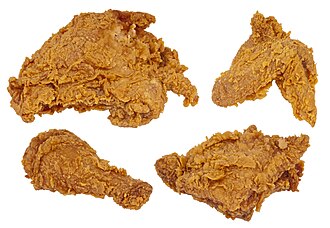
Photo: Wikipedia
This is a classic fried chicken thigh, complete with its juicy skin and crispy, seasoned breading. It delivers a satisfying crunch giving way to tender, flavorful dark meat, with a rich, savory taste amplified by the frying process. Nutritionally, it's a dense source of protein and fat, providing substantial energy in a small serving.
Calorie split: 28% protein · 13% carbs · 59% fat
↓ Full nutrition💚 Why it's loved
People love it for the irresistible contrast between the shatteringly crisp, seasoned breading and the succulent, juicy dark meat beneath. It's a universal comfort food, central to gatherings, fast-food culture, and home-style cooking across many regions.
⚠️ Watch-outs & how to enjoy it better
The high fat and calorie density can be a concern for weight management, and the frying process may create compounds some prefer to limit. The breading is often high in sodium and refined carbs. To counteract, pair a piece with a large, vinegar-dressed salad or steamed vegetables to add fiber and volume, and practice portion control by enjoying it as part of a balanced plate rather than the sole focus.
Key benefits
- High-quality protein for muscle maintenance and satiety
- Rich in iron and zinc from dark poultry meat
- Provides B vitamins, especially niacin and B6
- The skin and fat enhance flavor and nutrient absorption for fat-soluble vitamins
- A calorie-dense, convenient source of quick energy
🍽️ Popular dishes





🌍 Where it's eaten
💡 Did you know?
The practice of breading and frying chicken is often traced back to Scottish immigrants in the American South, but the signature technique of deep-frying in a heavy, cast-iron skillet is a distinct African American culinary innovation that defined the modern 'fried chicken' we know.
Full nutrition (USDA data · scales with serving)
| Water | 51.4 g |
| Energy | 274 kcal |
| Energy | 1147 kj |
| Protein | 19.2 g |
| Total lipid (fat) | 18.1 g |
| Ash | 2.6 g |
| Carbohydrate, by difference | 8.7 g |
| Fiber, total dietary | 0.10 g |
| Total Sugars | 0.00 g |
| Sucrose | 0.00 g |
| Glucose | 0.00 g |
| Fructose | 0.00 g |
| Lactose | 0.00 g |
| Maltose | 0.00 g |
| Galactose | 0.00 g |
| Starch | 8.6 g |
| Calcium, Ca | 54.0 mg |
| Iron, Fe | 1.0 mg |
| Magnesium, Mg | 22.0 mg |
| Phosphorus, P | 210 mg |
| Potassium, K | 240 mg |
| Sodium, Na | 747 mg |
| Zinc, Zn | 1.4 mg |
| Copper, Cu | 0.08 mg |
| Manganese, Mn | 0.15 mg |
| Selenium, Se | 25.2 ug |
| Vitamin C, total ascorbic acid | 0.00 mg |
| Thiamin | 0.10 mg |
| Riboflavin | 0.29 mg |
| Niacin | 5.6 mg |
| Pantothenic acid | 1.0 mg |
| Vitamin B-6 | 0.17 mg |
| Folate, total | 25.0 ug |
| Folic acid | 14.0 ug |
| Folate, food | 11.0 ug |
| Folate, DFE | 34.0 ug |
| Choline, total | 84.2 mg |
| Betaine | 7.2 mg |
| Vitamin B-12 | 0.43 ug |
| Vitamin B-12, added | 0.00 ug |
| Vitamin A, RAE | 16.0 ug |
| Retinol | 16.0 ug |
| Carotene, beta | 0.00 ug |
| Carotene, alpha | 0.00 ug |
| Cryptoxanthin, beta | 0.00 ug |
| Vitamin A, IU | 54.0 iu |
| Lycopene | 0.00 ug |
| Lutein + zeaxanthin | 0.00 ug |
| Vitamin E (alpha-tocopherol) | 0.61 mg |
| Vitamin E, added | 0.00 mg |
| Tocopherol, beta | 0.02 mg |
| Tocopherol, gamma | 0.67 mg |
| Tocopherol, delta | 0.03 mg |
| Tocotrienol, alpha | 0.01 mg |
| Tocotrienol, beta | 0.14 mg |
| Tocotrienol, gamma | 0.00 mg |
| Tocotrienol, delta | 0.00 mg |
| Vitamin D (D2 + D3), International Units | 7.0 iu |
| Vitamin D (D2 + D3) | 0.20 ug |
| Vitamin K (phylloquinone) | 0.00 ug |
| Alcohol, ethyl | 0.00 g |
| Caffeine | 0.00 mg |
| Theobromine | 0.00 mg |
Fat & fatty acid profile (per 100g)
| Fatty acids, total saturated | 4.8 g |
| SFA 4:0 | 0.00 g |
| SFA 6:0 | 0.00 g |
| SFA 8:0 | 0.00 g |
| SFA 10:0 | 0.01 g |
| SFA 12:0 | 0.01 g |
| SFA 14:0 | 0.15 g |
| SFA 15:0 | 0.02 g |
| SFA 16:0 | 3.3 g |
| SFA 17:0 | 0.05 g |
| SFA 18:0 | 1.2 g |
| SFA 20:0 | 0.04 g |
| SFA 22:0 | 0.02 g |
| SFA 24:0 | 0.01 g |
| Fatty acids, total monounsaturated | 8.5 g |
| MUFA 14:1 | 0.04 g |
| MUFA 15:1 | 0.00 g |
| MUFA 16:1 | 0.79 g |
| MUFA 17:1 | 0.03 g |
| MUFA 18:1 | 7.5 g |
| MUFA 20:1 | 0.14 g |
| MUFA 22:1 | 0.01 g |
| MUFA 24:1 c | 0.01 g |
| Fatty acids, total polyunsaturated | 2.9 g |
| PUFA 18:2 | 2.5 g |
| PUFA 18:3 | 0.33 g |
| PUFA 18:4 | 0.00 g |
| PUFA 20:2 n-6 c,c | 0.01 g |
| PUFA 20:3 | 0.03 g |
| PUFA 20:4 | 0.07 g |
| PUFA 20:5 n-3 (EPA) | 0.00 g |
| PUFA 22:4 | 0.02 g |
| PUFA 22:5 n-3 (DPA) | 0.01 g |
| PUFA 22:6 n-3 (DHA) | 0.00 g |
| Fatty acids, total trans | 0.25 g |
| Cholesterol | 106 mg |
Amino acid profile (per 100g)
Estimated from Fast foods, english muffin, with egg, cheese, and sausage — USDA does not publish this profile for Fast Foods.
| Tryptophan | 0.16 g |
| Threonine | 0.52 g |
| Isoleucine | 0.54 g |
| Leucine | 0.98 g |
| Lysine | 0.75 g |
| Methionine | 0.29 g |
| Cystine | 0.20 g |
| Phenylalanine | 0.59 g |
| Tyrosine | 0.41 g |
| Valine | 0.65 g |
| Arginine | 0.65 g |
| Histidine | 0.33 g |
| Alanine | 0.60 g |
| Aspartic acid | 1.1 g |
| Glutamic acid | 2.5 g |
| Glycine | 0.54 g |
| Proline | 0.90 g |
| Serine | 0.70 g |
FAQ
Is the skin the main source of fat and calories?
Yes, the skin and the attached subcutaneous fat are the primary sources of the fat and a significant portion of the calories in this dish. Removing the skin before eating reduces the fat and calorie content substantially.
How does the nutrition compare to a skinless, baked chicken thigh?
A fried thigh with skin and breading has roughly double the calories and fat of a similarly sized skinless, baked thigh, with slightly less protein by weight due to the added breading.
Why is dark meat often preferred for frying?
Dark meat (thighs and drumsticks) has more fat and connective tissue than white meat, which helps it stay moist and flavorful during the high-heat cooking of frying, resulting in a juicier final product.
Nutrient density (calculated · NRF9.3)
Nutrient Rich Foods index: beneficial nutrients (protein, fiber, vitamins, minerals) minus saturated fat, added sugar & sodium, per 100 kcal.
NRF9.3 index — Fulgoni, Keast & Drewnowski, 2009. Computed from USDA nutrients.
Weight-loss friendliness (composite index)
Energy density 2.74 kcal/g · 28% calories from protein · 0.1 g fiber · 0.0 g sugar per 100 g.
Composite of energy density (Rolls et al., 1999), protein & fiber satiety, minus sugar. A calculated heuristic — ranks satiety-per-calorie, not a clinical measure.
Dietary load (calculated from USDA values)
Potential renal acid load. Positive = acid-forming, negative = alkaline-forming.
Sodium-to-potassium ratio: 3.11 (lower is better — aim for ≤ 1)
Sodium:potassium per WHO potassium guidance. Computed from USDA nutrients.