

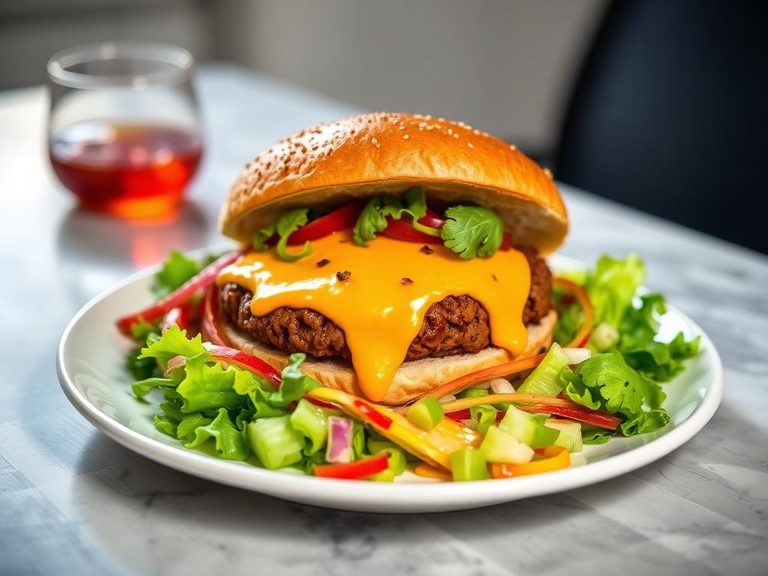
Fast foods, cheeseburger; single, regular patty, with condiments and vegetables
Whole food · Fast Foods
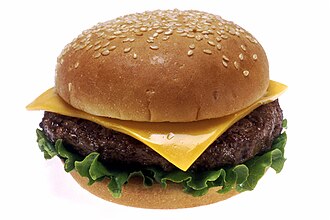
Photo: Wikipedia
The classic single cheeseburger is a compact, savory sandwich built on a soft, toasted bun, layered with a juicy beef patty, melted American cheese, and a crisp mix of lettuce, tomato, onion, and pickles, all tied together with tangy ketchup and mustard. Each bite delivers a satisfying contrast of textures and a balanced sweet-savory-umami flavor profile. Nutritionally, it provides a solid protein punch for its size but is calorie-dense, with over half its calories coming from fats and refined carbs.
Calorie split: 20% protein · 39% carbs · 40% fat
↓ Full nutrition💚 Why it's loved
People love the cheeseburger for its iconic, comforting flavor combination—the savory beef, creamy melted cheese, and tangy condiments create a deeply satisfying taste experience. It's a versatile, handheld meal that's central to casual dining culture and evokes a sense of nostalgia and convenience.
⚠️ Watch-outs & how to enjoy it better
The high sodium, saturated fat, and refined carbohydrates can contribute to blood pressure spikes and energy crashes, making it less ideal for those managing blood sugar or heart health. To counteract, pair it with a side salad or vegetables instead of fries, opt for a single patty, and drink water to help manage sodium intake. Be mindful of common allergens like wheat (bun), dairy (cheese), and sesame (bun seeds).
Key benefits
- Good source of high-quality protein for muscle maintenance.
- Provides quick energy from carbohydrates.
- Contains calcium from the cheese.
- Offers some dietary fiber from vegetable toppings.
- Convenient and widely accessible meal option.
🍽️ Popular dishes
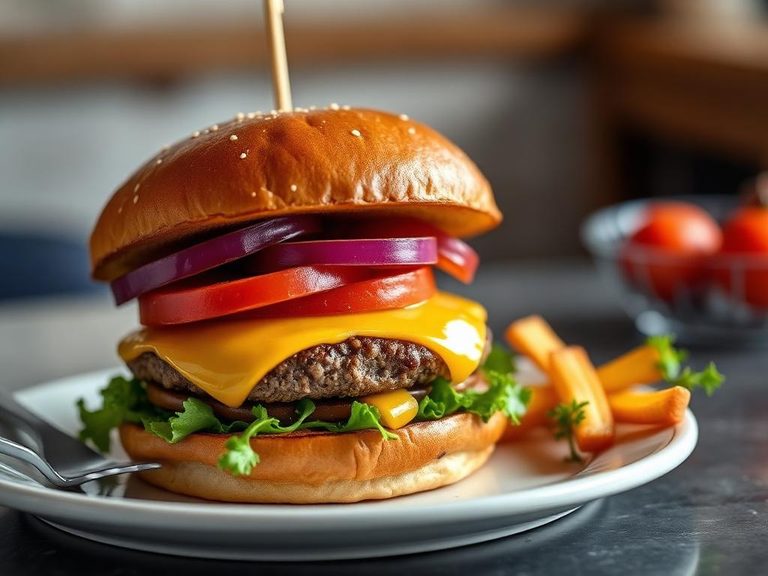
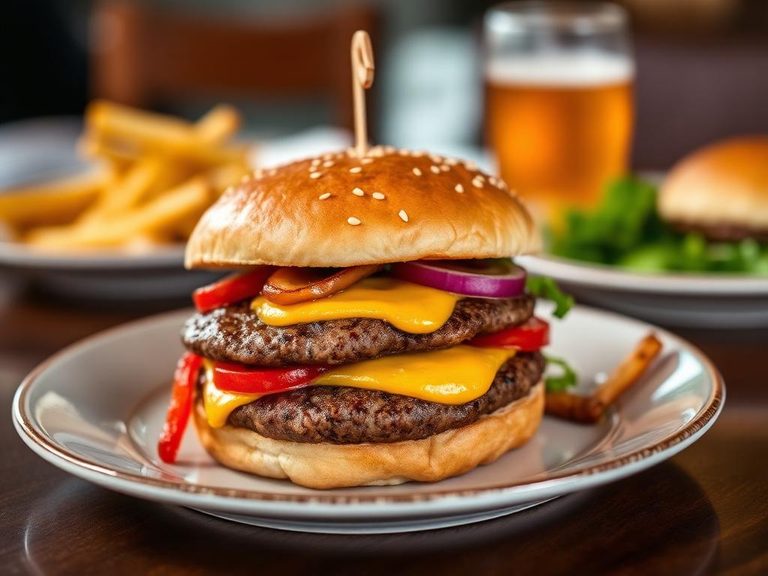
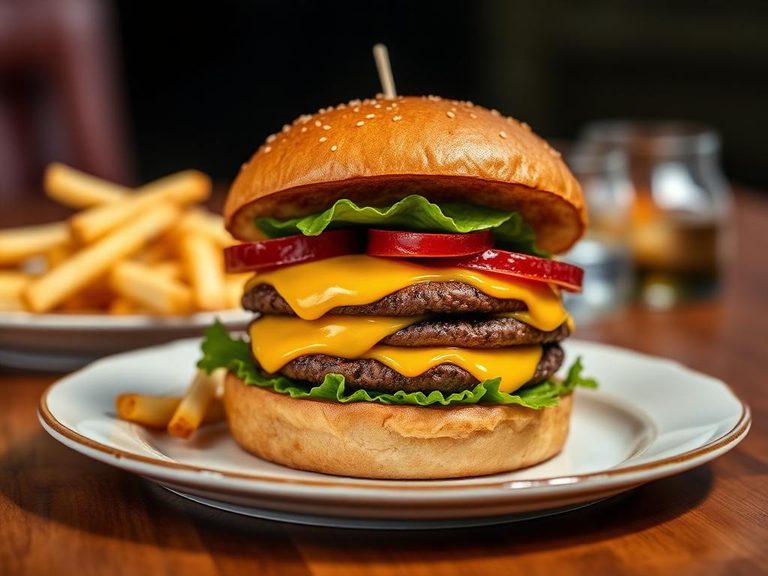

🌍 Where it's eaten
💡 Did you know?
The term 'cheeseburger' was trademarked in 1935 by Louis Ballt of the Humpty Dumpty Drive-In in Denver, Colorado.
Full nutrition (USDA data · scales with serving)
| Water | 48.1 g |
| Energy | 254 kcal |
| Energy | 1061 kj |
| Protein | 13.1 g |
| Total lipid (fat) | 11.5 g |
| Ash | 2.4 g |
| Carbohydrate, by difference | 25.0 g |
| Fiber, total dietary | 1.4 g |
| Total Sugars | 5.1 g |
| Sucrose | 0.00 g |
| Glucose | 2.1 g |
| Fructose | 2.2 g |
| Lactose | 0.23 g |
| Maltose | 0.15 g |
| Starch | 16.6 g |
| Calcium, Ca | 92.0 mg |
| Iron, Fe | 2.8 mg |
| Magnesium, Mg | 22.0 mg |
| Phosphorus, P | 134 mg |
| Potassium, K | 178 mg |
| Sodium, Na | 546 mg |
| Zinc, Zn | 2.2 mg |
| Copper, Cu | 0.11 mg |
| Manganese, Mn | 0.24 mg |
| Selenium, Se | 21.9 ug |
| Vitamin C, total ascorbic acid | 0.60 mg |
| Thiamin | 0.36 mg |
| Riboflavin | 0.17 mg |
| Niacin | 3.1 mg |
| Pantothenic acid | 0.30 mg |
| Vitamin B-6 | 0.96 mg |
| Folate, total | 42.0 ug |
| Folic acid | 28.0 ug |
| Folate, food | 14.0 ug |
| Folate, DFE | 62.0 ug |
| Choline, total | 37.3 mg |
| Vitamin B-12 | 1.3 ug |
| Vitamin B-12, added | 0.00 ug |
| Vitamin A, RAE | 12.0 ug |
| Retinol | 8.0 ug |
| Carotene, beta | 47.0 ug |
| Carotene, alpha | 1.0 ug |
| Cryptoxanthin, beta | 3.0 ug |
| Vitamin A, IU | 107 iu |
| Lycopene | 1170 ug |
| Lutein + zeaxanthin | 22.0 ug |
| Vitamin E (alpha-tocopherol) | 0.30 mg |
| Vitamin E, added | 0.00 mg |
| Vitamin D (D2 + D3), International Units | 2.0 iu |
| Vitamin D (D2 + D3) | 0.10 ug |
| Vitamin D3 (cholecalciferol) | 0.10 ug |
| Vitamin K (phylloquinone) | 4.2 ug |
| Vitamin K (Dihydrophylloquinone) | 0.00 ug |
| Alcohol, ethyl | 0.00 g |
| Caffeine | 0.00 mg |
| Theobromine | 0.00 mg |
Fat & fatty acid profile (per 100g)
| Fatty acids, total saturated | 5.2 g |
| SFA 4:0 | 0.10 g |
| SFA 6:0 | 0.07 g |
| SFA 8:0 | 0.04 g |
| SFA 10:0 | 0.08 g |
| SFA 12:0 | 0.10 g |
| SFA 14:0 | 0.48 g |
| SFA 15:0 | 0.06 g |
| SFA 16:0 | 2.7 g |
| SFA 17:0 | 0.11 g |
| SFA 18:0 | 1.4 g |
| SFA 20:0 | 0.02 g |
| SFA 22:0 | 0.00 g |
| SFA 24:0 | 0.01 g |
| Fatty acids, total monounsaturated | 4.4 g |
| MUFA 14:1 | 0.08 g |
| MUFA 15:1 | 0.00 g |
| MUFA 16:1 | 0.38 g |
| MUFA 16:1 c | 0.34 g |
| MUFA 17:1 | 0.04 g |
| MUFA 18:1 | 3.9 g |
| MUFA 18:1 c | 3.5 g |
| MUFA 20:1 | 0.03 g |
| MUFA 22:1 | 0.01 g |
| Fatty acids, total polyunsaturated | 1.2 g |
| PUFA 18:2 | 1.0 g |
| PUFA 18:2 n-6 c,c | 0.96 g |
| PUFA 18:2 i | 0.05 g |
| PUFA 18:3 | 0.12 g |
| PUFA 18:3 n-3 c,c,c (ALA) | 0.12 g |
| PUFA 18:4 | 0.03 g |
| PUFA 20:2 n-6 c,c | 0.00 g |
| PUFA 20:3 | 0.00 g |
| PUFA 20:3 n-6 | 0.00 g |
| PUFA 20:4 | 0.02 g |
| PUFA 20:4 n-6 | 0.02 g |
| PUFA 20:5 n-3 (EPA) | 0.00 g |
| PUFA 22:5 n-3 (DPA) | 0.00 g |
| PUFA 22:6 n-3 (DHA) | 0.00 g |
| Fatty acids, total trans | 0.47 g |
| Fatty acids, total trans-monoenoic | 0.42 g |
| TFA 16:1 t | 0.04 g |
| TFA 18:1 t | 0.39 g |
| Fatty acids, total trans-polyenoic | 0.05 g |
| Cholesterol | 36.0 mg |
Amino acid profile (per 100g)
Estimated from Fast foods, english muffin, with egg, cheese, and sausage — USDA does not publish this profile for Fast foods.
| Tryptophan | 0.16 g |
| Threonine | 0.52 g |
| Isoleucine | 0.54 g |
| Leucine | 0.98 g |
| Lysine | 0.75 g |
| Methionine | 0.29 g |
| Cystine | 0.20 g |
| Phenylalanine | 0.59 g |
| Tyrosine | 0.41 g |
| Valine | 0.65 g |
| Arginine | 0.65 g |
| Histidine | 0.33 g |
| Alanine | 0.60 g |
| Aspartic acid | 1.1 g |
| Glutamic acid | 2.5 g |
| Glycine | 0.54 g |
| Proline | 0.90 g |
| Serine | 0.70 g |
FAQ
How much protein is in a single cheeseburger?
A typical single cheeseburger (about 118g) contains approximately 13 grams of protein, primarily from the beef patty and cheese.
Is a cheeseburger a good source of fiber?
No, it's relatively low in fiber, providing only about 1.4 grams per 100g, mostly from the vegetable toppings like lettuce and tomato.
What makes a cheeseburger 'regular' vs. 'double'?
A 'regular' cheeseburger has one beef patty, while a 'double' has two, significantly increasing the calories, protein, and fat content.
Nutrient density (calculated · NRF9.3)
Nutrient Rich Foods index: beneficial nutrients (protein, fiber, vitamins, minerals) minus saturated fat, added sugar & sodium, per 100 kcal.
NRF9.3 index — Fulgoni, Keast & Drewnowski, 2009. Computed from USDA nutrients.
Weight-loss friendliness (composite index)
Energy density 2.54 kcal/g · 21% calories from protein · 1.4 g fiber · 5.1 g sugar per 100 g.
Composite of energy density (Rolls et al., 1999), protein & fiber satiety, minus sugar. A calculated heuristic — ranks satiety-per-calorie, not a clinical measure.
Dietary load (calculated from USDA values)
Potential renal acid load. Positive = acid-forming, negative = alkaline-forming.
Sodium-to-potassium ratio: 3.07 (lower is better — aim for ≤ 1)
Sodium:potassium per WHO potassium guidance. Computed from USDA nutrients.