

Crackers, flavored, fish-shaped
Whole food · Baked Products

Photo: Wikipedia
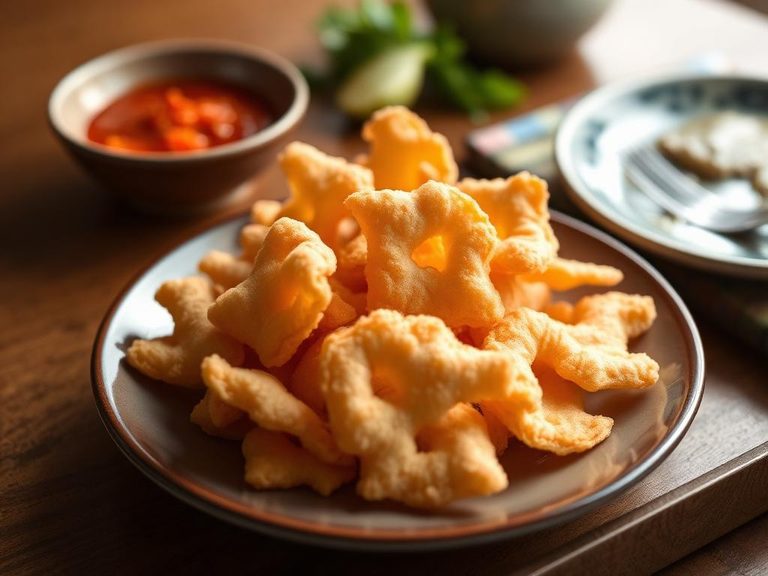
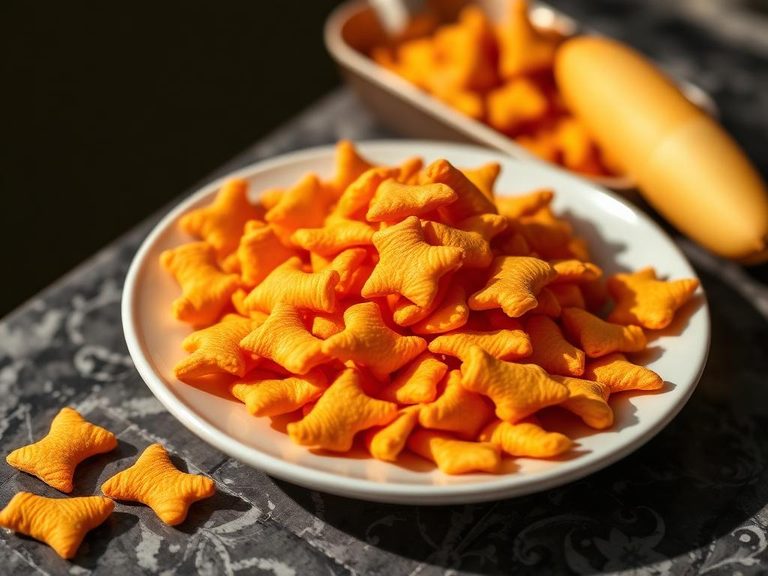
These crispy, fish-shaped crackers are a beloved snack, offering a satisfying crunch with a savory, often umami-rich flavor from fish powder or seasoning. Nutritionally, they are a dense source of carbohydrates for quick energy, with a moderate amount of protein and a notable fat content that contributes to their satisfying mouthfeel.
Calorie split: 9% protein · 57% carbs · 34% fat
↓ Full nutrition💚 Why it's loved
People adore them for their playful shape, addictive crunch, and the deep, savory umami flavor that makes them highly moreish. They are a nostalgic comfort food in many cultures, perfect for casual snacking or pairing with dips.
⚠️ Watch-outs & how to enjoy it better
Their high carbohydrate and fat content can contribute to blood sugar spikes and excess calorie intake if consumed in large portions. They are often high in sodium and may contain common allergens like fish or soy; pairing with fresh vegetables or a protein source like hummus can help balance the snack.
Key benefits
- Provides quick energy from high carbohydrate content
- Offers a moderate protein boost per serving
- Convenient, shelf-stable, and portable snack
- Delivers a satisfying crunch and savory flavor
🍽️ Popular dishes


🌍 Where it's eaten
💡 Did you know?
The most famous fish-shaped snack, the Goldfish cracker, was created in 1962 by a Swiss biscuit company for a client's promotional campaign, with the smiling fish design said to bring good luck.
Full nutrition (USDA data · scales with serving)
| Water | 3.4 g |
| Energy | 463 kcal |
| Energy | 1936 kj |
| Protein | 10.2 g |
| Total lipid (fat) | 17.7 g |
| Ash | 3.0 g |
| Carbohydrate, by difference | 65.7 g |
| Fiber, total dietary | 3.1 g |
| Total Sugars | 1.2 g |
| Sucrose | 0.00 g |
| Glucose | 0.30 g |
| Fructose | 0.09 g |
| Lactose | 0.00 g |
| Maltose | 0.79 g |
| Galactose | 0.00 g |
| Starch | 60.2 g |
| Calcium, Ca | 83.0 mg |
| Iron, Fe | 4.6 mg |
| Magnesium, Mg | 25.0 mg |
| Phosphorus, P | 167 mg |
| Potassium, K | 224 mg |
| Sodium, Na | 970 mg |
| Zinc, Zn | 1.1 mg |
| Copper, Cu | 0.13 mg |
| Manganese, Mn | 0.56 mg |
| Selenium, Se | 4.0 ug |
| Thiamin | 0.81 mg |
| Riboflavin | 0.51 mg |
| Niacin | 6.4 mg |
| Pantothenic acid | 0.66 mg |
| Vitamin B-6 | 0.09 mg |
| Folate, total | 153 ug |
| Vitamin E (alpha-tocopherol) | 3.7 mg |
| Tocopherol, beta | 0.17 mg |
| Tocopherol, gamma | 5.8 mg |
| Tocopherol, delta | 0.10 mg |
| Tocotrienol, alpha | 0.10 mg |
| Tocotrienol, beta | 0.83 mg |
| Tocotrienol, gamma | 0.00 mg |
| Tocotrienol, delta | 0.00 mg |
| Vitamin K (phylloquinone) | 27.7 ug |
| Vitamin K (Dihydrophylloquinone) | 0.00 ug |
| Vitamin K (Menaquinone-4) | 0.00 ug |
Fat & fatty acid profile (per 100g)
| Fatty acids, total saturated | 2.1 g |
| SFA 4:0 | 0.03 g |
| SFA 6:0 | 0.02 g |
| SFA 8:0 | 0.01 g |
| SFA 10:0 | 0.03 g |
| SFA 12:0 | 0.04 g |
| SFA 14:0 | 0.14 g |
| SFA 15:0 | 0.02 g |
| SFA 16:0 | 1.1 g |
| SFA 17:0 | 0.01 g |
| SFA 18:0 | 0.45 g |
| SFA 20:0 | 0.10 g |
| SFA 22:0 | 0.05 g |
| SFA 24:0 | 0.03 g |
| Fatty acids, total monounsaturated | 10.3 g |
| MUFA 14:1 | 0.01 g |
| MUFA 15:1 | 0.00 g |
| MUFA 16:1 | 0.08 g |
| MUFA 16:1 c | 0.07 g |
| MUFA 17:1 | 0.01 g |
| MUFA 18:1 | 10.0 g |
| MUFA 18:1 c | 10.0 g |
| MUFA 20:1 | 0.18 g |
| MUFA 22:1 | 0.01 g |
| MUFA 22:1 c | 0.01 g |
| MUFA 24:1 c | 0.02 g |
| Fatty acids, total polyunsaturated | 3.9 g |
| PUFA 18:2 | 3.5 g |
| PUFA 18:2 n-6 c,c | 3.4 g |
| PUFA 18:2 CLAs | 0.01 g |
| PUFA 18:3 | 0.42 g |
| PUFA 18:3 n-3 c,c,c (ALA) | 0.40 g |
| PUFA 18:3 n-6 c,c,c | 0.02 g |
| PUFA 18:3i | 0.00 g |
| PUFA 18:4 | 0.00 g |
| PUFA 20:2 n-6 c,c | 0.01 g |
| PUFA 20:3 | 0.00 g |
| PUFA 20:3 n-3 | 0.00 g |
| PUFA 20:3 n-6 | 0.00 g |
| PUFA 20:4 | 0.00 g |
| PUFA 20:5 n-3 (EPA) | 0.00 g |
| PUFA 22:4 | 0.00 g |
| PUFA 22:5 n-3 (DPA) | 0.00 g |
| PUFA 22:6 n-3 (DHA) | 0.00 g |
| Fatty acids, total trans | 0.06 g |
| Fatty acids, total trans-monoenoic | 0.04 g |
| TFA 16:1 t | 0.00 g |
| TFA 18:1 t | 0.04 g |
| TFA 22:1 t | 0.00 g |
| TFA 18:2 t not further defined | 0.02 g |
| Fatty acids, total trans-polyenoic | 0.02 g |
Amino acid profile (per 100g)
Estimated from Crackers, cheese, sandwich-type with cheese filling — USDA does not publish this profile for Crackers.
| Tryptophan | 0.11 g |
| Threonine | 0.33 g |
| Isoleucine | 0.36 g |
| Leucine | 0.64 g |
| Lysine | 0.39 g |
| Methionine | 0.15 g |
| Cystine | 0.15 g |
| Phenylalanine | 0.35 g |
| Tyrosine | 0.25 g |
| Valine | 0.38 g |
| Arginine | 0.29 g |
| Histidine | 0.17 g |
| Alanine | 0.30 g |
| Aspartic acid | 0.52 g |
| Glutamic acid | 2.2 g |
| Glycine | 0.24 g |
| Proline | 0.77 g |
| Serine | 0.40 g |
FAQ
Are fish-shaped crackers actually made from fish?
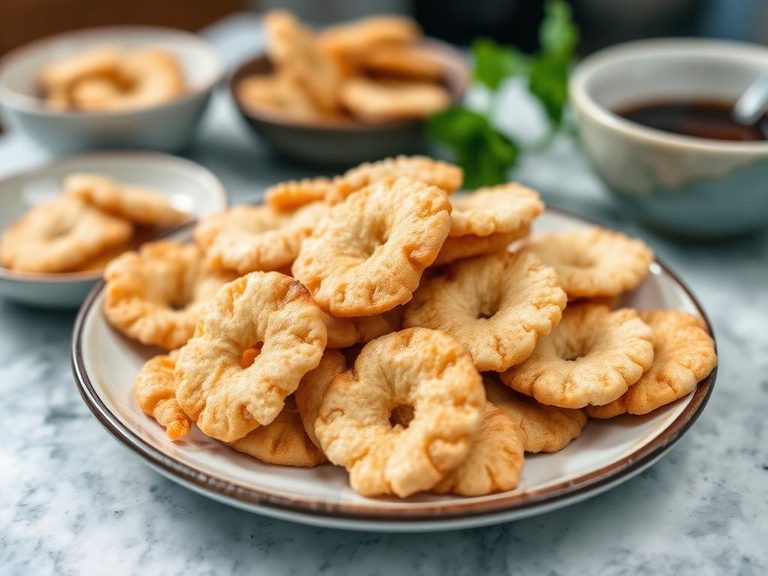
It varies greatly. Some traditional versions like Indonesian kerupuk contain shrimp or fish paste, while many commercial snacks like Goldfish crackers are flavored but contain no actual fish ingredients.
Why are they so high in fat?
The fat content comes from the oil used in frying or baking the crackers to achieve their characteristic crispness and from any added fats in the dough or seasoning.
Can they be part of a healthy diet?
Yes, in moderation. They can be enjoyed as an occasional treat, especially when portion-controlled and paired with nutrient-dense foods like fruits, vegetables, or lean proteins to create a more balanced snack.
Nutrient density (calculated · NRF9.3)
Nutrient Rich Foods index: beneficial nutrients (protein, fiber, vitamins, minerals) minus saturated fat, added sugar & sodium, per 100 kcal.
NRF9.3 index — Fulgoni, Keast & Drewnowski, 2009. Computed from USDA nutrients.
Weight-loss friendliness (composite index)
Energy density 4.63 kcal/g · 9% calories from protein · 3.1 g fiber · 1.2 g sugar per 100 g.
Composite of energy density (Rolls et al., 1999), protein & fiber satiety, minus sugar. A calculated heuristic — ranks satiety-per-calorie, not a clinical measure.
Dietary load (calculated from USDA values)
Potential renal acid load. Positive = acid-forming, negative = alkaline-forming.
Sodium-to-potassium ratio: 4.33 (lower is better — aim for ≤ 1)
Sodium:potassium per WHO potassium guidance. Computed from USDA nutrients.