

Bread, multi-grain, toasted (includes whole-grain)
Whole food · Baked Products

Photo: Wikipedia
Toasted multi-grain bread is a hearty, nutty slice with a satisfying crunch and chewy interior, packed with visible seeds and grains. It offers a robust, earthy flavor profile that's more complex than plain white bread. Nutritionally, it's a strong source of plant-based protein and dietary fiber, making it a filling and energy-sustaining staple.
Calorie split: 20% protein · 65% carbs · 14% fat
↓ Full nutrition💚 Why it's loved
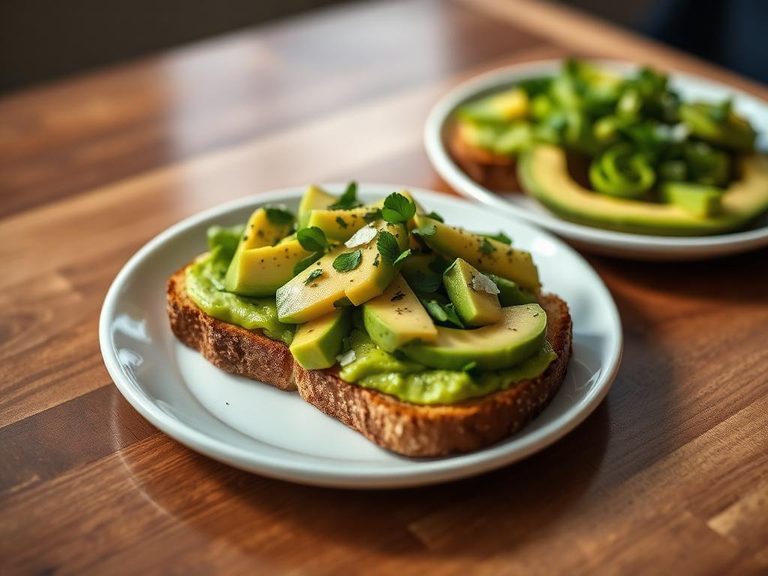
People love it for its robust, nutty flavor and satisfying crunch that elevates simple toppings. It's a versatile canvas for both sweet (like avocado and honey) and savory (like eggs and cheese) combinations, making it a beloved breakfast and lunch staple.
⚠️ Watch-outs & how to enjoy it better
The dense fiber content can cause digestive discomfort for some if consumed in large amounts. Those monitoring blood sugar should be aware that while it's better than white bread, it still contains carbohydrates; pairing it with protein (like nut butter) or fat (like avocado) can help moderate the glycemic response. It often contains common allergens like wheat, and sometimes seeds (sesame, sunflower).
Key benefits
- High in dietary fiber for digestive health and satiety.
- Good source of plant-based protein for muscle maintenance.
- Provides complex carbohydrates for sustained energy release.
- Contains micronutrients like B vitamins and iron from whole grains.
- The toasting process enhances its nutty flavor and crunchy texture.
🍽️ Popular dishes




🌍 Where it's eaten
💡 Did you know?
The 'multi-grain' label can be a marketing term; for true whole-grain benefits, the first ingredient on the label should specify 'whole' grain (e.g., whole wheat, whole rye).
Full nutrition (USDA data · scales with serving)
| Water | 31.5 g |
| Energy | 288 kcal |
| Energy | 1204 kj |
| Protein | 14.5 g |
| Total lipid (fat) | 4.6 g |
| Ash | 2.3 g |
| Carbohydrate, by difference | 47.1 g |
| Fiber, total dietary | 8.1 g |
| Total Sugars | 6.9 g |
| Sucrose | 0.00 g |
| Glucose | 1.8 g |
| Fructose | 2.7 g |
| Lactose | 0.62 g |
| Maltose | 1.8 g |
| Calcium, Ca | 111 mg |
| Iron, Fe | 2.7 mg |
| Magnesium, Mg | 85.0 mg |
| Phosphorus, P | 247 mg |
| Potassium, K | 250 mg |
| Sodium, Na | 414 mg |
| Zinc, Zn | 1.9 mg |
| Copper, Cu | 0.31 mg |
| Manganese, Mn | 2.2 mg |
| Selenium, Se | 35.8 ug |
| Vitamin C, total ascorbic acid | 0.10 mg |
| Thiamin | 0.24 mg |
| Riboflavin | 0.14 mg |
| Niacin | 4.4 mg |
| Pantothenic acid | 0.36 mg |
| Vitamin B-6 | 0.29 mg |
| Folate, total | 70.0 ug |
| Folic acid | 0.00 ug |
| Folate, food | 70.0 ug |
| Folate, DFE | 70.0 ug |
| Choline, total | 28.8 mg |
| Vitamin B-12 | 0.00 ug |
| Vitamin B-12, added | 0.00 ug |
| Vitamin A, RAE | 0.00 ug |
| Retinol | 0.00 ug |
| Carotene, beta | 0.00 ug |
| Carotene, alpha | 0.00 ug |
| Cryptoxanthin, beta | 0.00 ug |
| Vitamin A, IU | 0.00 iu |
| Lycopene | 0.00 ug |
| Lutein + zeaxanthin | 97.0 ug |
| Vitamin E (alpha-tocopherol) | 0.40 mg |
| Vitamin E, added | 0.00 mg |
| Tocopherol, beta | 0.10 mg |
| Tocopherol, gamma | 1.6 mg |
| Tocopherol, delta | 0.59 mg |
| Tocotrienol, alpha | 0.11 mg |
| Tocotrienol, beta | 0.00 mg |
| Tocotrienol, gamma | 0.02 mg |
| Tocotrienol, delta | 0.00 mg |
| Vitamin D (D2 + D3), International Units | 0.00 iu |
| Vitamin D (D2 + D3) | 0.00 ug |
| Vitamin K (phylloquinone) | 1.5 ug |
| Alcohol, ethyl | 0.00 g |
| Caffeine | 0.00 mg |
| Theobromine | 0.00 mg |
Fat & fatty acid profile (per 100g)
| Fatty acids, total saturated | 0.95 g |
| SFA 4:0 | 0.00 g |
| SFA 6:0 | 0.00 g |
| SFA 8:0 | 0.00 g |
| SFA 10:0 | 0.00 g |
| SFA 12:0 | 0.00 g |
| SFA 14:0 | 0.00 g |
| SFA 15:0 | 0.00 g |
| SFA 16:0 | 0.55 g |
| SFA 17:0 | 0.00 g |
| SFA 18:0 | 0.39 g |
| SFA 20:0 | 0.00 g |
| SFA 22:0 | 0.01 g |
| SFA 24:0 | 0.00 g |
| Fatty acids, total monounsaturated | 0.83 g |
| MUFA 14:1 | 0.00 g |
| MUFA 15:1 | 0.00 g |
| MUFA 16:1 | 0.02 g |
| MUFA 17:1 | 0.00 g |
| MUFA 18:1 | 0.79 g |
| MUFA 20:1 | 0.01 g |
| MUFA 22:1 | 0.00 g |
| MUFA 24:1 c | 0.00 g |
| Fatty acids, total polyunsaturated | 2.0 g |
| PUFA 18:2 | 1.8 g |
| PUFA 18:3 | 0.22 g |
| PUFA 18:4 | 0.00 g |
| PUFA 20:2 n-6 c,c | 0.00 g |
| PUFA 20:3 | 0.00 g |
| PUFA 20:4 | 0.00 g |
| PUFA 20:5 n-3 (EPA) | 0.00 g |
| PUFA 21:5 | 0.00 g |
| PUFA 22:4 | 0.00 g |
| PUFA 22:5 n-3 (DPA) | 0.00 g |
| PUFA 22:6 n-3 (DHA) | 0.00 g |
| Fatty acids, total trans | 0.00 g |
| Cholesterol | 0.00 mg |
Amino acid profile (per 100g)
| Tryptophan | 0.14 g |
| Threonine | 0.29 g |
| Isoleucine | 0.35 g |
| Leucine | 0.60 g |
| Lysine | 0.31 g |
| Methionine | 0.15 g |
| Cystine | 0.19 g |
| Phenylalanine | 0.42 g |
| Tyrosine | 0.26 g |
| Valine | 0.43 g |
| Arginine | 0.53 g |
| Histidine | 0.21 g |
| Alanine | 0.37 g |
| Aspartic acid | 0.60 g |
| Glutamic acid | 2.4 g |
| Glycine | 0.41 g |
| Proline | 0.77 g |
| Serine | 0.41 g |
FAQ
Is toasted multi-grain bread healthier than untoasted?
Toasting doesn't significantly change the core nutritional profile (calories, protein, fiber), but it can make the starches slightly less digestible, potentially leading to a lower glycemic response. It also enhances flavor and texture, which might make you more satisfied with a smaller portion.
Why does multi-grain bread sometimes have a lot of sugar?
Some commercial brands add sugar, honey, or molasses to balance the bitterness of whole grains and seeds, improve browning, and extend shelf life. Check the ingredient list and nutrition facts; a good option should have minimal added sugars (under 2-3g per slice).
How do I store it to prevent mold?
Due to its moisture and nutrient content, it can mold faster than white bread. Store it in a bread box at room temperature for 2-3 days, or freeze slices immediately. You can toast slices directly from the freezer for a quick, fresh-tasting result.
Nutrient density (calculated · NRF9.3)
Nutrient Rich Foods index: beneficial nutrients (protein, fiber, vitamins, minerals) minus saturated fat, added sugar & sodium, per 100 kcal.
NRF9.3 index — Fulgoni, Keast & Drewnowski, 2009. Computed from USDA nutrients.
Weight-loss friendliness (composite index)
Energy density 2.88 kcal/g · 20% calories from protein · 8.1 g fiber · 6.9 g sugar per 100 g.
Composite of energy density (Rolls et al., 1999), protein & fiber satiety, minus sugar. A calculated heuristic — ranks satiety-per-calorie, not a clinical measure.
Dietary load (calculated from USDA values)
Potential renal acid load. Positive = acid-forming, negative = alkaline-forming.
Sodium-to-potassium ratio: 1.66 (lower is better — aim for ≤ 1)
Sodium:potassium per WHO potassium guidance. Computed from USDA nutrients.