

Pie crust, standard-type, frozen, ready-to-bake, enriched
Whole food · Baked Products
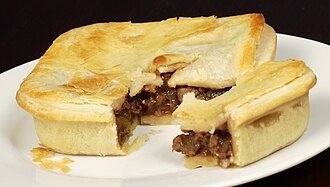
Photo: Wikipedia
This is a pre-made, frozen disc of enriched dough, ready to be thawed and baked into a golden, flaky, buttery shell. Its texture is tender yet sturdy enough to hold fillings, with a rich, savory flavor from added fats and egg. Nutritionally, it's a dense source of energy, primarily from refined carbohydrates and fats.
Calorie split: 5% protein · 43% carbs · 52% fat
↓ Full nutrition💚 Why it's loved
People love it for its unmatched convenience, transforming a multi-step, skill-intensive process into a simple thaw-and-fill task. It's the reliable, flaky foundation for everything from holiday apple pie to a weeknight quiche.
⚠️ Watch-outs & how to enjoy it better
It is high in calories, refined carbs, and saturated fat, which can contribute to blood-sugar spikes and isn't ideal for those monitoring intake. To enjoy it, practice strict portion control (a thin slice) and pair it with high-fiber fruits or protein-rich fillings like chicken or lentils to slow digestion. It also contains common allergens like wheat and may have dairy.
Key benefits
- Saves significant time for home bakers
- Provides a consistent, reliable base for pies
- Offers a good source of quick energy from carbs
- Enriched with iron and B vitamins like thiamin
- Convenient for making both sweet and savory dishes
🍽️ Popular dishes
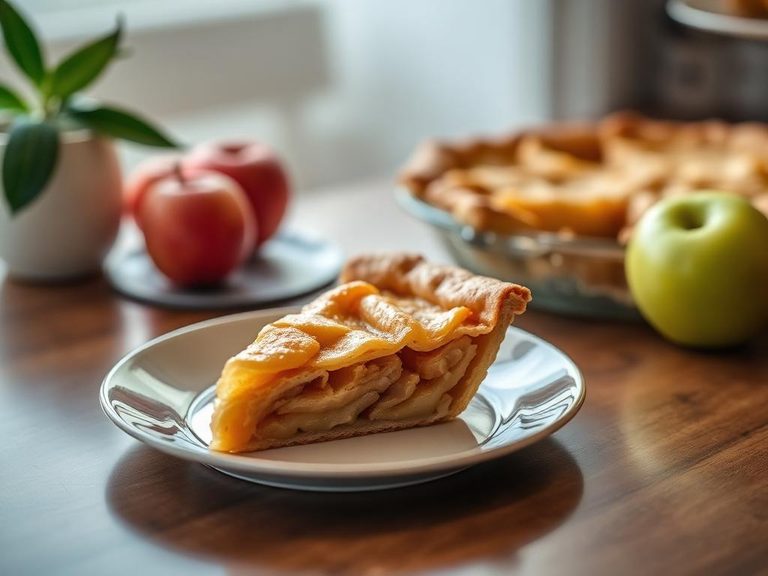



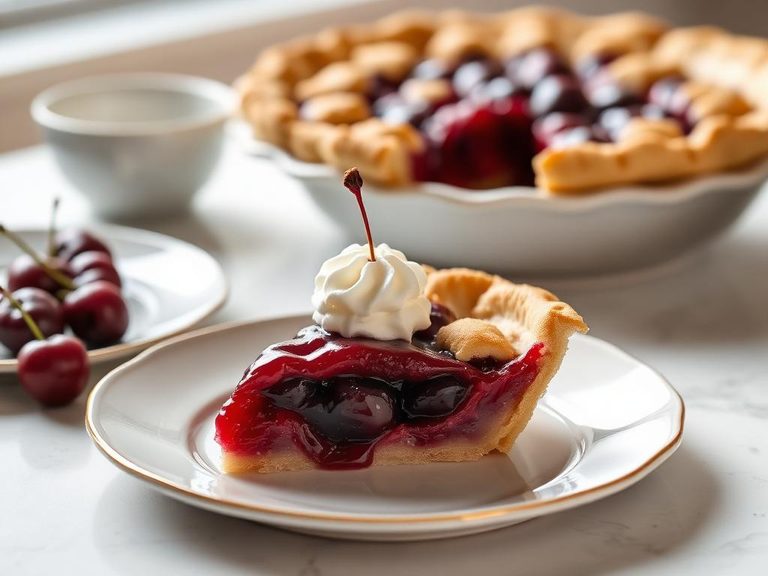

🌍 Where it's eaten
💡 Did you know?
The term 'short' in 'shortcrust pastry' refers to the high fat content, which shortens the gluten strands, creating a tender, crumbly texture rather than a chewy one.
Full nutrition (USDA data · scales with serving)
| Water | 17.8 g |
| Energy | 457 kcal |
| Energy | 1910 kj |
| Protein | 6.2 g |
| Total lipid (fat) | 26.1 g |
| Ash | 1.3 g |
| Carbohydrate, by difference | 48.6 g |
| Fiber, total dietary | 2.5 g |
| Total Sugars | 3.7 g |
| Starch | 44.1 g |
| Calcium, Ca | 19.0 mg |
| Iron, Fe | 2.6 mg |
| Magnesium, Mg | 15.0 mg |
| Phosphorus, P | 72.0 mg |
| Potassium, K | 97.0 mg |
| Sodium, Na | 409 mg |
| Zinc, Zn | 0.45 mg |
| Copper, Cu | 0.07 mg |
| Manganese, Mn | 0.44 mg |
| Selenium, Se | 5.7 ug |
| Vitamin C, total ascorbic acid | 0.00 mg |
| Thiamin | 0.28 mg |
| Riboflavin | 0.17 mg |
| Niacin | 2.7 mg |
| Pantothenic acid | 0.41 mg |
| Vitamin B-6 | 0.05 mg |
| Folate, total | 70.0 ug |
| Folic acid | 46.0 ug |
| Folate, food | 25.0 ug |
| Folate, DFE | 102 ug |
| Choline, total | 11.8 mg |
| Vitamin B-12 | 0.00 ug |
| Vitamin B-12, added | 0.00 ug |
| Vitamin A, RAE | 0.00 ug |
| Retinol | 0.00 ug |
| Carotene, beta | 0.00 ug |
| Carotene, alpha | 0.00 ug |
| Cryptoxanthin, beta | 0.00 ug |
| Vitamin A, IU | 1.0 iu |
| Lycopene | 0.00 ug |
| Lutein + zeaxanthin | 1.0 ug |
| Vitamin E (alpha-tocopherol) | 0.46 mg |
| Vitamin E, added | 0.00 mg |
| Tocopherol, beta | 0.07 mg |
| Tocopherol, gamma | 4.5 mg |
| Tocopherol, delta | 1.5 mg |
| Tocotrienol, alpha | 0.02 mg |
| Tocotrienol, beta | 0.00 mg |
| Tocotrienol, gamma | 0.02 mg |
| Tocotrienol, delta | 0.00 mg |
| Vitamin D (D2 + D3), International Units | 0.00 iu |
| Vitamin D (D2 + D3) | 0.00 ug |
| Vitamin K (phylloquinone) | 5.4 ug |
| Vitamin K (Dihydrophylloquinone) | 30.9 ug |
| Vitamin K (Menaquinone-4) | 1.8 ug |
| Alcohol, ethyl | 0.00 g |
| Caffeine | 0.00 mg |
| Theobromine | 0.00 mg |
Fat & fatty acid profile (per 100g)
| Fatty acids, total saturated | 8.2 g |
| SFA 4:0 | 0.00 g |
| SFA 6:0 | 0.00 g |
| SFA 8:0 | 0.00 g |
| SFA 10:0 | 0.00 g |
| SFA 12:0 | 0.00 g |
| SFA 14:0 | 0.23 g |
| SFA 15:0 | 0.00 g |
| SFA 16:0 | 4.7 g |
| SFA 17:0 | 0.07 g |
| SFA 18:0 | 3.0 g |
| SFA 20:0 | 0.07 g |
| SFA 22:0 | 0.03 g |
| Fatty acids, total monounsaturated | 12.2 g |
| MUFA 14:1 | 0.00 g |
| MUFA 15:1 | 0.00 g |
| MUFA 16:1 | 0.36 g |
| MUFA 17:1 | 0.00 g |
| MUFA 18:1 | 11.7 g |
| MUFA 20:1 | 0.13 g |
| MUFA 22:1 | 0.00 g |
| Fatty acids, total polyunsaturated | 3.2 g |
| PUFA 18:2 | 3.0 g |
| PUFA 18:3 | 0.12 g |
| PUFA 18:3 n-3 c,c,c (ALA) | 0.12 g |
| PUFA 18:3 n-6 c,c,c | 0.00 g |
| PUFA 18:4 | 0.00 g |
| PUFA 20:2 n-6 c,c | 0.08 g |
| PUFA 20:3 | 0.00 g |
| PUFA 20:4 | 0.02 g |
| PUFA 20:5 n-3 (EPA) | 0.00 g |
| PUFA 22:5 n-3 (DPA) | 0.00 g |
| PUFA 22:6 n-3 (DHA) | 0.00 g |
| Cholesterol | 0.00 mg |
Amino acid profile (per 100g)
| Tryptophan | 0.06 g |
| Threonine | 0.12 g |
| Isoleucine | 0.22 g |
| Leucine | 0.41 g |
| Lysine | 0.17 g |
| Methionine | 0.09 g |
| Cystine | 0.11 g |
| Phenylalanine | 0.26 g |
| Tyrosine | 0.12 g |
| Valine | 0.27 g |
| Arginine | 0.21 g |
| Histidine | 0.10 g |
| Alanine | 0.19 g |
| Aspartic acid | 0.27 g |
| Glutamic acid | 1.9 g |
| Glycine | 0.22 g |
| Proline | 0.79 g |
| Serine | 0.28 g |
| Hydroxyproline | 0.00 g |
FAQ
How do I prevent a soggy bottom?
Blind bake the crust first: line the frozen crust with parchment, fill with pie weights or dried beans, and bake at 375°F (190°C) for 10-15 minutes before adding a wet filling.
Can I use it for savory dishes?
Absolutely. It's a perfect base for quiches, pot pies, and savory tarts. For sweet pies, you may want to sprinkle the unbaked crust with sugar to counteract any savory notes.
How long does it last in the freezer?
Unopened, it will maintain best quality for up to 12 months. Once thawed, use it within a few days and do not refreeze the raw dough.
Nutrient density (calculated · NRF9.3)
Nutrient Rich Foods index: beneficial nutrients (protein, fiber, vitamins, minerals) minus saturated fat, added sugar & sodium, per 100 kcal.
NRF9.3 index — Fulgoni, Keast & Drewnowski, 2009. Computed from USDA nutrients.
Weight-loss friendliness (composite index)
Energy density 4.57 kcal/g · 5% calories from protein · 2.5 g fiber · 3.7 g sugar per 100 g.
Composite of energy density (Rolls et al., 1999), protein & fiber satiety, minus sugar. A calculated heuristic — ranks satiety-per-calorie, not a clinical measure.
Dietary load (calculated from USDA values)
Potential renal acid load. Positive = acid-forming, negative = alkaline-forming.
Sodium-to-potassium ratio: 4.22 (lower is better — aim for ≤ 1)
Sodium:potassium per WHO potassium guidance. Computed from USDA nutrients.