

Fast Foods, Fried Chicken, Breast, meat and skin and breading
Whole food · Fast Foods
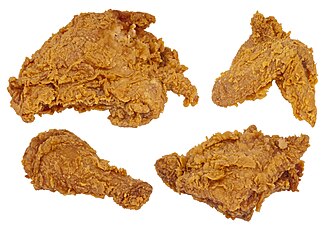
Photo: Wikipedia
This is the classic, crowd-pleasing piece of fried chicken: a juicy breast fillet coated in seasoned, crispy breading and deep-fried to a golden brown. The exterior delivers a satisfying crunch, giving way to tender, moist white meat inside. Nutritionally, it's a high-protein, moderate-fat food with minimal carbohydrates, making it a substantial source of energy and muscle-building nutrients.
Calorie split: 41% protein · 10% carbs · 49% fat
↓ Full nutrition💚 Why it's loved
People adore the irresistible contrast between the shatteringly crisp, savory coating and the succulent, flavorful meat inside. It's a universal comfort food, central to everything from quick family dinners to social gatherings and cultural celebrations.
⚠️ Watch-outs & how to enjoy it better
The deep-frying process adds significant calories and saturated fat, and the breading can be high in sodium, which is a consideration for heart health. To enjoy it more mindfully, practice portion control (stick to one breast), pair it with a large, vinegar-dressed salad or steamed vegetables to increase fiber and volume, and blot excess oil with a paper towel after cooking.
Key benefits
- Excellent source of high-quality protein for muscle maintenance and satiety.
- Provides essential nutrients like niacin, vitamin B6, and phosphorus.
- The skin and breading add dietary fat, which aids in the absorption of fat-soluble vitamins.
- A convenient, calorie-dense option for quick energy needs.
🍽️ Popular dishes


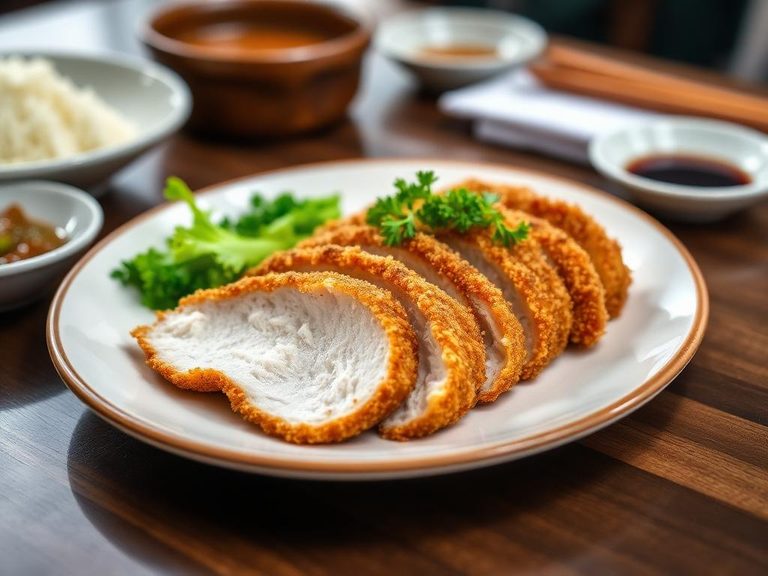
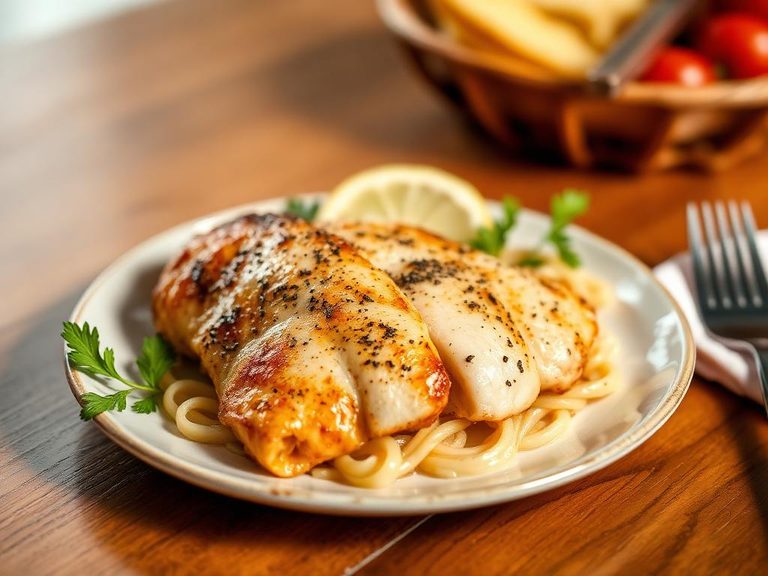

🌍 Where it's eaten
💡 Did you know?
The modern technique of deep-frying chicken in a pan of hot lard is widely attributed to Scottish immigrants in the American South, while the practice of seasoning the flour coating was influenced by West African cooking traditions.
Full nutrition (USDA data · scales with serving)
| Water | 55.5 g |
| Energy | 230 kcal |
| Energy | 963 kj |
| Protein | 23.5 g |
| Total lipid (fat) | 12.4 g |
| Ash | 2.6 g |
| Carbohydrate, by difference | 6.0 g |
| Fiber, total dietary | 0.10 g |
| Total Sugars | 0.00 g |
| Sucrose | 0.00 g |
| Glucose | 0.00 g |
| Fructose | 0.00 g |
| Lactose | 0.00 g |
| Maltose | 0.00 g |
| Galactose | 0.00 g |
| Starch | 6.3 g |
| Calcium, Ca | 45.0 mg |
| Iron, Fe | 0.72 mg |
| Magnesium, Mg | 26.0 mg |
| Phosphorus, P | 230 mg |
| Potassium, K | 282 mg |
| Sodium, Na | 657 mg |
| Zinc, Zn | 0.92 mg |
| Copper, Cu | 0.06 mg |
| Manganese, Mn | 0.12 mg |
| Selenium, Se | 29.2 ug |
| Vitamin C, total ascorbic acid | 0.00 mg |
| Thiamin | 0.10 mg |
| Riboflavin | 0.23 mg |
| Niacin | 7.9 mg |
| Pantothenic acid | 1.2 mg |
| Vitamin B-6 | 0.26 mg |
| Folate, total | 21.0 ug |
| Folic acid | 10.0 ug |
| Folate, food | 11.0 ug |
| Folate, DFE | 28.0 ug |
| Choline, total | 78.9 mg |
| Betaine | 6.3 mg |
| Vitamin B-12 | 0.31 ug |
| Vitamin B-12, added | 0.00 ug |
| Vitamin A, RAE | 10.0 ug |
| Retinol | 10.0 ug |
| Carotene, beta | 0.00 ug |
| Carotene, alpha | 0.00 ug |
| Cryptoxanthin, beta | 0.00 ug |
| Vitamin A, IU | 32.0 iu |
| Lycopene | 0.00 ug |
| Lutein + zeaxanthin | 0.00 ug |
| Vitamin E (alpha-tocopherol) | 0.48 mg |
| Vitamin E, added | 0.00 mg |
| Tocopherol, beta | 0.01 mg |
| Tocopherol, gamma | 0.51 mg |
| Tocopherol, delta | 0.02 mg |
| Tocotrienol, alpha | 0.00 mg |
| Tocotrienol, beta | 0.09 mg |
| Tocotrienol, gamma | 0.00 mg |
| Tocotrienol, delta | 0.00 mg |
| Vitamin D (D2 + D3), International Units | 5.0 iu |
| Vitamin D (D2 + D3) | 0.10 ug |
| Vitamin K (phylloquinone) | 0.00 ug |
| Alcohol, ethyl | 0.00 g |
| Caffeine | 0.00 mg |
| Theobromine | 0.00 mg |
Fat & fatty acid profile (per 100g)
| Fatty acids, total saturated | 3.3 g |
| SFA 4:0 | 0.01 g |
| SFA 6:0 | 0.00 g |
| SFA 8:0 | 0.00 g |
| SFA 10:0 | 0.01 g |
| SFA 12:0 | 0.01 g |
| SFA 14:0 | 0.11 g |
| SFA 15:0 | 0.02 g |
| SFA 16:0 | 2.2 g |
| SFA 17:0 | 0.04 g |
| SFA 18:0 | 0.89 g |
| SFA 20:0 | 0.03 g |
| SFA 22:0 | 0.01 g |
| SFA 24:0 | 0.01 g |
| Fatty acids, total monounsaturated | 6.0 g |
| MUFA 14:1 | 0.03 g |
| MUFA 15:1 | 0.00 g |
| MUFA 16:1 | 0.49 g |
| MUFA 17:1 | 0.02 g |
| MUFA 18:1 | 5.2 g |
| MUFA 20:1 | 0.10 g |
| MUFA 22:1 | 0.01 g |
| MUFA 24:1 c | 0.01 g |
| Fatty acids, total polyunsaturated | 2.1 g |
| PUFA 18:2 | 1.7 g |
| PUFA 18:3 | 0.24 g |
| PUFA 18:4 | 0.00 g |
| PUFA 20:2 n-6 c,c | 0.01 g |
| PUFA 20:3 | 0.02 g |
| PUFA 20:4 | 0.05 g |
| PUFA 20:5 n-3 (EPA) | 0.00 g |
| PUFA 22:4 | 0.01 g |
| PUFA 22:5 n-3 (DPA) | 0.01 g |
| PUFA 22:6 n-3 (DHA) | 0.00 g |
| Fatty acids, total trans | 0.19 g |
| Cholesterol | 92.0 mg |
Amino acid profile (per 100g)
Estimated from Fast foods, english muffin, with egg, cheese, and sausage — USDA does not publish this profile for Fast Foods.
| Tryptophan | 0.16 g |
| Threonine | 0.52 g |
| Isoleucine | 0.54 g |
| Leucine | 0.98 g |
| Lysine | 0.75 g |
| Methionine | 0.29 g |
| Cystine | 0.20 g |
| Phenylalanine | 0.59 g |
| Tyrosine | 0.41 g |
| Valine | 0.65 g |
| Arginine | 0.65 g |
| Histidine | 0.33 g |
| Alanine | 0.60 g |
| Aspartic acid | 1.1 g |
| Glutamic acid | 2.5 g |
| Glycine | 0.54 g |
| Proline | 0.90 g |
| Serine | 0.70 g |
FAQ
How does the nutrition change if I remove the skin and breading?
Removing the skin and breading drastically reduces the fat and calorie content. A plain, roasted chicken breast of similar weight has roughly 165 kcal, 31g protein, and only 3.6g fat, making it a much leaner protein source.
Is this a good post-workout food?
Yes, it can be. The high protein content is ideal for muscle repair. However, the fat from frying slows digestion, so for immediate post-workout recovery, a leaner protein source might be absorbed faster. Blotting excess oil can help.
Why does the breading sometimes fall off?
The coating can detach if the chicken surface is too wet, the oil isn't hot enough, or the chicken is moved too soon after placing it in the pan. Ensuring the chicken is patted dry, the oil is at 350-375°F (175-190°C), and letting it cook undisturbed for a few minutes helps the crust set firmly.
Nutrient density (calculated · NRF9.3)
Nutrient Rich Foods index: beneficial nutrients (protein, fiber, vitamins, minerals) minus saturated fat, added sugar & sodium, per 100 kcal.
NRF9.3 index — Fulgoni, Keast & Drewnowski, 2009. Computed from USDA nutrients.
Weight-loss friendliness (composite index)
Energy density 2.30 kcal/g · 41% calories from protein · 0.1 g fiber · 0.0 g sugar per 100 g.
Composite of energy density (Rolls et al., 1999), protein & fiber satiety, minus sugar. A calculated heuristic — ranks satiety-per-calorie, not a clinical measure.
Dietary load (calculated from USDA values)
Potential renal acid load. Positive = acid-forming, negative = alkaline-forming.
Sodium-to-potassium ratio: 2.33 (lower is better — aim for ≤ 1)
Sodium:potassium per WHO potassium guidance. Computed from USDA nutrients.