

Chicken, thighs, frozen, breaded, reheated
Whole food · Meals, Entrees, and Side Dishes

Photo: Wikipedia
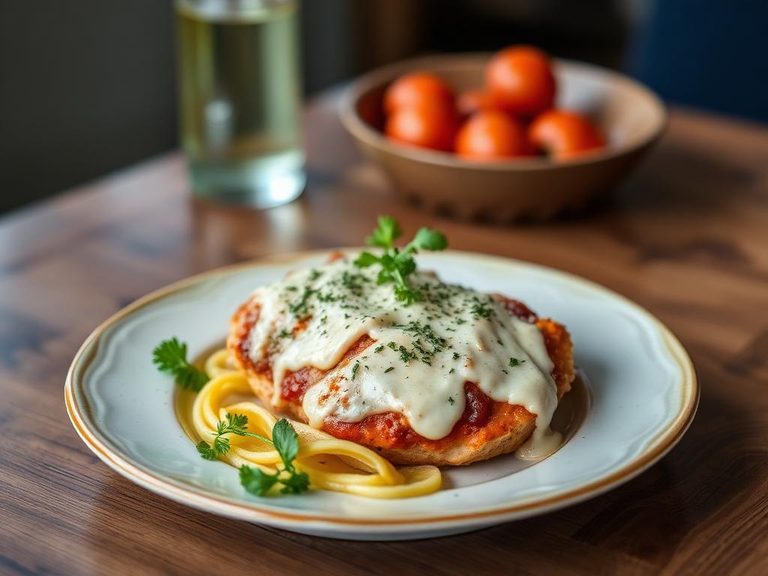
These are boneless, skinless chicken thighs coated in a seasoned breadcrumb or batter mixture, frozen for convenience, and then reheated to a crispy, golden finish. The meat inside remains juicy and flavorful, while the exterior offers a satisfying crunch. Nutritionally, they are a solid source of protein but come with a notable fat content from the thigh meat and the frying oil absorbed during cooking.
Calorie split: 22% protein · 17% carbs · 61% fat
↓ Full nutrition💚 Why it's loved
People love them for the perfect marriage of crispy coating and succulent, tender chicken, offering a comforting and savory bite. Their pre-breaded nature makes them a reliable and quick solution for a hearty weeknight dinner or snack.
⚠️ Watch-outs & how to enjoy it better
The reheating process can sometimes lead to a soggy crust if not done properly, and the breading adds extra refined carbohydrates and sodium. Those monitoring fat intake or blood sugar should be mindful of portions. To counteract, reheat in an air fryer or oven (not microwave) to restore crispness, and pair with a large, non-starchy vegetable salad to boost fiber and balance the meal.
Key benefits
- High-quality protein for muscle maintenance
- Convenient, quick-prep meal component
- Juicier and more flavorful than breast meat
- Good source of iron and zinc from dark meat
- Versatile base for many global cuisines
🍽️ Popular dishes




🌍 Where it's eaten
💡 Did you know?
The practice of breading and frying chicken is believed to have been popularized in the United States by German and Scottish immigrants in the 18th and 19th centuries.
Full nutrition (USDA data · scales with serving)
| Water | 41.6 g |
| Energy | 334 kcal |
| Energy | 1396 kj |
| Protein | 18.7 g |
| Total lipid (fat) | 22.4 g |
| Ash | 3.0 g |
| Carbohydrate, by difference | 14.2 g |
| Fiber, total dietary | 0.10 g |
| Total Sugars | 0.00 g |
| Sucrose | 0.00 g |
| Glucose | 0.00 g |
| Fructose | 0.00 g |
| Lactose | 0.00 g |
| Maltose | 0.00 g |
| Galactose | 0.00 g |
| Calcium, Ca | 75.0 mg |
| Iron, Fe | 1.3 mg |
| Magnesium, Mg | 31.0 mg |
| Phosphorus, P | 190 mg |
| Potassium, K | 279 mg |
| Sodium, Na | 813 mg |
| Zinc, Zn | 1.4 mg |
| Copper, Cu | 0.12 mg |
| Manganese, Mn | 0.29 mg |
| Selenium, Se | 25.7 ug |
| Thiamin | 0.15 mg |
| Riboflavin | 0.29 mg |
| Niacin | 4.3 mg |
| Pantothenic acid | 1.1 mg |
| Vitamin B-6 | 0.14 mg |
| Folate, total | 20.0 ug |
| Vitamin B-12 | 0.54 ug |
| Vitamin A, RAE | 37.0 ug |
| Retinol | 37.0 ug |
| Vitamin A, IU | 125 iu |
| Vitamin E (alpha-tocopherol) | 1.2 mg |
| Tocopherol, beta | 0.09 mg |
| Tocopherol, gamma | 4.2 mg |
| Tocopherol, delta | 1.6 mg |
| Tocotrienol, alpha | 0.02 mg |
| Tocotrienol, beta | 0.19 mg |
| Tocotrienol, gamma | 0.00 mg |
| Tocotrienol, delta | 0.00 mg |
Fat & fatty acid profile (per 100g)
| Fatty acids, total saturated | 5.2 g |
| SFA 4:0 | 0.00 g |
| SFA 6:0 | 0.00 g |
| SFA 8:0 | 0.00 g |
| SFA 10:0 | 0.01 g |
| SFA 12:0 | 0.01 g |
| SFA 14:0 | 0.07 g |
| SFA 15:0 | 0.01 g |
| SFA 16:0 | 3.7 g |
| SFA 17:0 | 0.02 g |
| SFA 18:0 | 1.3 g |
| SFA 20:0 | 0.06 g |
| SFA 22:0 | 0.05 g |
| SFA 24:0 | 0.02 g |
| Fatty acids, total monounsaturated | 10.1 g |
| MUFA 14:1 | 0.02 g |
| MUFA 15:1 | 0.00 g |
| MUFA 16:1 | 0.75 g |
| MUFA 16:1 c | 0.75 g |
| MUFA 17:1 | 0.01 g |
| MUFA 18:1 | 9.2 g |
| MUFA 18:1 c | 8.2 g |
| MUFA 20:1 | 0.11 g |
| MUFA 22:1 | 0.00 g |
| MUFA 22:1 c | 0.00 g |
| MUFA 24:1 c | 0.01 g |
| Fatty acids, total polyunsaturated | 4.8 g |
| PUFA 18:2 | 4.4 g |
| PUFA 18:2 n-6 c,c | 4.1 g |
| PUFA 18:2 CLAs | 0.03 g |
| PUFA 18:3 | 0.24 g |
| PUFA 18:3 n-3 c,c,c (ALA) | 0.23 g |
| PUFA 18:3 n-6 c,c,c | 0.01 g |
| PUFA 18:3i | 0.00 g |
| PUFA 18:4 | 0.00 g |
| PUFA 20:2 n-6 c,c | 0.01 g |
| PUFA 20:3 | 0.03 g |
| PUFA 20:3 n-3 | 0.00 g |
| PUFA 20:3 n-6 | 0.03 g |
| PUFA 20:4 | 0.08 g |
| PUFA 20:5 n-3 (EPA) | 0.00 g |
| PUFA 22:4 | 0.02 g |
| PUFA 22:5 n-3 (DPA) | 0.01 g |
| PUFA 22:6 n-3 (DHA) | 0.00 g |
| Fatty acids, total trans | 1.3 g |
| Fatty acids, total trans-monoenoic | 1.0 g |
| TFA 16:1 t | 0.00 g |
| TFA 18:1 t | 1.0 g |
| TFA 22:1 t | 0.00 g |
| TFA 18:2 t not further defined | 0.25 g |
| Fatty acids, total trans-polyenoic | 0.25 g |
| Cholesterol | 87.0 mg |
Amino acid profile (per 100g)
Estimated from Taquitos, frozen, chicken and cheese, oven-heated — USDA does not publish this profile for Chicken.
| Tryptophan | 0.10 g |
| Threonine | 0.27 g |
| Isoleucine | 0.36 g |
| Leucine | 0.72 g |
| Lysine | 0.47 g |
| Methionine | 0.19 g |
| Cystine | 0.20 g |
| Phenylalanine | 0.42 g |
| Tyrosine | 0.25 g |
| Valine | 0.43 g |
| Arginine | 0.48 g |
| Histidine | 0.25 g |
| Alanine | 0.37 g |
| Aspartic acid | 0.63 g |
| Glutamic acid | 2.5 g |
| Glycine | 0.41 g |
| Proline | 1.1 g |
| Serine | 0.47 g |
| Hydroxyproline | 0.00 g |
FAQ
What's the best way to reheat frozen breaded chicken thighs?
For the crispiest texture, use an air fryer at 375°F (190°C) for 10-15 minutes or bake on a wire rack in a 400°F (200°C) oven for 20-25 minutes, flipping halfway. Avoid the microwave, which will make the coating tough and chewy.
Are frozen breaded chicken thighs healthier than fried chicken from a restaurant?
They can be, as they often contain less total fat and sodium per serving than deep-fried restaurant chicken. However, they are still a processed food. Check labels for brands with shorter ingredient lists and lower sodium content.
Can I use these in recipes that call for raw chicken?
No, they are fully cooked and only require reheating. Using them in recipes meant for raw chicken (like curries or stews) will result in an overcooked, tough texture and a mushy, disintegrating breading.
Nutrient density (calculated · NRF9.3)
Nutrient Rich Foods index: beneficial nutrients (protein, fiber, vitamins, minerals) minus saturated fat, added sugar & sodium, per 100 kcal.
NRF9.3 index — Fulgoni, Keast & Drewnowski, 2009. Computed from USDA nutrients.
Weight-loss friendliness (composite index)
Energy density 3.34 kcal/g · 22% calories from protein · 0.1 g fiber · 0.0 g sugar per 100 g.
Composite of energy density (Rolls et al., 1999), protein & fiber satiety, minus sugar. A calculated heuristic — ranks satiety-per-calorie, not a clinical measure.
Dietary load (calculated from USDA values)
Potential renal acid load. Positive = acid-forming, negative = alkaline-forming.
Sodium-to-potassium ratio: 2.91 (lower is better — aim for ≤ 1)
Sodium:potassium per WHO potassium guidance. Computed from USDA nutrients.