

Beef, rib eye roast, boneless, lip-on, separable lean only, trimmed to 1/8" fat, choice, cooked, roasted
Whole food · Beef Products

Photo: Wikipedia
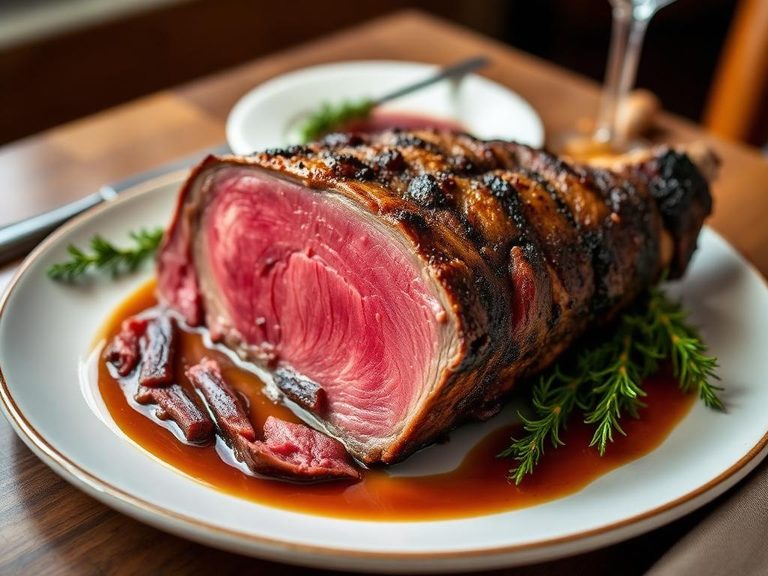
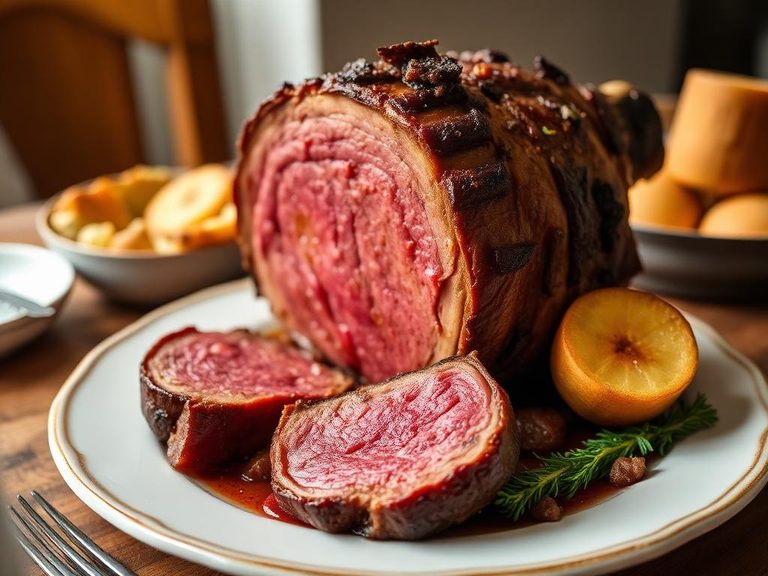
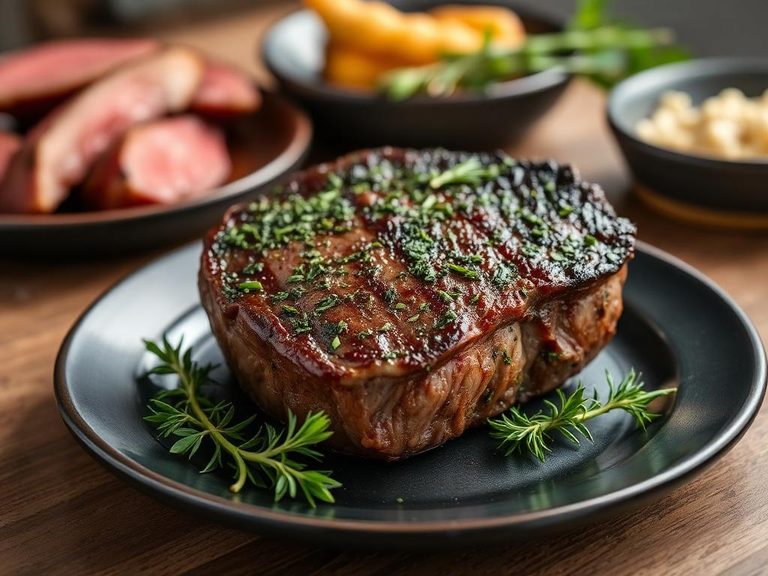
A premium, boneless rib eye roast with a thin fat cap, this cut delivers a rich, buttery beef flavor and a tender, juicy texture when roasted to perfection. With 27.87g of protein and 13.01g of fat per 100g, it provides substantial energy and essential nutrients without any carbohydrates. The lip-on fat adds a layer of succulence that bastes the meat during cooking, enhancing its natural umami depth.
Calorie split: 49% protein · 0% carbs · 51% fat
↓ Full nutrition💚 Why it's loved
People adore this cut for its luxurious marbling and robust, beefy taste that stands up to simple seasoning like salt, pepper, and rosemary. Its versatility shines in everything from holiday roasts to everyday steaks, embodying a classic comfort food that brings families together.
⚠️ Watch-outs & how to enjoy it better
The high saturated fat content (about 5.6g per 100g) may concern those managing cholesterol levels, and it can be calorie-dense if overconsumed. To mitigate, pair it with fiber-rich vegetables like roasted Brussels sprouts or a side salad, practice portion control (aim for 100-150g per serving), and trim any excess fat before cooking.
Key benefits
- High-quality complete protein for muscle maintenance and repair
- Rich in iron and zinc, supporting immune function and energy metabolism
- Contains B vitamins, especially B12, crucial for nerve health
- Provides conjugated linoleic acid (CLA) from the fat, linked to metabolic benefits
- Naturally carb-free, making it suitable for low-carb and ketogenic diets
🍽️ Popular dishes
🌍 Where it's eaten
💡 Did you know?
The rib eye comes from the rib section (ribs 6-12) of the cow, and the 'lip-on' refers to the fat cap from the rib's outer edge, which is prized for its flavor but often trimmed for leaner preparations.
Full nutrition (USDA data · scales with serving)
| Water | 58.3 g |
| Energy | 229 kcal |
| Energy | 956 kj |
| Protein | 27.9 g |
| Total lipid (fat) | 13.0 g |
| Ash | 1.0 g |
| Carbohydrate, by difference | 0.00 g |
| Fiber, total dietary | 0.00 g |
| Total Sugars | 0.00 g |
| Calcium, Ca | 8.0 mg |
| Iron, Fe | 2.2 mg |
| Magnesium, Mg | 24.0 mg |
| Phosphorus, P | 175 mg |
| Potassium, K | 319 mg |
| Sodium, Na | 54.0 mg |
| Zinc, Zn | 7.1 mg |
| Copper, Cu | 0.09 mg |
| Manganese, Mn | 0.09 mg |
| Selenium, Se | 34.8 ug |
| Vitamin C, total ascorbic acid | 0.00 mg |
| Thiamin | 0.10 mg |
| Riboflavin | 0.28 mg |
| Niacin | 5.7 mg |
| Pantothenic acid | 0.66 mg |
| Vitamin B-6 | 0.53 mg |
| Folate, total | 7.0 ug |
| Folic acid | 0.00 ug |
| Folate, food | 7.0 ug |
| Folate, DFE | 7.0 ug |
| Choline, total | 56.5 mg |
| Betaine | 14.1 mg |
| Vitamin B-12 | 2.4 ug |
| Vitamin B-12, added | 0.00 ug |
| Vitamin A, RAE | 2.0 ug |
| Retinol | 2.0 ug |
| Carotene, beta | 0.00 ug |
| Carotene, alpha | 0.00 ug |
| Cryptoxanthin, beta | 0.00 ug |
| Vitamin A, IU | 5.0 iu |
| Lycopene | 0.00 ug |
| Lutein + zeaxanthin | 0.00 ug |
| Vitamin E (alpha-tocopherol) | 0.12 mg |
| Vitamin E, added | 0.00 mg |
| Vitamin D (D2 + D3), International Units | 5.0 iu |
| Vitamin D (D2 + D3) | 0.10 ug |
| Vitamin D3 (cholecalciferol) | 0.10 ug |
| Vitamin K (phylloquinone) | 1.6 ug |
| Alcohol, ethyl | 0.00 g |
| Caffeine | 0.00 mg |
| Theobromine | 0.00 mg |
Fat & fatty acid profile (per 100g)
| Fatty acids, total saturated | 5.2 g |
| SFA 4:0 | 0.00 g |
| SFA 6:0 | 0.00 g |
| SFA 8:0 | 0.00 g |
| SFA 10:0 | 0.01 g |
| SFA 12:0 | 0.01 g |
| SFA 14:0 | 0.31 g |
| SFA 15:0 | 0.07 g |
| SFA 16:0 | 2.9 g |
| SFA 17:0 | 0.17 g |
| SFA 18:0 | 1.8 g |
| SFA 20:0 | 0.00 g |
| SFA 24:0 | 0.02 g |
| Fatty acids, total monounsaturated | 6.1 g |
| MUFA 14:1 | 0.07 g |
| MUFA 15:1 | 0.05 g |
| MUFA 16:1 | 0.39 g |
| MUFA 16:1 c | 0.39 g |
| MUFA 17:1 | 0.12 g |
| MUFA 18:1 | 5.4 g |
| MUFA 18:1 c | 4.8 g |
| MUFA 20:1 | 0.01 g |
| MUFA 22:1 | 0.00 g |
| Fatty acids, total polyunsaturated | 0.78 g |
| PUFA 18:2 | 0.61 g |
| PUFA 18:2 n-6 c,c | 0.56 g |
| PUFA 18:2 CLAs | 0.05 g |
| PUFA 18:3 | 0.02 g |
| PUFA 18:3 n-3 c,c,c (ALA) | 0.02 g |
| PUFA 18:4 | 0.00 g |
| PUFA 20:2 n-6 c,c | 0.00 g |
| PUFA 20:3 | 0.02 g |
| PUFA 20:3 n-6 | 0.02 g |
| PUFA 20:4 | 0.10 g |
| PUFA 20:5 n-3 (EPA) | 0.01 g |
| PUFA 22:5 n-3 (DPA) | 0.01 g |
| PUFA 22:6 n-3 (DHA) | 0.00 g |
| Fatty acids, total trans | 0.67 g |
| Fatty acids, total trans-monoenoic | 0.66 g |
| TFA 16:1 t | 0.01 g |
| TFA 18:1 t | 0.65 g |
| TFA 18:2 t not further defined | 0.01 g |
| Fatty acids, total trans-polyenoic | 0.01 g |
| Cholesterol | 81.0 mg |
Amino acid profile (per 100g)
| Tryptophan | 0.33 g |
| Threonine | 1.4 g |
| Isoleucine | 1.4 g |
| Leucine | 2.5 g |
| Lysine | 2.8 g |
| Methionine | 0.77 g |
| Cystine | 0.29 g |
| Phenylalanine | 1.2 g |
| Tyrosine | 1.1 g |
| Valine | 1.4 g |
| Arginine | 1.9 g |
| Histidine | 1.1 g |
| Alanine | 1.7 g |
| Aspartic acid | 2.8 g |
| Glutamic acid | 4.8 g |
| Glycine | 1.3 g |
| Proline | 1.2 g |
| Serine | 1.2 g |
| Hydroxyproline | 0.14 g |
FAQ
How should I cook a boneless rib eye roast for best results?
For optimal tenderness, roast at 325°F (163°C) until internal temperature reaches 130-135°F (54-57°C) for medium-rare, then rest for 15-20 minutes before slicing against the grain.
Is this cut suitable for grilling?
Yes, it can be grilled as steaks or sliced for kebabs, but the boneless roast is better suited for oven roasting to evenly render the fat and develop a crust.
What's the difference between choice and prime grade for this cut?
Choice grade has moderate marbling, offering good flavor and tenderness at a lower cost, while prime grade has more fat marbling, resulting in juicier, more luxurious results but at a higher price.
Nutrient density (calculated · NRF9.3)
Nutrient Rich Foods index: beneficial nutrients (protein, fiber, vitamins, minerals) minus saturated fat, added sugar & sodium, per 100 kcal.
NRF9.3 index — Fulgoni, Keast & Drewnowski, 2009. Computed from USDA nutrients.
Weight-loss friendliness (composite index)
Energy density 2.29 kcal/g · 49% calories from protein · 0.0 g fiber · 0.0 g sugar per 100 g.
Composite of energy density (Rolls et al., 1999), protein & fiber satiety, minus sugar. A calculated heuristic — ranks satiety-per-calorie, not a clinical measure.
Dietary load (calculated from USDA values)
Potential renal acid load. Positive = acid-forming, negative = alkaline-forming.
Sodium-to-potassium ratio: 0.17 (lower is better — aim for ≤ 1)
Sodium:potassium per WHO potassium guidance. Computed from USDA nutrients.