

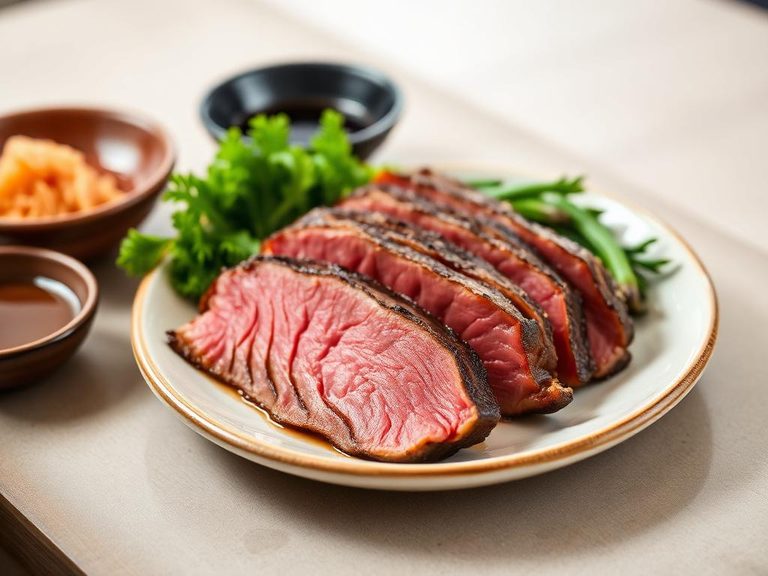
Beef, rib eye roast, bone-in, lip-on, separable lean only, trimmed to 1/8" fat, choice, cooked, roasted
Whole food · Beef Products

Photo: Wikipedia
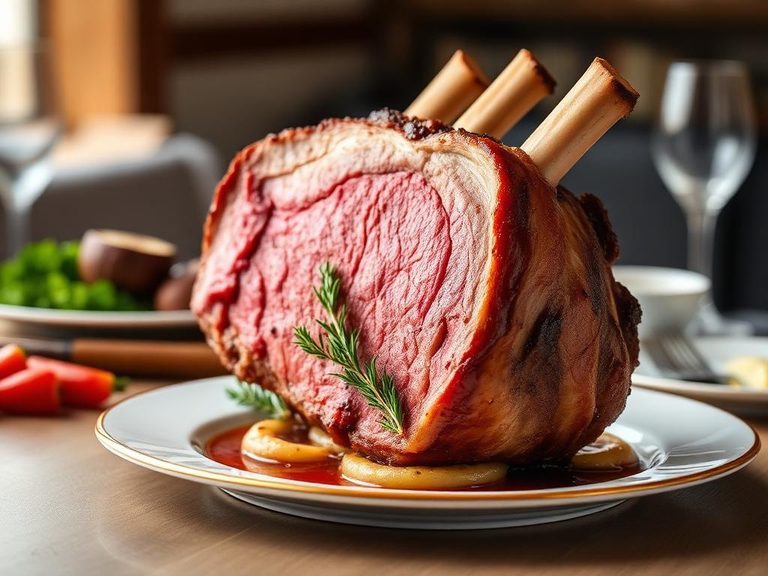
This is a premium, bone-in ribeye roast, meticulously trimmed to a thin 1/8-inch fat cap and roasted to a juicy, beefy perfection. The meat is exceptionally marbled, yielding a rich, buttery flavor and a tender, succulent texture that practically melts on the tongue. As a pure protein source with zero carbs, it's a powerhouse for muscle maintenance and a cornerstone of low-carb and ketogenic diets.
Calorie split: 45% protein · 0% carbs · 55% fat
↓ Full nutrition💚 Why it's loved
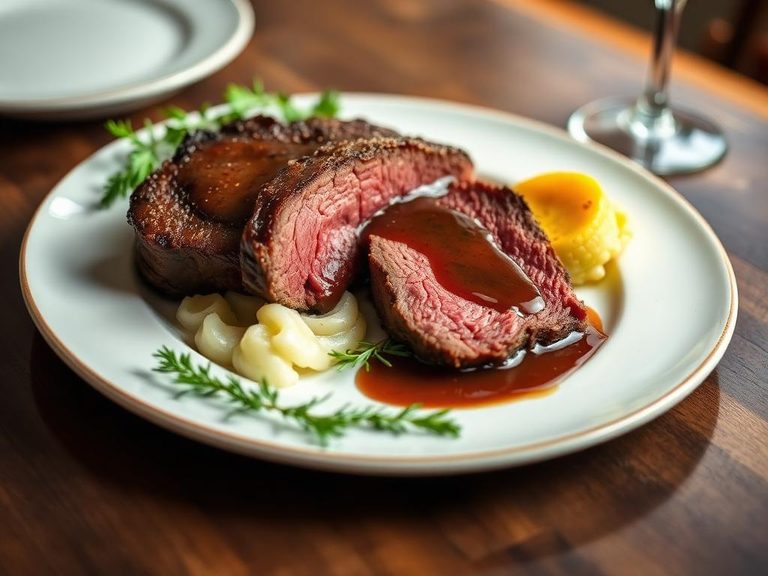
People adore the ribeye for its unparalleled marbling, which creates a deep, savory umami flavor and a luxuriously juicy bite. It's the celebratory centerpiece of holiday feasts and steakhouse dinners, prized for its ability to be both a show-stopping roast and a versatile cut for slicing into steaks.
⚠️ Watch-outs & how to enjoy it better
The high saturated fat content (about 6g per 100g) means it should be enjoyed in moderation, especially for those monitoring heart health or cholesterol levels. To counteract this, practice strict portion control (see portions below) and balance your plate with large servings of fiber-rich, non-starchy vegetables like roasted broccoli or a leafy green salad to aid digestion and nutrient balance.
Key benefits
- Excellent source of high-quality, complete protein (27g per 100g).
- Rich in bioavailable heme iron, which is more easily absorbed than plant-based iron.
- Provides essential B vitamins, especially B12, crucial for nerve function and energy.
- Contains zinc, which supports immune system health and wound healing.
- Zero carbohydrates, making it ideal for blood sugar management and keto diets.
🍽️ Popular dishes
🌍 Where it's eaten
💡 Did you know?
The 'lip-on' specification refers to the small, flavorful layer of fat left attached to the outer edge of the roast, which bastes the meat from the outside as it cooks, adding extra flavor and moisture.
Full nutrition (USDA data · scales with serving)
| Water | 57.6 g |
| Energy | 240 kcal |
| Energy | 1003 kj |
| Protein | 27.2 g |
| Total lipid (fat) | 14.6 g |
| Ash | 1.0 g |
| Carbohydrate, by difference | 0.00 g |
| Fiber, total dietary | 0.00 g |
| Total Sugars | 0.00 g |
| Calcium, Ca | 11.0 mg |
| Iron, Fe | 2.4 mg |
| Magnesium, Mg | 24.0 mg |
| Phosphorus, P | 174 mg |
| Potassium, K | 296 mg |
| Sodium, Na | 68.0 mg |
| Zinc, Zn | 6.1 mg |
| Copper, Cu | 0.09 mg |
| Manganese, Mn | 0.09 mg |
| Selenium, Se | 28.5 ug |
| Vitamin C, total ascorbic acid | 0.00 mg |
| Thiamin | 0.11 mg |
| Riboflavin | 0.33 mg |
| Niacin | 5.5 mg |
| Pantothenic acid | 0.68 mg |
| Vitamin B-6 | 0.52 mg |
| Folate, total | 7.0 ug |
| Folic acid | 0.00 ug |
| Folate, food | 7.0 ug |
| Folate, DFE | 7.0 ug |
| Choline, total | 55.7 mg |
| Betaine | 16.2 mg |
| Vitamin B-12 | 2.2 ug |
| Vitamin B-12, added | 0.00 ug |
| Vitamin A, RAE | 2.0 ug |
| Retinol | 2.0 ug |
| Carotene, beta | 0.00 ug |
| Carotene, alpha | 0.00 ug |
| Cryptoxanthin, beta | 0.00 ug |
| Vitamin A, IU | 5.0 iu |
| Lycopene | 0.00 ug |
| Lutein + zeaxanthin | 0.00 ug |
| Vitamin E (alpha-tocopherol) | 0.12 mg |
| Vitamin E, added | 0.00 mg |
| Vitamin D (D2 + D3), International Units | 4.0 iu |
| Vitamin D (D2 + D3) | 0.10 ug |
| Vitamin D3 (cholecalciferol) | 0.10 ug |
| Vitamin K (phylloquinone) | 1.6 ug |
| Alcohol, ethyl | 0.00 g |
| Caffeine | 0.00 mg |
| Theobromine | 0.00 mg |
Fat & fatty acid profile (per 100g)
| Fatty acids, total saturated | 5.6 g |
| SFA 4:0 | 0.00 g |
| SFA 6:0 | 0.00 g |
| SFA 8:0 | 0.00 g |
| SFA 10:0 | 0.01 g |
| SFA 12:0 | 0.01 g |
| SFA 14:0 | 0.36 g |
| SFA 15:0 | 0.08 g |
| SFA 16:0 | 3.1 g |
| SFA 17:0 | 0.18 g |
| SFA 18:0 | 1.8 g |
| SFA 20:0 | 0.01 g |
| SFA 24:0 | 0.01 g |
| Fatty acids, total monounsaturated | 6.6 g |
| MUFA 14:1 | 0.08 g |
| MUFA 15:1 | 0.05 g |
| MUFA 16:1 | 0.44 g |
| MUFA 16:1 c | 0.44 g |
| MUFA 17:1 | 0.13 g |
| MUFA 18:1 | 5.9 g |
| MUFA 18:1 c | 5.2 g |
| MUFA 20:1 | 0.03 g |
| MUFA 22:1 | 0.00 g |
| Fatty acids, total polyunsaturated | 0.66 g |
| PUFA 18:2 | 0.54 g |
| PUFA 18:2 n-6 c,c | 0.48 g |
| PUFA 18:2 CLAs | 0.05 g |
| PUFA 18:3 | 0.02 g |
| PUFA 18:3 n-3 c,c,c (ALA) | 0.02 g |
| PUFA 18:4 | 0.00 g |
| PUFA 20:2 n-6 c,c | 0.00 g |
| PUFA 20:3 | 0.02 g |
| PUFA 20:3 n-6 | 0.02 g |
| PUFA 20:4 | 0.06 g |
| PUFA 20:5 n-3 (EPA) | 0.00 g |
| PUFA 22:5 n-3 (DPA) | 0.01 g |
| PUFA 22:6 n-3 (DHA) | 0.00 g |
| Fatty acids, total trans | 0.67 g |
| Fatty acids, total trans-monoenoic | 0.66 g |
| TFA 16:1 t | 0.01 g |
| TFA 18:1 t | 0.65 g |
| TFA 18:2 t not further defined | 0.01 g |
| Fatty acids, total trans-polyenoic | 0.01 g |
| Cholesterol | 83.0 mg |
Amino acid profile (per 100g)
| Tryptophan | 0.32 g |
| Threonine | 1.3 g |
| Isoleucine | 1.3 g |
| Leucine | 2.4 g |
| Lysine | 2.7 g |
| Methionine | 0.75 g |
| Cystine | 0.28 g |
| Phenylalanine | 1.1 g |
| Tyrosine | 1.1 g |
| Valine | 1.4 g |
| Arginine | 1.9 g |
| Histidine | 1.0 g |
| Alanine | 1.7 g |
| Aspartic acid | 2.7 g |
| Glutamic acid | 4.6 g |
| Glycine | 1.2 g |
| Proline | 1.2 g |
| Serine | 1.1 g |
| Hydroxyproline | 0.14 g |
FAQ
What does 'choice' mean in the beef grading?
'Choice' is a USDA quality grade indicating good marbling and tenderness, just below the top 'Prime' grade. It offers excellent flavor and value for roasting.
Why is it 'separable lean only'?
This means the nutritional data accounts for the meat after the large, visible bones and external fat cap are removed. The actual edible portion you consume is leaner than the whole roast.
How should I cook it for the best results?
For a roast, sear it first in a hot pan to develop a crust, then roast at a lower temperature (around 325°F/165°C) until your desired doneness. Let it rest for 15-20 minutes before slicing to allow the juices to redistribute.
Nutrient density (calculated · NRF9.3)
Nutrient Rich Foods index: beneficial nutrients (protein, fiber, vitamins, minerals) minus saturated fat, added sugar & sodium, per 100 kcal.
NRF9.3 index — Fulgoni, Keast & Drewnowski, 2009. Computed from USDA nutrients.
Weight-loss friendliness (composite index)
Energy density 2.40 kcal/g · 45% calories from protein · 0.0 g fiber · 0.0 g sugar per 100 g.
Composite of energy density (Rolls et al., 1999), protein & fiber satiety, minus sugar. A calculated heuristic — ranks satiety-per-calorie, not a clinical measure.
Dietary load (calculated from USDA values)
Potential renal acid load. Positive = acid-forming, negative = alkaline-forming.
Sodium-to-potassium ratio: 0.23 (lower is better — aim for ≤ 1)
Sodium:potassium per WHO potassium guidance. Computed from USDA nutrients.