Babyfood, cereal, oatmeal, dry fortified
Whole food · Baby Foods

Photo: Wikipedia
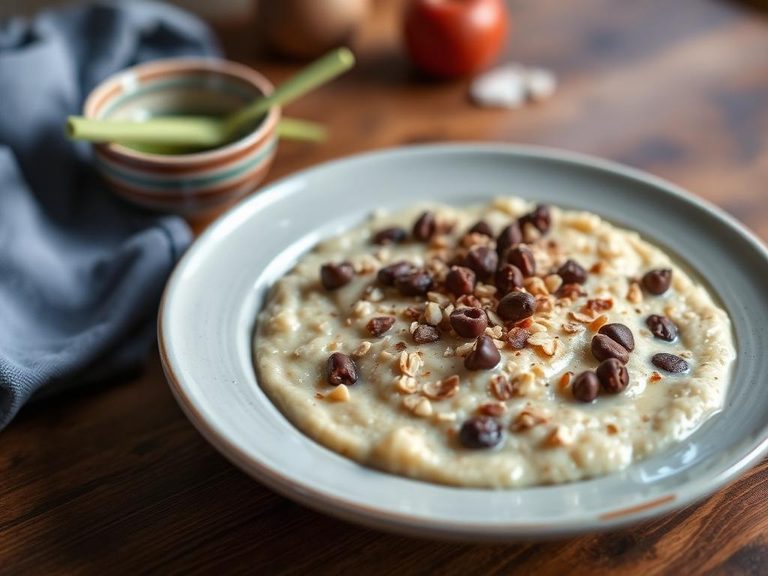
This is a finely milled, dehydrated oat cereal powder, designed for infants but also used by adults as a quick-cooking base. It has a mild, slightly nutty, and earthy oat flavor with a smooth, non-gritty texture when prepared with liquid. Nutritionally, it's a concentrated source of complex carbohydrates and is often fortified with iron and other vitamins for developmental support.
💚 Why it's loved
People appreciate its incredible versatility as a blank canvas for sweet or savory flavors, and its comforting, familiar taste that evokes a sense of simple, wholesome nourishment. It's a beloved staple for its convenience, requiring only hot water or milk for a ready meal in minutes.
⚠️ Watch-outs & how to enjoy it better
As a refined carbohydrate, it can cause a rapid blood-sugar spike if eaten alone, which is a concern for diabetics or those managing energy levels. To counteract this, always pair it with a source of protein (like nut butter or yogurt) and healthy fat (like seeds or avocado) to slow digestion. The dry powder can also be a choking hazard for very young children if not properly mixed.
Key benefits
- Excellent source of soluble fiber (beta-glucan) for digestive health.
- Fortified with essential nutrients like iron, zinc, and B vitamins.
- Provides sustained energy from complex carbohydrates.
- High in plant-based protein for a grain product.
- Gluten-free if made from certified oats, suitable for many dietary needs.
🍽️ Popular dishes
🌍 Where it's eaten
💡 Did you know?
The process of making this cereal involves gelatinizing the starch through extrusion cooking, which makes the oats more digestible for immature digestive systems and allows the powder to dissolve smoothly without cooking.
Full nutrition (scales with serving)
| Water | 4.6 g |
| Energy | 394 kcal |
| Energy | 1649 kj |
| Protein | 11.0 g |
| Total lipid (fat) | 6.4 g |
| Ash | 4.6 g |
| Carbohydrate, by difference | 73.5 g |
| Fiber, total dietary | 7.3 g |
| Total Sugars | 11.7 g |
| Sucrose | 0.99 g |
| Glucose | 6.5 g |
| Fructose | 0.15 g |
| Lactose | 0.00 g |
| Maltose | 4.0 g |
| Galactose | 0.00 g |
| Starch | 42.7 g |
| Calcium, Ca | 1160 mg |
| Iron, Fe | 64.1 mg |
| Magnesium, Mg | 110 mg |
| Phosphorus, P | 506 mg |
| Potassium, K | 549 mg |
| Sodium, Na | 21.0 mg |
| Zinc, Zn | 12.7 mg |
| Copper, Cu | 0.42 mg |
| Manganese, Mn | 3.9 mg |
| Selenium, Se | 23.4 ug |
| Vitamin C, total ascorbic acid | 0.00 mg |
| Thiamin | 1.4 mg |
| Riboflavin | 1.6 mg |
| Niacin | 21.3 mg |
| Pantothenic acid | 1.9 mg |
| Vitamin B-6 | 0.85 mg |
| Folate, total | 247 ug |
| Folic acid | 212 ug |
| Folate, food | 35.0 ug |
| Folate, DFE | 396 ug |
| Choline, total | 27.0 mg |
| Betaine | 21.4 mg |
| Vitamin B-12 | 4.6 ug |
| Vitamin B-12, added | 4.6 ug |
| Vitamin A, RAE | 0.00 ug |
| Retinol | 0.00 ug |
| Carotene, beta | 0.00 ug |
| Carotene, alpha | 0.00 ug |
| Cryptoxanthin, beta | 0.00 ug |
| Vitamin A, IU | 16.0 iu |
| Lycopene | 0.00 ug |
| Lutein + zeaxanthin | 185 ug |
| Vitamin E (alpha-tocopherol) | 12.2 mg |
| Vitamin E, added | 11.8 mg |
| Tocopherol, beta | 0.00 mg |
| Tocopherol, gamma | 0.00 mg |
| Tocopherol, delta | 0.00 mg |
| Tocotrienol, alpha | 1.4 mg |
| Tocotrienol, beta | 0.00 mg |
| Tocotrienol, gamma | 0.00 mg |
| Tocotrienol, delta | 0.00 mg |
| Vitamin D (D2 + D3), International Units | 510 iu |
| Vitamin D (D2 + D3) | 12.7 ug |
| Vitamin D2 (ergocalciferol) | 0.00 ug |
| Vitamin D3 (cholecalciferol) | 12.7 ug |
| Vitamin K (phylloquinone) | 1.4 ug |
| Vitamin K (Dihydrophylloquinone) | 0.00 ug |
| Vitamin K (Menaquinone-4) | 0.00 ug |
| Alcohol, ethyl | 0.00 g |
| Caffeine | 0.00 mg |
| Theobromine | 0.00 mg |
Fat & fatty acid profile (per 100g)
| Fatty acids, total saturated | 0.84 g |
| SFA 4:0 | 0.00 g |
| SFA 6:0 | 0.00 g |
| SFA 8:0 | 0.00 g |
| SFA 10:0 | 0.00 g |
| SFA 12:0 | 0.00 g |
| SFA 14:0 | 0.01 g |
| SFA 15:0 | 0.00 g |
| SFA 16:0 | 0.74 g |
| SFA 17:0 | 0.00 g |
| SFA 18:0 | 0.07 g |
| SFA 20:0 | 0.01 g |
| SFA 22:0 | 0.00 g |
| SFA 24:0 | 0.00 g |
| Fatty acids, total monounsaturated | 1.6 g |
| MUFA 14:1 | 0.00 g |
| MUFA 15:1 | 0.00 g |
| MUFA 16:1 | 0.01 g |
| MUFA 16:1 c | 0.01 g |
| MUFA 17:1 | 0.00 g |
| MUFA 18:1 | 1.5 g |
| MUFA 18:1 c | 1.5 g |
| MUFA 20:1 | 0.03 g |
| MUFA 22:1 | 0.00 g |
| MUFA 22:1 c | 0.00 g |
| MUFA 24:1 c | 0.00 g |
| Fatty acids, total polyunsaturated | 1.7 g |
| PUFA 18:2 | 1.7 g |
| PUFA 18:2 n-6 c,c | 1.7 g |
| PUFA 18:2 CLAs | 0.00 g |
| PUFA 18:3 | 0.06 g |
| PUFA 18:3 n-3 c,c,c (ALA) | 0.06 g |
| PUFA 18:3 n-6 c,c,c | 0.00 g |
| PUFA 18:3i | 0.00 g |
| PUFA 18:4 | 0.00 g |
| PUFA 20:2 n-6 c,c | 0.00 g |
| PUFA 20:3 | 0.00 g |
| PUFA 20:3 n-3 | 0.00 g |
| PUFA 20:3 n-6 | 0.00 g |
| PUFA 20:4 | 0.00 g |
| PUFA 20:5 n-3 (EPA) | 0.00 g |
| PUFA 21:5 | 0.00 g |
| PUFA 22:4 | 0.00 g |
| PUFA 22:5 n-3 (DPA) | 0.00 g |
| PUFA 22:6 n-3 (DHA) | 0.00 g |
| Fatty acids, total trans | 0.00 g |
| Fatty acids, total trans-monoenoic | 0.00 g |
| TFA 16:1 t | 0.00 g |
| TFA 18:1 t | 0.00 g |
| TFA 22:1 t | 0.00 g |
| TFA 18:2 t not further defined | 0.00 g |
| Fatty acids, total trans-polyenoic | 0.00 g |
| Cholesterol | 0.00 mg |
Amino acid profile (per 100g)
| Hydroxyproline | 0.00 g |
FAQ
Is this the same as regular oatmeal?
No. This is pre-cooked, finely ground, and fortified, designed to dissolve into a smooth paste with liquid. Regular rolled or steel-cut oats are whole groats that require cooking and have a chewier texture.
Can adults eat this?
Absolutely. It's used as a quick-cooking base for porridge, a thickener for sauces, or a nutrient boost in smoothies and baked goods, though it lacks the texture of whole oats.
Why is it fortified?
Fortification adds key nutrients like iron and zinc that are crucial for infant brain development and are not abundant in plain oats. It ensures a more complete nutritional profile for growing babies.