

Milk, chocolate, fluid, commercial, reduced fat, with added calcium
Whole food · Dairy and Egg Products
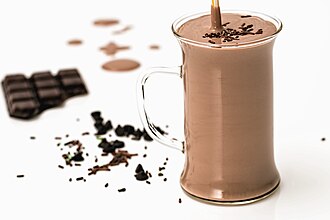
Photo: Wikipedia
This is a smooth, creamy, commercially prepared reduced-fat chocolate milk, fortified with extra calcium for a nutritional boost. It offers the classic sweet, cocoa-kissed flavor and velvety texture of chocolate milk, but with a lighter body due to its reduced fat content. Each 100g serving provides a modest 78 calories, making it a more guilt-free indulgence compared to full-fat versions.
Calorie split: 15% protein · 63% carbs · 22% fat
↓ Full nutrition💚 Why it's loved
People love it for its comforting, nostalgic taste that perfectly balances sweet chocolate with creamy milk, making it a beloved treat for all ages. It's incredibly versatile, enjoyed chilled on its own, as a post-workout recovery drink, or poured over cereal.
⚠️ Watch-outs & how to enjoy it better
The primary downside is its added sugar content (9.55g per 100g), which can contribute to blood sugar spikes, making it a less ideal choice for those monitoring their sugar intake. To counteract this, pair it with a source of protein or healthy fat (like nuts or a piece of cheese) to slow sugar absorption, and be mindful of portion sizes. As a dairy product, it contains lactose and milk proteins, which are common allergens.
Key benefits
- Good source of calcium for bone health
- Provides protein for muscle maintenance
- Lower in fat than regular chocolate milk
- Contains added calcium for enhanced nutrition
- Offers a convenient source of energy and hydration
🍽️ Popular dishes



🌍 Where it's eaten
💡 Did you know?
Chocolate milk is often officially recommended as an effective post-exercise recovery drink by sports nutritionists due to its near-ideal carbohydrate-to-protein ratio for replenishing glycogen and repairing muscle.
Full nutrition (USDA data · scales with serving)
| Water | 82.2 g |
| Energy | 78.0 kcal |
| Energy | 325 kj |
| Protein | 3.0 g |
| Total lipid (fat) | 1.9 g |
| Ash | 0.81 g |
| Carbohydrate, by difference | 12.1 g |
| Fiber, total dietary | 0.70 g |
| Total Sugars | 9.6 g |
| Sucrose | 4.8 g |
| Glucose | 0.53 g |
| Fructose | 0.41 g |
| Lactose | 3.8 g |
| Maltose | 0.00 g |
| Starch | 1.6 g |
| Calcium, Ca | 194 mg |
| Iron, Fe | 0.24 mg |
| Magnesium, Mg | 14.0 mg |
| Phosphorus, P | 76.0 mg |
| Potassium, K | 123 mg |
| Sodium, Na | 66.0 mg |
| Zinc, Zn | 0.39 mg |
| Copper, Cu | 0.07 mg |
| Manganese, Mn | 0.06 mg |
| Selenium, Se | 3.4 ug |
| Vitamin C, total ascorbic acid | 0.00 mg |
| Thiamin | 0.04 mg |
| Riboflavin | 0.56 mg |
| Niacin | 0.16 mg |
| Pantothenic acid | 0.54 mg |
| Vitamin B-6 | 0.02 mg |
| Folate, total | 2.0 ug |
| Folic acid | 0.00 ug |
| Folate, food | 2.0 ug |
| Folate, DFE | 2.0 ug |
| Vitamin B-12 | 0.33 ug |
| Vitamin B-12, added | 0.00 ug |
| Vitamin A, RAE | 64.0 ug |
| Retinol | 63.0 ug |
| Carotene, beta | 11.0 ug |
| Carotene, alpha | 0.00 ug |
| Cryptoxanthin, beta | 0.00 ug |
| Vitamin A, IU | 227 iu |
| Lycopene | 0.00 ug |
| Lutein + zeaxanthin | 0.00 ug |
| Vitamin E (alpha-tocopherol) | 0.04 mg |
| Vitamin E, added | 0.00 mg |
| Tocopherol, beta | 0.00 mg |
| Tocopherol, gamma | 0.02 mg |
| Tocopherol, delta | 0.00 mg |
| Tocotrienol, alpha | 0.03 mg |
| Tocotrienol, beta | 0.00 mg |
| Tocotrienol, gamma | 0.00 mg |
| Tocotrienol, delta | 0.00 mg |
| Vitamin K (phylloquinone) | 0.20 ug |
| Vitamin K (Dihydrophylloquinone) | 0.00 ug |
| Alcohol, ethyl | 0.00 g |
| Caffeine | 1.0 mg |
| Theobromine | 22.0 mg |
Fat & fatty acid profile (per 100g)
| Fatty acids, total saturated | 1.2 g |
| SFA 4:0 | 0.06 g |
| SFA 6:0 | 0.03 g |
| SFA 8:0 | 0.02 g |
| SFA 10:0 | 0.04 g |
| SFA 12:0 | 0.04 g |
| SFA 14:0 | 0.17 g |
| SFA 15:0 | 0.01 g |
| SFA 16:0 | 0.52 g |
| SFA 17:0 | 0.01 g |
| SFA 18:0 | 0.27 g |
| SFA 20:0 | 0.00 g |
| SFA 22:0 | 0.00 g |
| SFA 24:0 | 0.00 g |
| Fatty acids, total monounsaturated | 0.46 g |
| MUFA 14:1 | 0.01 g |
| MUFA 15:1 | 0.00 g |
| MUFA 16:1 | 0.02 g |
| MUFA 17:1 | 0.00 g |
| MUFA 18:1 | 0.43 g |
| MUFA 20:1 | 0.00 g |
| MUFA 22:1 | 0.00 g |
| Fatty acids, total polyunsaturated | 0.09 g |
| PUFA 18:2 | 0.08 g |
| PUFA 18:3 | 0.00 g |
| PUFA 18:3 n-3 c,c,c (ALA) | 0.00 g |
| PUFA 18:4 | 0.01 g |
| PUFA 20:2 n-6 c,c | 0.00 g |
| PUFA 20:3 | 0.00 g |
| PUFA 20:4 | 0.00 g |
| PUFA 20:5 n-3 (EPA) | 0.00 g |
| PUFA 22:5 n-3 (DPA) | 0.00 g |
| PUFA 22:6 n-3 (DHA) | 0.00 g |
| Cholesterol | 8.0 mg |
| Stigmasterol | 0.00 mg |
| Campesterol | 0.00 mg |
| Beta-sitosterol | 0.00 mg |
Amino acid profile (per 100g)
| Tryptophan | 0.04 g |
| Threonine | 0.14 g |
| Isoleucine | 0.14 g |
| Leucine | 0.28 g |
| Lysine | 0.23 g |
| Methionine | 0.07 g |
| Cystine | 0.03 g |
| Phenylalanine | 0.14 g |
| Tyrosine | 0.12 g |
| Valine | 0.18 g |
| Arginine | 0.10 g |
| Histidine | 0.08 g |
| Alanine | 0.10 g |
| Aspartic acid | 0.27 g |
| Glutamic acid | 0.65 g |
| Glycine | 0.06 g |
| Proline | 0.28 g |
| Serine | 0.17 g |
FAQ
Is reduced-fat chocolate milk healthier than regular chocolate milk?
It's lower in fat and calories, but often has a similar or even slightly higher sugar content to maintain flavor. It can be a better choice for those watching fat intake, but always check the label for sugar.
Can I use this as a workout recovery drink?
Yes, it's an excellent choice. The combination of carbohydrates and protein helps replenish energy stores and repair muscle tissue after moderate exercise.
How does the added calcium benefit me?
Added calcium increases the total calcium content beyond that of regular milk, supporting stronger bones and teeth, and is important for nerve and muscle function.
Nutrient density (calculated · NRF9.3)
Nutrient Rich Foods index: beneficial nutrients (protein, fiber, vitamins, minerals) minus saturated fat, added sugar & sodium, per 100 kcal.
NRF9.3 index — Fulgoni, Keast & Drewnowski, 2009. Computed from USDA nutrients.
Weight-loss friendliness (composite index)
Energy density 0.78 kcal/g · 15% calories from protein · 0.7 g fiber · 9.6 g sugar per 100 g.
Composite of energy density (Rolls et al., 1999), protein & fiber satiety, minus sugar. A calculated heuristic — ranks satiety-per-calorie, not a clinical measure.
Dietary load (calculated from USDA values)
Potential renal acid load. Positive = acid-forming, negative = alkaline-forming.
Sodium-to-potassium ratio: 0.54 (lower is better — aim for ≤ 1)
Sodium:potassium per WHO potassium guidance. Computed from USDA nutrients.