

Fast foods, coleslaw
Whole food · Fast Foods
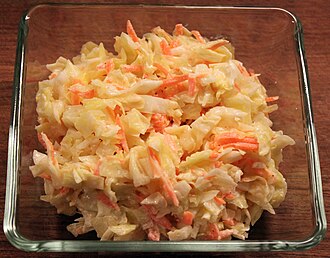
Photo: Wikipedia
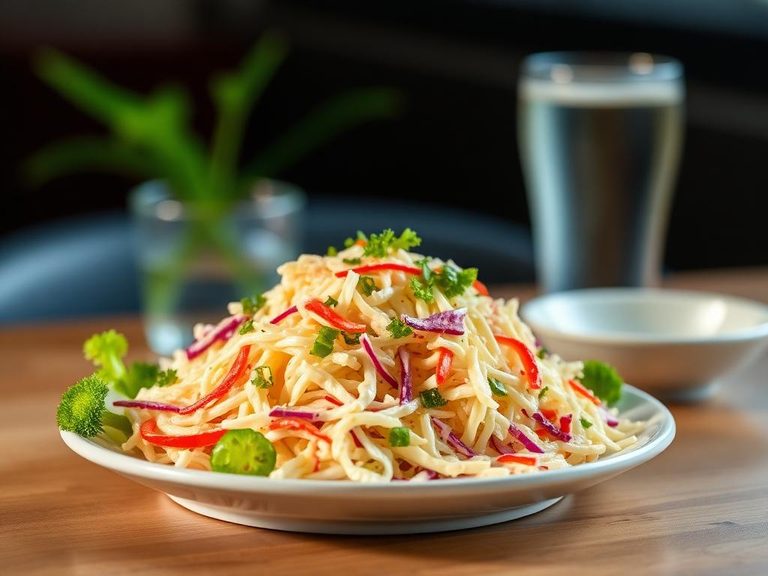
A crunchy, creamy salad of shredded cabbage and carrots bound in a tangy, mayonnaise-based dressing. It offers a refreshing contrast of textures—crisp vegetables against a smooth, rich sauce—with a flavor profile that balances sweetness, acidity, and savory notes. Nutritionally, it's a source of fiber and vitamin K from cabbage, but its calorie and fat content come primarily from the dressing.
Calorie split: 2% protein · 39% carbs · 58% fat
↓ Full nutrition💚 Why it's loved
People love coleslaw for its perfect balance of creamy and crunchy textures, and its ability to cut through the richness of fried or grilled foods. It's a versatile staple at barbecues, picnics, and as a sandwich topping, deeply embedded in American comfort food culture.
⚠️ Watch-outs & how to enjoy it better
The mayonnaise-based dressing is high in saturated fat and calories, which can contribute to weight gain if consumed in large portions. The added sugar can cause blood-sugar spikes, and store-bought versions are often high in sodium. To counteract this, opt for a vinegar-based slaw, practice portion control (a 1/2 cup serving), or pair it with a lean protein like grilled chicken to balance the meal.
Key benefits
- Provides dietary fiber from cabbage and carrots
- Good source of vitamin K for bone health
- Contains vitamin C from fresh vegetables
- Offers a crunchy texture that adds satisfaction to meals
- Can be a lower-carb side option compared to starchy sides
🍽️ Popular dishes

🌍 Where it's eaten
💡 Did you know?
The word 'coleslaw' comes from the Dutch term 'koolsla,' which literally means 'cabbage salad,' reflecting its 18th-century Dutch immigrant origins in America.
Full nutrition (USDA data · scales with serving)
| Water | 73.4 g |
| Energy | 153 kcal |
| Energy | 638 kj |
| Protein | 0.95 g |
| Total lipid (fat) | 9.9 g |
| Ash | 0.84 g |
| Carbohydrate, by difference | 14.9 g |
| Fiber, total dietary | 1.9 g |
| Total Sugars | 12.2 g |
| Sucrose | 9.0 g |
| Glucose | 1.7 g |
| Fructose | 1.4 g |
| Lactose | 0.00 g |
| Maltose | 0.00 g |
| Galactose | 0.09 g |
| Calcium, Ca | 30.0 mg |
| Iron, Fe | 0.22 mg |
| Magnesium, Mg | 8.0 mg |
| Phosphorus, P | 20.0 mg |
| Potassium, K | 129 mg |
| Sodium, Na | 203 mg |
| Zinc, Zn | 0.14 mg |
| Copper, Cu | 0.01 mg |
| Manganese, Mn | 0.10 mg |
| Vitamin C, total ascorbic acid | 14.6 mg |
| Thiamin | 0.03 mg |
| Riboflavin | 0.02 mg |
| Niacin | 0.21 mg |
| Pantothenic acid | 0.25 mg |
| Vitamin B-6 | 0.11 mg |
| Folic acid | 0.00 ug |
| Vitamin B-12 | 0.01 ug |
| Vitamin A, RAE | 28.0 ug |
| Retinol | 28.0 ug |
| Vitamin A, IU | 95.0 iu |
| Vitamin E (alpha-tocopherol) | 0.54 mg |
| Tocopherol, beta | 0.04 mg |
| Tocopherol, gamma | 4.8 mg |
| Tocopherol, delta | 1.6 mg |
| Tocotrienol, alpha | 0.00 mg |
| Tocotrienol, beta | 0.00 mg |
| Tocotrienol, gamma | 0.00 mg |
| Tocotrienol, delta | 0.00 mg |
| Vitamin K (phylloquinone) | 70.9 ug |
| Vitamin K (Dihydrophylloquinone) | 0.00 ug |
| Vitamin K (Menaquinone-4) | 0.00 ug |
Fat & fatty acid profile (per 100g)
| Fatty acids, total saturated | 1.6 g |
| SFA 4:0 | 0.00 g |
| SFA 6:0 | 0.01 g |
| SFA 8:0 | 0.00 g |
| SFA 10:0 | 0.01 g |
| SFA 12:0 | 0.00 g |
| SFA 14:0 | 0.01 g |
| SFA 15:0 | 0.00 g |
| SFA 16:0 | 1.0 g |
| SFA 17:0 | 0.02 g |
| SFA 18:0 | 0.44 g |
| SFA 20:0 | 0.03 g |
| SFA 22:0 | 0.03 g |
| SFA 24:0 | 0.02 g |
| Fatty acids, total monounsaturated | 2.7 g |
| MUFA 14:1 | 0.00 g |
| MUFA 15:1 | 0.00 g |
| MUFA 16:1 | 0.02 g |
| MUFA 16:1 c | 0.02 g |
| MUFA 17:1 | 0.01 g |
| MUFA 18:1 | 2.2 g |
| MUFA 18:1 c | 2.2 g |
| MUFA 20:1 | 0.40 g |
| MUFA 22:1 | 0.01 g |
| MUFA 22:1 c | 0.01 g |
| MUFA 24:1 c | 0.00 g |
| Fatty acids, total polyunsaturated | 5.3 g |
| PUFA 18:2 | 5.0 g |
| PUFA 18:2 n-6 c,c | 5.0 g |
| PUFA 18:2 CLAs | 0.01 g |
| PUFA 18:3 | 0.30 g |
| PUFA 18:3 n-3 c,c,c (ALA) | 0.28 g |
| PUFA 18:3 n-6 c,c,c | 0.02 g |
| PUFA 18:4 | 0.00 g |
| PUFA 20:2 n-6 c,c | 0.00 g |
| PUFA 20:3 | 0.01 g |
| PUFA 20:3 n-3 | 0.00 g |
| PUFA 20:3 n-6 | 0.01 g |
| PUFA 20:4 | 0.00 g |
| PUFA 20:5 n-3 (EPA) | 0.01 g |
| PUFA 22:4 | 0.00 g |
| PUFA 22:5 n-3 (DPA) | 0.00 g |
| PUFA 22:6 n-3 (DHA) | 0.00 g |
| Fatty acids, total trans | 0.04 g |
| Fatty acids, total trans-monoenoic | 0.01 g |
| TFA 16:1 t | 0.00 g |
| TFA 18:1 t | 0.01 g |
| TFA 22:1 t | 0.00 g |
| TFA 18:2 t not further defined | 0.03 g |
| Fatty acids, total trans-polyenoic | 0.03 g |
| Cholesterol | 4.0 mg |
Amino acid profile (per 100g)
Estimated from Fast foods, english muffin, with egg, cheese, and sausage — USDA does not publish this profile for Fast foods.
| Tryptophan | 0.16 g |
| Threonine | 0.52 g |
| Isoleucine | 0.54 g |
| Leucine | 0.98 g |
| Lysine | 0.75 g |
| Methionine | 0.29 g |
| Cystine | 0.20 g |
| Phenylalanine | 0.59 g |
| Tyrosine | 0.41 g |
| Valine | 0.65 g |
| Arginine | 0.65 g |
| Histidine | 0.33 g |
| Alanine | 0.60 g |
| Aspartic acid | 1.1 g |
| Glutamic acid | 2.5 g |
| Glycine | 0.54 g |
| Proline | 0.90 g |
| Serine | 0.70 g |
FAQ
Is coleslaw healthy?
It can be part of a healthy diet in moderation. The vegetables provide fiber and vitamins, but the traditional mayonnaise dressing is calorie-dense and high in fat. Choosing a lighter, vinegar-based dressing or making it at home with less mayo improves its nutritional profile.
How long does homemade coleslaw last?
When stored in an airtight container in the refrigerator, homemade coleslaw typically lasts for 3 to 5 days. The cabbage will soften over time, so it's best enjoyed fresh for optimal crunch.
Can coleslaw be made without mayonnaise?
Absolutely. Popular alternatives include vinegar-based dressings (using apple cider or white vinegar), yogurt-based dressings for a tangy and lighter option, or even a simple olive oil and lemon juice vinaigrette.
Nutrient density (calculated · NRF9.3)
Nutrient Rich Foods index: beneficial nutrients (protein, fiber, vitamins, minerals) minus saturated fat, added sugar & sodium, per 100 kcal.
NRF9.3 index — Fulgoni, Keast & Drewnowski, 2009. Computed from USDA nutrients.
Weight-loss friendliness (composite index)
Energy density 1.53 kcal/g · 2% calories from protein · 1.9 g fiber · 12.2 g sugar per 100 g.
Composite of energy density (Rolls et al., 1999), protein & fiber satiety, minus sugar. A calculated heuristic — ranks satiety-per-calorie, not a clinical measure.
Dietary load (calculated from USDA values)
Potential renal acid load. Positive = acid-forming, negative = alkaline-forming.
Sodium-to-potassium ratio: 1.57 (lower is better — aim for ≤ 1)
Sodium:potassium per WHO potassium guidance. Computed from USDA nutrients.