

Dulce de Leche
Whole food · Dairy and Egg Products
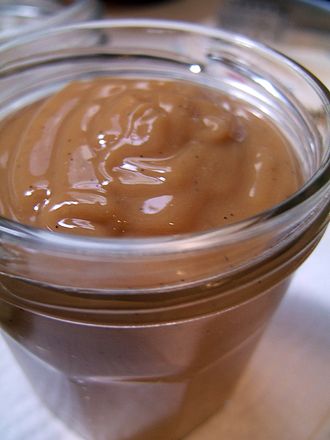
Photo: Wikipedia
Dulce de leche is a luscious, caramel-like confection made by slowly heating sweetened milk until it reduces into a thick, glossy, amber-hued spread. Its texture is velvety-smooth and slightly sticky, with a deep, buttery sweetness that's richer and more complex than plain caramel. Nutritionally, it's a concentrated source of energy, with nearly 50 grams of sugar per 100g, providing quick fuel but little else beyond calories.
Calorie split: 9% protein · 70% carbs · 21% fat
↓ Full nutrition💚 Why it's loved
People adore dulce de leche for its intoxicating, nostalgic sweetness and its incredible versatility—it transforms everything from toast and ice cream to pastries and coffee. It's deeply embedded in Latin American culture, evoking comfort, celebration, and childhood memories.
⚠️ Watch-outs & how to enjoy it better
Its extremely high sugar content (nearly 50g per 100g) makes it a poor choice for those managing blood sugar or calorie intake. To enjoy it mindfully, use it as a occasional topping rather than a main ingredient, pair it with high-fiber foods like whole-grain toast or nuts to slow sugar absorption, and strictly control portion sizes.
Key benefits
- Provides a quick, dense source of energy from carbohydrates.
- Contains small amounts of protein and calcium from its milk base.
- Offers a rich, satisfying flavor that can enhance smaller portions of other foods.
- A staple ingredient in traditional baking and confectionery.
- No artificial colors or flavors in authentic versions.
🍽️ Popular dishes



🌍 Where it's eaten
💡 Did you know?
While often associated with Argentina, the first known published recipe for dulce de leche appeared in an 1878 French cookbook under the name 'confiture de lait' (milk jam).
Full nutrition (USDA data · scales with serving)
| Water | 28.7 g |
| Energy | 315 kcal |
| Energy | 1318 kj |
| Protein | 6.8 g |
| Total lipid (fat) | 7.3 g |
| Ash | 1.7 g |
| Carbohydrate, by difference | 55.4 g |
| Fiber, total dietary | 0.00 g |
| Total Sugars | 49.7 g |
| Sucrose | 41.8 g |
| Glucose | 1.7 g |
| Fructose | 0.32 g |
| Lactose | 4.9 g |
| Maltose | 0.00 g |
| Galactose | 1.0 g |
| Calcium, Ca | 251 mg |
| Iron, Fe | 0.17 mg |
| Magnesium, Mg | 22.0 mg |
| Phosphorus, P | 193 mg |
| Potassium, K | 350 mg |
| Sodium, Na | 129 mg |
| Zinc, Zn | 0.79 mg |
| Copper, Cu | 0.00 mg |
| Manganese, Mn | 0.00 mg |
| Selenium, Se | 2.7 ug |
| Vitamin C, total ascorbic acid | 2.6 mg |
| Thiamin | 0.02 mg |
| Riboflavin | 0.41 mg |
| Niacin | 0.21 mg |
| Pantothenic acid | 0.83 mg |
| Vitamin B-6 | 0.02 mg |
| Folate, total | 11.0 ug |
| Folic acid | 0.00 ug |
| Folate, food | 11.0 ug |
| Folate, DFE | 11.0 ug |
| Choline, total | 89.1 mg |
| Vitamin B-12 | 0.31 ug |
| Vitamin B-12, added | 0.00 ug |
| Vitamin A, RAE | 74.0 ug |
| Retinol | 73.0 ug |
| Carotene, beta | 14.0 ug |
| Carotene, alpha | 0.00 ug |
| Cryptoxanthin, beta | 0.00 ug |
| Vitamin A, IU | 267 iu |
| Lycopene | 0.00 ug |
| Lutein + zeaxanthin | 0.00 ug |
| Vitamin E (alpha-tocopherol) | 0.20 mg |
| Vitamin E, added | 0.00 mg |
| Tocopherol, beta | 0.00 mg |
| Tocopherol, gamma | 0.00 mg |
| Tocopherol, delta | 0.00 mg |
| Tocotrienol, alpha | 0.00 mg |
| Tocotrienol, beta | 0.00 mg |
| Tocotrienol, gamma | 0.00 mg |
| Tocotrienol, delta | 0.00 mg |
| Vitamin D (D2 + D3), International Units | 6.0 iu |
| Vitamin D (D2 + D3) | 0.20 ug |
| Vitamin D3 (cholecalciferol) | 0.20 ug |
| Vitamin K (phylloquinone) | 1.3 ug |
| Vitamin K (Dihydrophylloquinone) | 0.00 ug |
| Vitamin K (Menaquinone-4) | 4.2 ug |
| Alcohol, ethyl | 0.00 g |
| Caffeine | 0.00 mg |
| Theobromine | 0.00 mg |
Fat & fatty acid profile (per 100g)
| Fatty acids, total saturated | 4.5 g |
| SFA 4:0 | 0.18 g |
| SFA 6:0 | 0.14 g |
| SFA 8:0 | 0.08 g |
| SFA 10:0 | 0.21 g |
| SFA 12:0 | 0.21 g |
| SFA 14:0 | 0.75 g |
| SFA 15:0 | 0.08 g |
| SFA 16:0 | 2.0 g |
| SFA 17:0 | 0.05 g |
| SFA 18:0 | 0.81 g |
| SFA 20:0 | 0.01 g |
| SFA 22:0 | 0.01 g |
| SFA 24:0 | 0.00 g |
| Fatty acids, total monounsaturated | 2.1 g |
| MUFA 14:1 | 0.07 g |
| MUFA 15:1 | 0.00 g |
| MUFA 16:1 | 0.16 g |
| MUFA 16:1 c | 0.13 g |
| MUFA 17:1 | 0.00 g |
| MUFA 18:1 | 1.9 g |
| MUFA 18:1 c | 1.6 g |
| MUFA 20:1 | 0.02 g |
| MUFA 22:1 | 0.00 g |
| MUFA 22:1 c | 0.00 g |
| MUFA 24:1 c | 0.00 g |
| Fatty acids, total polyunsaturated | 0.38 g |
| PUFA 18:2 | 0.29 g |
| PUFA 18:2 n-6 c,c | 0.13 g |
| PUFA 18:2 CLAs | 0.08 g |
| PUFA 18:3 | 0.05 g |
| PUFA 18:3 n-3 c,c,c (ALA) | 0.05 g |
| PUFA 18:3 n-6 c,c,c | 0.00 g |
| PUFA 18:4 | 0.00 g |
| PUFA 20:2 n-6 c,c | 0.00 g |
| PUFA 20:3 | 0.01 g |
| PUFA 20:3 n-3 | 0.00 g |
| PUFA 20:3 n-6 | 0.01 g |
| PUFA 20:4 | 0.01 g |
| PUFA 20:5 n-3 (EPA) | 0.00 g |
| PUFA 22:4 | 0.00 g |
| PUFA 22:5 n-3 (DPA) | 0.01 g |
| PUFA 22:6 n-3 (DHA) | 0.00 g |
| Fatty acids, total trans | 0.36 g |
| Fatty acids, total trans-monoenoic | 0.29 g |
| TFA 16:1 t | 0.04 g |
| TFA 18:1 t | 0.26 g |
| TFA 22:1 t | 0.00 g |
| TFA 18:2 t not further defined | 0.07 g |
| Fatty acids, total trans-polyenoic | 0.07 g |
| Cholesterol | 29.0 mg |
FAQ
What's the difference between dulce de leche and caramel?
Caramel is made by caramelizing sugar alone, while dulce de leche is made by slowly cooking sweetened milk, giving it a distinct milky, creamy flavor and a smoother, less brittle texture.
Can I make it at home?
Yes, the simplest method is to simmer an unopened can of sweetened condensed milk in a water bath for 2-3 hours until it turns a deep caramel color. Always ensure the can is fully submerged in water during cooking.
How should I store it?
Store-bought, unopened jars are shelf-stable. Once opened, keep it in an airtight container in the refrigerator for up to 2-3 weeks. It will thicken when chilled.
Nutrient density (calculated · NRF9.3)
Nutrient Rich Foods index: beneficial nutrients (protein, fiber, vitamins, minerals) minus saturated fat, added sugar & sodium, per 100 kcal.
NRF9.3 index — Fulgoni, Keast & Drewnowski, 2009. Computed from USDA nutrients.
Weight-loss friendliness (composite index)
Energy density 3.15 kcal/g · 9% calories from protein · 0.0 g fiber · 49.7 g sugar per 100 g.
Composite of energy density (Rolls et al., 1999), protein & fiber satiety, minus sugar. A calculated heuristic — ranks satiety-per-calorie, not a clinical measure.
Dietary load (calculated from USDA values)
Potential renal acid load. Positive = acid-forming, negative = alkaline-forming.
Sodium-to-potassium ratio: 0.37 (lower is better — aim for ≤ 1)
Sodium:potassium per WHO potassium guidance. Computed from USDA nutrients.