

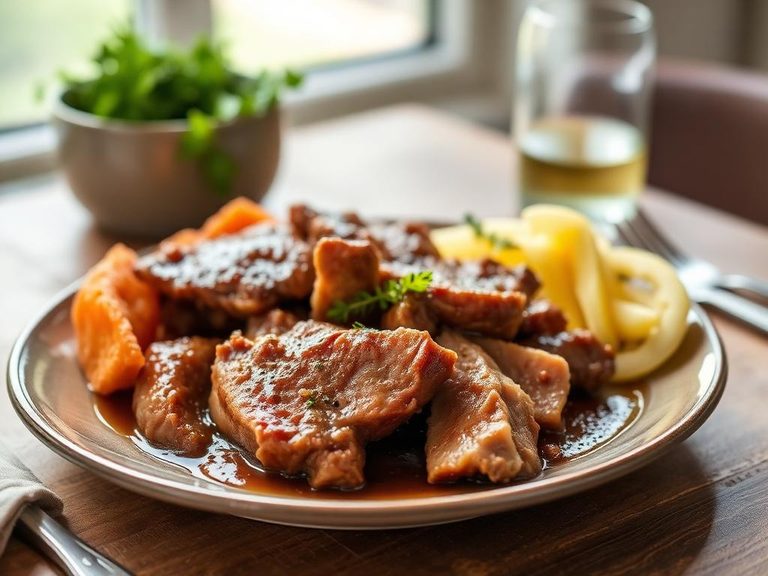
Pork, fresh, loin, country-style ribs, separable lean only, cooked, braised
Whole food · Pork Products

Photo: Wikipedia
Country-style pork loin ribs are not true ribs but a cut from the blade end of the loin, featuring a meaty, bone-in portion with rich marbling. When braised, the lean meat becomes incredibly tender and succulent, absorbing flavors deeply while retaining a satisfying, hearty texture. Nutritionally, it's a powerhouse of complete protein with virtually no carbohydrates, making it a staple for high-protein, low-carb diets.
Calorie split: 46% protein · 0% carbs · 54% fat
↓ Full nutrition💚 Why it's loved
People adore this cut for its perfect balance of meaty substance and tenderness after braising, delivering deep, savory pork flavor without the fuss of traditional ribs. Its versatility makes it a beloved centerpiece for comforting home-cooked meals across many cuisines.
⚠️ Watch-outs & how to enjoy it better
While lean, it can still be a significant source of saturated fat and cholesterol, so those monitoring heart health should practice portion control. The braising process often involves added sodium in broths or sauces; using low-sodium ingredients and rinsing the meat can help mitigate this.
Key benefits
- Excellent source of high-quality, complete protein for muscle maintenance.
- Naturally zero-carbohydrate, suitable for ketogenic and low-carb dietary patterns.
- Rich in B vitamins like thiamin (B1) and niacin (B3) for energy metabolism.
- Provides essential minerals such as selenium and phosphorus.
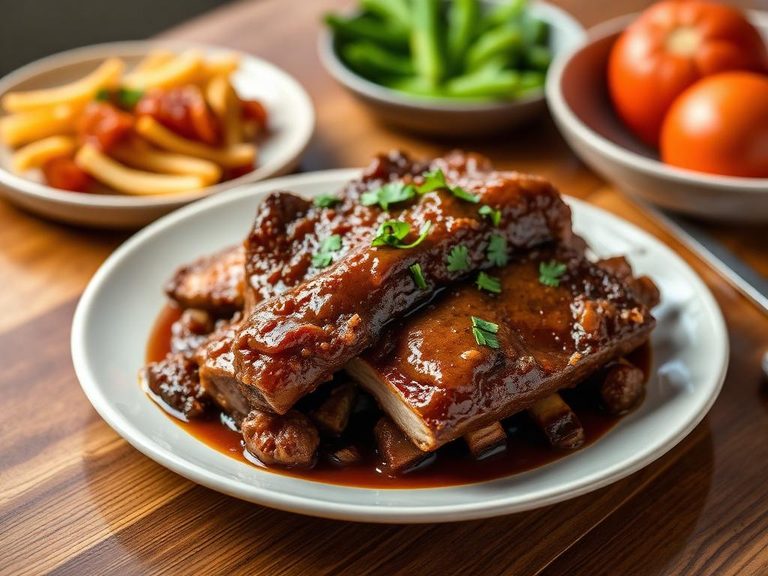
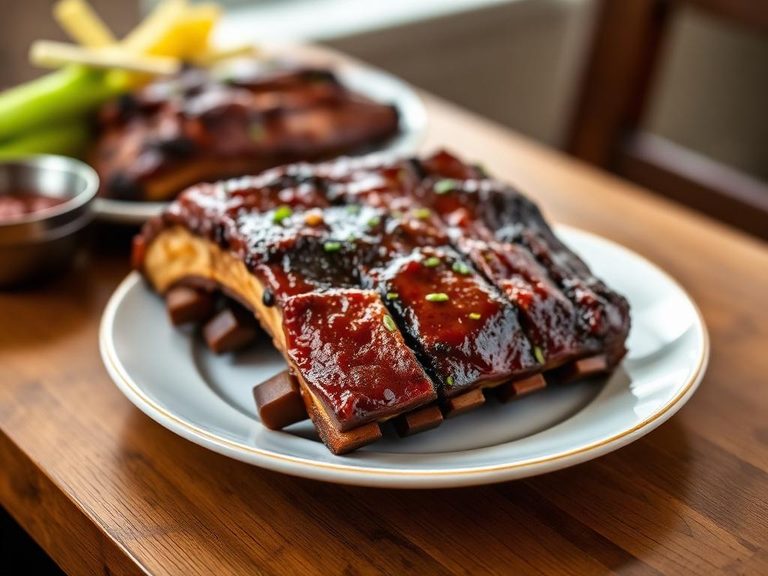
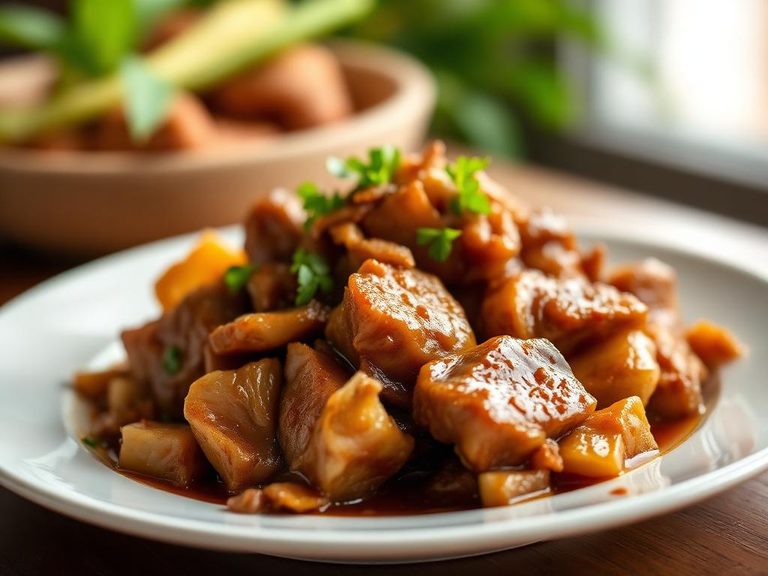
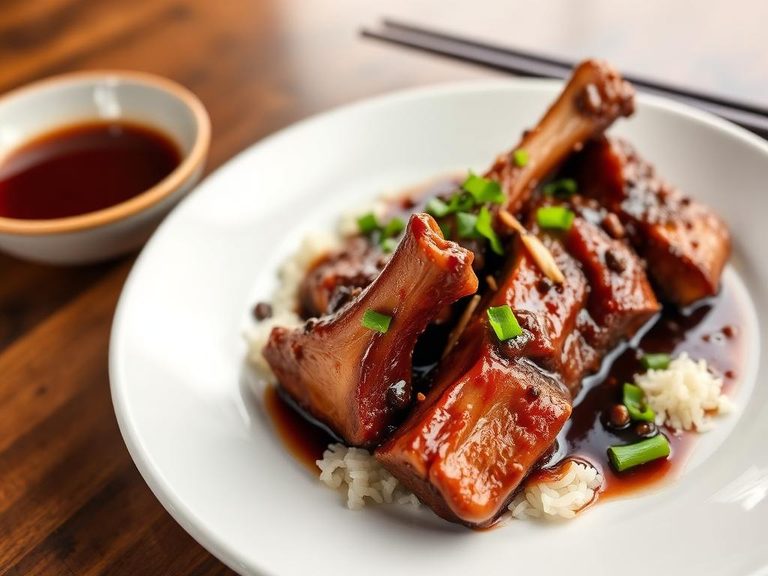
🍽️ Popular dishes
🌍 Where it's eaten
💡 Did you know?
Despite the name, country-style ribs contain no rib bones; they are cut from the blade end of the loin near the shoulder, making them the meatiest 'rib' cut available.
Full nutrition (USDA data · scales with serving)
| Water | 56.2 g |
| Energy | 247 kcal |
| Energy | 1034 kj |
| Protein | 27.7 g |
| Total lipid (fat) | 14.3 g |
| Ash | 0.92 g |
| Carbohydrate, by difference | 0.00 g |
| Fiber, total dietary | 0.00 g |
| Total Sugars | 0.00 g |
| Calcium, Ca | 33.0 mg |
| Iron, Fe | 1.4 mg |
| Magnesium, Mg | 23.0 mg |
| Phosphorus, P | 208 mg |
| Potassium, K | 297 mg |
| Sodium, Na | 60.0 mg |
| Zinc, Zn | 4.5 mg |
| Copper, Cu | 0.10 mg |
| Manganese, Mn | 0.01 mg |
| Selenium, Se | 48.6 ug |
| Vitamin C, total ascorbic acid | 0.00 mg |
| Thiamin | 0.48 mg |
| Riboflavin | 0.30 mg |
| Niacin | 5.7 mg |
| Pantothenic acid | 1.4 mg |
| Vitamin B-6 | 0.49 mg |
| Folate, total | 0.00 ug |
| Folic acid | 0.00 ug |
| Folate, food | 0.00 ug |
| Folate, DFE | 0.00 ug |
| Choline, total | 114 mg |
| Betaine | 3.7 mg |
| Vitamin B-12 | 0.94 ug |
| Vitamin B-12, added | 0.00 ug |
| Vitamin A, RAE | 0.00 ug |
| Retinol | 0.00 ug |
| Carotene, beta | 0.00 ug |
| Carotene, alpha | 0.00 ug |
| Cryptoxanthin, beta | 0.00 ug |
| Vitamin A, IU | 0.00 iu |
| Lycopene | 0.00 ug |
| Lutein + zeaxanthin | 0.00 ug |
| Vitamin E (alpha-tocopherol) | 0.11 mg |
| Vitamin E, added | 0.00 mg |
| Vitamin D (D2 + D3), International Units | 49.0 iu |
| Vitamin D (D2 + D3) | 1.2 ug |
| Vitamin D3 (cholecalciferol) | 1.2 ug |
| Vitamin K (phylloquinone) | 0.00 ug |
| Vitamin K (Dihydrophylloquinone) | 0.00 ug |
| Alcohol, ethyl | 0.00 g |
| Caffeine | 0.00 mg |
| Theobromine | 0.00 mg |
Fat & fatty acid profile (per 100g)
| Fatty acids, total saturated | 5.1 g |
| SFA 4:0 | 0.00 g |
| SFA 6:0 | 0.00 g |
| SFA 8:0 | 0.00 g |
| SFA 10:0 | 0.01 g |
| SFA 12:0 | 0.01 g |
| SFA 14:0 | 0.18 g |
| SFA 15:0 | 0.00 g |
| SFA 16:0 | 3.1 g |
| SFA 17:0 | 0.04 g |
| SFA 18:0 | 1.7 g |
| SFA 20:0 | 0.02 g |
| SFA 22:0 | 0.00 g |
| Fatty acids, total monounsaturated | 6.3 g |
| MUFA 14:1 | 0.00 g |
| MUFA 15:1 | 0.00 g |
| MUFA 16:1 | 0.36 g |
| MUFA 17:1 | 0.00 g |
| MUFA 18:1 | 5.8 g |
| MUFA 18:1 c | 5.7 g |
| MUFA 20:1 | 0.09 g |
| MUFA 22:1 | 0.00 g |
| Fatty acids, total polyunsaturated | 1.6 g |
| PUFA 18:2 | 1.4 g |
| PUFA 18:2 n-6 c,c | 1.4 g |
| PUFA 18:3 | 0.06 g |
| PUFA 18:3 n-3 c,c,c (ALA) | 0.06 g |
| PUFA 18:3 n-6 c,c,c | 0.00 g |
| PUFA 18:4 | 0.00 g |
| PUFA 20:2 n-6 c,c | 0.05 g |
| PUFA 20:3 | 0.01 g |
| PUFA 20:4 | 0.09 g |
| PUFA 20:5 n-3 (EPA) | 0.00 g |
| PUFA 22:5 n-3 (DPA) | 0.00 g |
| PUFA 22:6 n-3 (DHA) | 0.00 g |
| Fatty acids, total trans | 0.11 g |
| Fatty acids, total trans-monoenoic | 0.07 g |
| TFA 18:1 t | 0.07 g |
| TFA 18:2 t,t | 0.04 g |
| Fatty acids, total trans-polyenoic | 0.04 g |
| Cholesterol | 105 mg |
Amino acid profile (per 100g)
| Tryptophan | 0.29 g |
| Threonine | 1.2 g |
| Isoleucine | 1.4 g |
| Leucine | 2.4 g |
| Lysine | 2.6 g |
| Methionine | 0.76 g |
| Cystine | 0.32 g |
| Phenylalanine | 1.2 g |
| Tyrosine | 1.1 g |
| Valine | 1.4 g |
| Arginine | 1.8 g |
| Histidine | 1.2 g |
| Alanine | 1.6 g |
| Aspartic acid | 2.7 g |
| Glutamic acid | 4.4 g |
| Glycine | 1.3 g |
| Proline | 1.1 g |
| Serine | 1.2 g |
| Hydroxyproline | 0.07 g |
FAQ
Are country-style ribs the same as spare ribs or baby back ribs?
No. Country-style ribs are cut from the blade end of the pork loin near the shoulder and contain no actual rib bones. Spare ribs and baby back ribs come from the rib cage and contain bones.
What is the best cooking method for this cut?
Braising (slow cooking in liquid) is ideal as it breaks down connective tissue, resulting in fork-tender meat. Grilling or roasting is possible but requires careful attention to avoid drying out the lean meat.
Is this a good cut for meal prep?
Yes, its high protein content and ability to reheat well make it excellent for meal prep. Store cooked portions in airtight containers for up to 4 days in the refrigerator.
Nutrient density (calculated · NRF9.3)
Nutrient Rich Foods index: beneficial nutrients (protein, fiber, vitamins, minerals) minus saturated fat, added sugar & sodium, per 100 kcal.
NRF9.3 index — Fulgoni, Keast & Drewnowski, 2009. Computed from USDA nutrients.
Weight-loss friendliness (composite index)
Energy density 2.47 kcal/g · 45% calories from protein · 0.0 g fiber · 0.0 g sugar per 100 g.
Composite of energy density (Rolls et al., 1999), protein & fiber satiety, minus sugar. A calculated heuristic — ranks satiety-per-calorie, not a clinical measure.
Dietary load (calculated from USDA values)
Potential renal acid load. Positive = acid-forming, negative = alkaline-forming.
Sodium-to-potassium ratio: 0.20 (lower is better — aim for ≤ 1)
Sodium:potassium per WHO potassium guidance. Computed from USDA nutrients.